


TL;DR:
- Sweden has a low smoking rate and low tobacco-related mortality due to snus.
- Snus is a smoke-free, diverse alternative to cigarettes with various nicotine dosages.
- Swiss perception often views nicotine products as being just as dangerous as smoking, which limits the potential for prevention.
Sweden has a smoking rate below 10% and, at the same time, one of the lowest tobacco-related mortality rates in Europe, which health experts attribute to the widespread consumption of snus. In Switzerland, interest in this smoke-free alternative is growing rapidly, and import volumes are increasing year after year. Many Swiss consumers, however, face the same questions: Is snus really cheaper than cigarettes? What flavors are available? And what are the risks involved? This article provides you with clear answers and helps you make an informed decision.
Table of Contents
- The most important differences between snus and cigarettes
- Health risks: How do snus and cigarettes differ?
- Price-performance and flavor variety: Which alternative is worth it?
- Legal framework and Swiss trends
- Why price alone is not the deciding factor: Personal experiences with tobacco alternatives
- Your path to high-quality tobacco alternatives
- Frequently Asked Questions
Key Findings
| Point | Details |
|---|---|
| Snus reduces smoking rate | In Sweden, the smoking rate is falling significantly due to snus use, with positive effects on health. |
| Risk depends on nicotine content | High-dose snus pouches can significantly increase the risk of addiction and health hazards. |
| Price-performance often advantageous | For many Swiss, snus offers better value for money and more flavor options than cigarettes. |
| Note laws and trends | Swiss imports, youth protection, and product selection are subject to clear rules and current market developments. |
The most important differences between snus and cigarettes
After learning about the impact of the snus consumption trend in Sweden, we will analyze the concrete differences between snus and cigarettes. The two products differ significantly not only in their application but also in the experience, price, and nicotine effect.
Application and effect in direct comparison
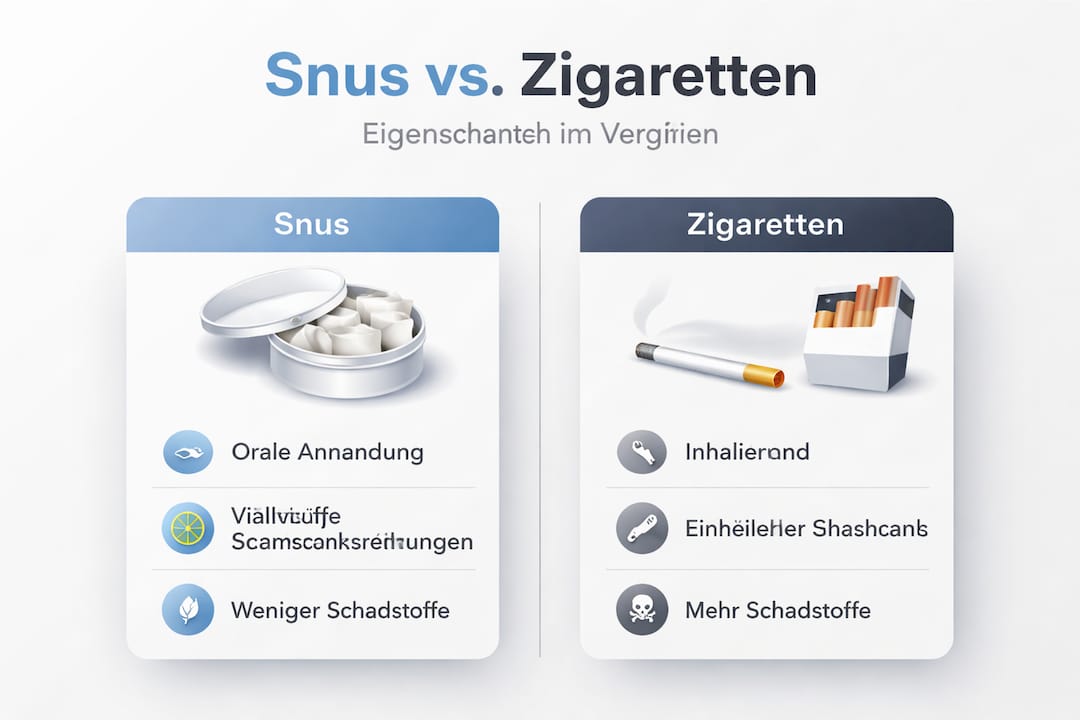
Cigarettes are smoked, and the nicotine reaches the blood through the lungs. Snus, on the other hand, is a moist tobacco product in pouch form that is placed under the upper lip. The nicotine is absorbed through the oral mucosa. This sounds simple but has important practical consequences: no smoke, no fire, no smell for those around you.
For the snus and cigarette quantity comparison, the nicotine content plays a central role. Snus pouches vary greatly in their dosage, from mild 4 mg to high-dose variants with over 20 mg of nicotine per pouch. Cigarettes actually deliver about 1 to 2 mg of nicotine into the body on average, even though the tobacco itself contains more.
Comparison table: Snus vs. cigarettes at a glance
| Feature | Snus | Cigarettes |
|---|---|---|
| Application | Oral, under the lip | Inhaling, smoked |
| Nicotine absorption | Slow, via mucosa | Rapid, via lungs |
| Smell for surroundings | Minimal to none | Strong, persistent |
| Flavor options | Very diverse (mint, fruit, tobacco) | Limited (tobacco, menthol) |
| Combustion | None | Yes |
| Average nicotine content | 4 to 45 mg per pouch | 10 to 14 mg per cigarette (tobacco content) |
| Shelf life | Weeks to months | Limited |
Taste and variety as a real advantage
Anyone switching from cigarettes to snus is often surprised by the variety. While cigarettes essentially taste like burnt tobacco or menthol, modern snus and nicotine pouches offer an astonishing range. Fresh mint, wild berries, citrus, classic tobacco, licorice, or even tropical fruits are available to choose from.
This variety is no coincidence. Manufacturers specifically develop new flavors to appeal to different taste preferences and to make switching from cigarettes more attractive. Brands like Velo offer over twenty different varieties alone, from strong to ultra-light.
As the Swedes show, a wide product variety can help more people switch from cigarettes to smoke-free alternatives, with positive effects on public health. The low smoking rate of under 10% in Sweden is considered a strong indication that this connection is real.
Important differences at a glance:
- Snus requires no fire and produces no smoke
- Nicotine absorption in snus is slower and more consistent
- Flavor variety in snus is significantly greater than in cigarettes
- Snus leaves behind no ashtray and no secondhand smoke risk
- Pouch snus is discreet and can be consumed almost anywhere
The comparison between snus and cigarettes in terms of risk also shows that the absence of combustion processes in snus is a key factor in different risk profiles. But more on that in the next section.
Health risks: How do snus and cigarettes differ?
Now that you have learned the differences, we will delve into the effects on health and the risk of addiction. The topic is complex and is often simplified or misrepresented in public debate.
Nicotine doses and the risk of addiction
A crucial point: Not every snus pouch is the same. Nicotine doses in pouches can reach up to 45 mg per unit, while a cigarette typically contains around 10 mg of nicotine in the tobacco. This means: Those who opt for high-dose snus variants can ingest more nicotine than by smoking, which significantly increases the potential for addiction.
The risk of addiction to nicotine is generally not dependent on the method of consumption, but on the amount ingested. Those who use snus as an introductory product and switch to stronger varieties can quickly develop an intense dependency. The same applies here as with cigarettes: less is often better, and conscious handling of the dosage is crucial.
“Nicotine-free variants significantly minimize risks, but the majority of users choose products with nicotine. Youth protection is absolutely critical here." (Source: AOK Health Magazine)
Also read our overview of nicotine levels and risks to better assess your personal dosage.
Long-term risks and oral health
Cigarettes burn tobacco and release thousands of pollutants in the process, including carbon monoxide, tar, and numerous carcinogenic substances. While snus also contains tobacco and thus tobacco-specific nitrosamines, it lacks the combustion process. This reduces certain risks, but it does not make snus risk-free.
Especially oral health when smoking suffers from chronic tobacco use: tooth discoloration, gum problems, and an increased risk of oral cancer are known consequences. Snus can also cause local irritation and, in extreme cases, mucosal changes through constant contact with the oral mucosa.
Risk profile at a glance:
- Cigarettes: High cancer risk due to combustion, severely damaging to lungs and cardiovascular system
- Snus: Lower cancer risk than cigarettes, but possible oral mucosa damage
- Tobacco-free nicotine pouches: Lower risk than snus, but higher than nicotine replacement therapy products
- Nicotine-free pouches: Minimal health risk
Inform yourself about risks of snus in detail to base your personal assessment on facts.
Distorted risk perception in Switzerland
This is one of the biggest misunderstandings: According to current research, the majority of the Swiss population rates nicotine alternatives as being just as dangerous as smoking. This does not correspond to the scientific consensus. Tobacco-free pouches are considered significantly less harmful than snus, and snus, in turn, is considered significantly less harmful than cigarettes.
This distorted perception has practical consequences: Many people who actually want to quit cigarettes shy away from switching to less harmful alternatives because they believe the risk is the same. This is not true, however. Experts estimate the risk of tobacco-free pouches to be about 1 to 2% of the cigarette risk; for snus, these figures are in the range of 5 to 10% of the smoking risk.
Pro Tip: Anyone who wants to consume nicotine but wants to take fewer risks should look more closely at the option of nicotine-free snus products. This allows the ritual of snus consumption to be maintained without ingesting nicotine.
Price-performance and flavor variety: Which alternative is worth it?
With knowledge of the risks, we now turn our attention to the cost factor and the variety for pleasure and budget. Because for many Swiss consumers, price plays a central role in the decision between snus and cigarettes.
Price comparison in Switzerland
Cigarettes are expensive in Switzerland. A pack of 20 cigarettes costs between 8 and 10 francs on average. Anyone who smokes a pack a day spends about 240 to 300 francs per month, or 2,880 to 3,600 francs per year. That is a considerable amount.
Snus cans cost between 6 and 12 francs per can with 20 to 24 pouches in Switzerland, depending on the brand and variety. With a typical consumption of two to three pouches per day, one can lasts about a week. This results in monthly costs of about 30 to 50 francs, which is a fraction of cigarette costs.
| Product | Unit price | Daily consumption | Monthly costs |
|---|---|---|---|
| Cigarettes (pack of 20) | 8 to 10 CHF | 1 pack | 240 to 300 CHF |
| Snus Standard (24 pouches) | 7 to 10 CHF | 2 to 3 pouches | 30 to 50 CHF |
| Nicotine pouches (tobacco-free) | 6 to 9 CHF | 2 to 4 pouches | 25 to 50 CHF |
| Nicotine-free pouches | 5 to 8 CHF | 3 to 5 pouches | 20 to 45 CHF |
The 303 tons of snus imported into Switzerland in 2024 show: More and more consumers are voting with their wallets and switching to the cheaper alternative.
How to find the best price when buying
- Brand comparison: Different brands offer similar nicotine strengths at different prices. It is worth testing several options.
- Use bulk packs: Many online providers offer discounts when purchasing multiple cans at once.
- Test taste preferences: Buy single cans of different varieties first before ordering larger quantities.
- Watch for special offers: Providers like Snustrend regularly inform about new promotions and reduced prices.
- Adjust nicotine strength: Strength and price do not always correlate. Cheaper products can definitely be of high quality.
Discover the world of tobacco alternatives and find products that suit your taste and budget.
Flavor variety: A real added value
The flavor variety in snus and nicotine pouches is an argument that should not be underestimated. Those who have been content with the monotonous taste of cigarettes for five years will experience a real surprise with the first pouch of fresh mint or sweet berries.
Popular flavors in Switzerland currently include spearmint, wintergreen, citrus, blueberry, coffee, and classic tobacco. Brands like Velo and Siberia cover the entire range. Those who want to try nicotine pouches will find a clear selection sorted by strength and flavor at Snustrend.
Pro Tip: Start with medium nicotine strengths and fresh flavors like mint or citrus. These are perceived as pleasant by most switchers and make starting out much easier. Those who want to learn more about alternatives to snus will find detailed comparisons in the Snustrend blog.
Legal framework and Swiss trends
Finally, we look at the legal and market trends so that you can make informed purchasing decisions as a Swiss resident. The legal situation regarding snus is more complex in Switzerland than many think.
What is allowed in Switzerland?
Unlike in the European Union, where snus containing tobacco has been banned for years, a more liberal regulation applies in Switzerland. The import and sale of snus are generally legal but are subject to the Tobacco Products Act and corresponding youth protection regulations. A detailed overview of the current snus legal situation in Switzerland gives you a clear overview of the current regulations.
Key points of regulation:
- Sale to minors under 18 is strictly prohibited
- Product labeling with warnings is mandatory
- Online trade is subject to age verification requirements
- Reputable providers like Snustrend comply with all legal requirements
- Import for personal use is permitted
- Advertising restrictions apply, similar to other tobacco products
Market trends and growth in Switzerland
The snus market in Switzerland is growing strongly. The 303 tons of imported snus in 2024 prove that this is more than just a short-term trend. Nicotine-free and tobacco-free pouches, in particular, are gaining popularity, as they are easier to categorize from a regulatory perspective and are perceived by young adults as a modern alternative.
Retailers report strongly increasing order volumes, especially in urban areas such as Zurich, Bern, and Basel. Online platforms dominate the Swiss market, as they can offer a wider variety of products at lower prices. While physical kiosks and tobacco shops do stock common varieties, they cannot keep up with the product range of specialized online retailers.
Another trend is the increasing demand for Nordic brands with a long tradition. Swedish manufacturers are considered quality leaders, and their products are particularly sought after in Switzerland. At the same time, new suppliers from Austria and Germany are pushing into the market with innovative formats.
Why price alone is not the deciding factor: Personal experiences with tobacco alternatives
With legal and market trends in view, we turn to a surprisingly important question for Swiss consumers. We see every day how people switching from cigarettes to snus focus primarily on the price, overlooking something crucial in the process.
Price is important, no question. But anyone who only looks for the cheapest pouch risks ending up with a nicotine dose that is far higher than what they are used to. This sounds harmless, but it can lead to more intense dependency than before. We have often observed this: someone switches from ten cigarettes a day to high-dose snus pouches and ends up consuming more nicotine than ever before.
Quality and personal responsibility are therefore more important than price. In concrete terms, this means: Read the product descriptions carefully. Pay attention to the nicotine content per pouch. Start with low dosages and increase only if necessary. Information on nicotine content and user experience helps in making the right choice.
Another point that is often ignored: risk perception. Many Swiss people perceive snus and cigarettes as having similar risk levels, which, according to current studies, does not reflect reality. This misjudgment leads potential switchers to hesitate and stick with cigarettes, even though less harmful alternatives are available. This is a missed opportunity for one's own health.
Our practical recommendation: consciously separate the three decision dimensions. First, nicotine content as a safety question. Second, taste as an experience question. Third, price as a budget question. Those who systematically weigh all three points instead of just clicking on the cheapest offer make better decisions in the long term. A cheap product with too high a nicotine dose is not a bargain; it is a trap. A more expensive product with the right dosage and a taste you really like is an investment in pleasant and controlled consumption.
Finally, something that hardly anyone says openly: switching to tobacco alternatives is only sensible if you approach it with a clear head. Anyone who orders on a whim without familiarizing themselves with the product and dosage will be disappointed. But those who choose specifically, buy informed, and consciously manage their consumption will experience the real added value of these products.
Your path to high-quality tobacco alternatives
From our personal perspective, here is where you will find the best options for purchasing tobacco alternatives in Switzerland. At Snustrend, we offer a carefully curated selection of snus, nicotine pouches, and snuff products for every taste and budget.

Whether you are just switching from cigarettes or are already an experienced snus user: at Snustrend, you will find exactly what you are looking for. For beginners, we recommend the classic Südfrucht Schmalzler as an uncomplicated introduction to the world of snuff, or the practical Schmalzler 25g for on the go. Our entire assortment of snus and tobacco alternatives is regularly expanded with new varieties and brands. Fast shipping throughout Switzerland is standard for us, and special offers make getting started even more attractive.
Frequently Asked Questions
How many cigarettes does a snus correspond to?
High-dose pouches with up to 45 mg of nicotine can replace significantly more than one cigarette, while weak variants correspond to a single cigarette. The exact amount depends heavily on the chosen product.
Are snus products healthier than cigarettes?
Tobacco-free pouches are considered significantly less harmful than cigarettes, and snus also clearly sits lower on the risk profile. However, no tobacco product is risk-free.
What is the legal situation for snus in Switzerland?
Import and sale are legal, but subject to the Tobacco Products Act with strict youth protection rules. Reputable retailers like Snustrend consistently comply with all legal requirements, as the increasing snus import of 303 tons in 2024 shows.
Are there nicotine-free snus variants?
Yes, nicotine-free variants are available in Switzerland and are suitable for anyone who wants to enjoy the ritual of snus consumption without taking in nicotine. The risk of addiction is almost completely eliminated.
Why is the risk of snus considered similarly high to that of cigarettes in Switzerland?
According to experts, this assessment is a distorted risk perception that contradicts scientific findings. Nicotine alternatives such as snus and pouches are clearly distinguishable from cigarettes in their risk profile.
Recommendation
- Snus explained: Overview of effects, risks, and alternatives – Snustrend - Snus, Vapes & Snuff
- How many cigarettes does a snus correspond to? The big comparison – Snustrend - Snus, Vapes & Snuff
- Can you get cancer from snus? A comparison between snus and cigarettes – Snustrend - Snus, Vapes & Snuff
- Is snus harmful? Overview of the most important side effects and risks – Snustrend - Snus, Vapes & Snuff






Share:
Risks of nicotine products: facts and safe alternatives
Snuff Guide: Usage, Selection and Safety