

TL;DR:
- Snuff is experiencing a quiet renaissance in Switzerland, driven by increasing curiosity and a lack of public information. Its safe use requires knowledge of legal frameworks, quality, and techniques, particularly concerning gentle application and proper dosage. Moderate consumption, high-quality products, and conscious rituals help minimize risks while allowing one to enjoy the sensory experience.
Snuff is enjoying a quiet renaissance in Switzerland. More and more adults are curious about this traditional form of tobacco consumption but feel uncertain about how to use, dose, and select it. It is no wonder: unlike cigarettes or snus, there are hardly any modern, easy-to-understand guides for snuff. This guide changes that. We explain what really matters when getting started, which techniques work, which mistakes you should avoid, and what both beginners and experienced users need to look out for regarding quality and safety.
Table of Contents
- Foundations and Prerequisites for Snuff in Switzerland
- Tools and Techniques: How to Snuff Successfully
- Step-by-Step Guide: Snuffing Like a Pro
- Typical Mistakes and Health Risks of Snuff
- Expert Opinion: What You Really Need to Know About Snuff
- Directly to High-Quality Snuff Products
- Frequently Asked Questions About Snuff
Key Findings
| Point | Details |
|---|---|
| Legally regulated in Switzerland | Snuff is legal for those 18 and older and is subject to specific laws. |
| Technique determines enjoyment | Proper application and dosage prevent unpleasant side effects. |
| Tool selection simplifies the start | Whether using the back of the hand, fingertips, or a tube, everyone can find a suitable method. |
| Fewer risks than smoking | While snuff is less harmful than cigarettes, it still carries nicotine and mucosal risks. |
| Product variety for every need | Quality products allow for individual enjoyment for both beginners and experienced users. |
Foundations and Prerequisites for Snuff in Switzerland
Before you start snuffing, it is worth looking at the legal and quality foundations. Knowing what is permitted and what characterizes good products helps you make better decisions right from the start.
Legal Framework
In Switzerland, snuff is legal and regulated for adults 18 and older by the Tobacco Ordinance and the Tobacco Products Act (TabPG). Purchase and possession are permitted without restriction for adults, but the sale to minors is strictly prohibited. Those who purchase online should be aware that reputable providers carry out mandatory age verification. This is not bureaucratic red tape, but protection for all parties involved.
The legal overview for Switzerland shows that snuff is treated differently than oral snus, which is more restricted in terms of sales. Snuff is one of the oldest tobacco products in existence and has historically always enjoyed a different legal status.
Safety Aspects and Nicotine Risks
An important point for beginners: snuff does not burn. While this sounds reassuring, it does not mean consumption is risk-free. No smoke is created, meaning no tar or carbon monoxide. However, snuff does contain nicotine, which is quickly absorbed through the nasal mucosa and can lead to dependency. Mucosal irritation is also a known risk with regular or excessive consumption.
Moderate consumption is therefore not just a platitude, but a genuine recommendation. Anyone who uses snuff occasionally and consciously faces a different risk profile than someone who uses it in large quantities daily.
Typical Quality Characteristics
Not all snuff is created equal. You can recognize quality products by the following features:
- Fineness of the grind: High-quality snuff is finely and evenly ground, without coarse pieces or fibers.
- Aroma and scent: A balanced, clear aroma without musty or chemical notes indicates good processing.
- Moisture content: Snuff that is too dry irritates the mucous membranes more, while snuff that is too moist is sticky and difficult to dose.
- Packaging: Tight, well-sealed tins or vials protect the product from drying out and foreign odors.
- Origin and brand: Established Swiss and European brands are subject to strict quality controls.
| Feature | Quality Product | Inferior Product |
|---|---|---|
| Grind | Fine and even | Coarse or inconsistent |
| Aroma | Clear and balanced | Musty or artificial |
| Moisture | Optimally balanced | Too dry or too wet |
| Packaging | Tight, well sealed | Poorly closed |
Pro Tip: Always buy snuff in small quantities until you have found your favorite variety. This helps you avoid larger mistakes and allows you to test various aromas and degrees of fineness in a targeted manner.
Compared to other tobacco products, snuff offers a long tradition and a very specific sensory experience. Cigarettes burn tobacco and create smoke, snus is consumed orally, and vapes vaporize liquids. Snuff is unique because it acts through the nose, thus creating an entirely distinct experience.
Tools and Techniques: How to Snuff Successfully
With the necessary background knowledge, we now move on to the actual application. Which techniques and tools are available, and why does the choice make a difference?
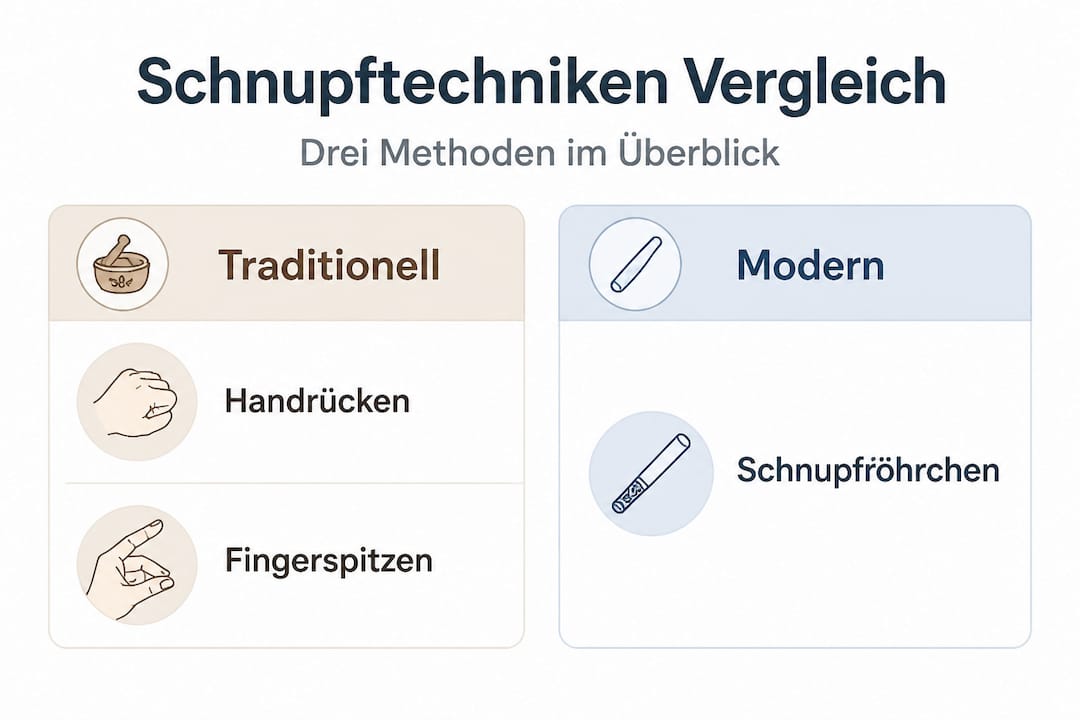
The Three Classic Snuffing Techniques
There are three common methods for using snuff. Each has its pros and cons, and the choice often depends on personal preference and tradition.
1. Back of the hand (Swiss tradition)
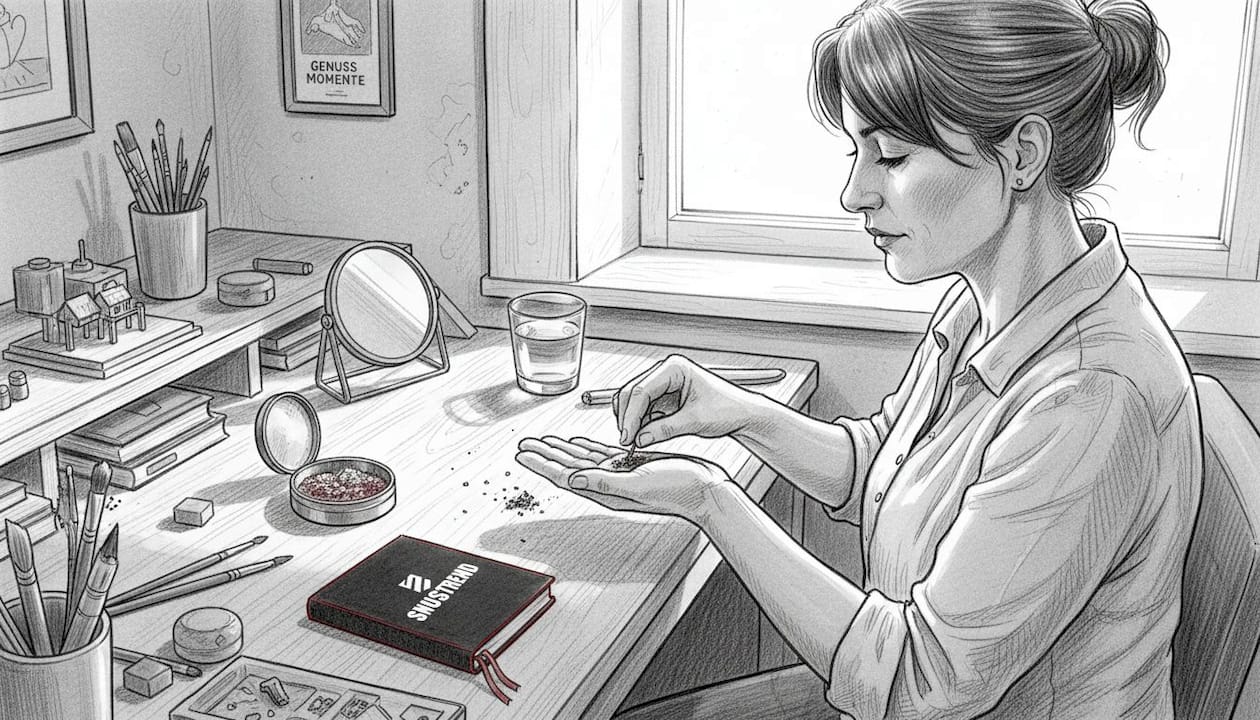
The oldest and most widespread method in Switzerland. A small pinch is placed on the back of the hand between the thumb and index finger and then inhaled through the nose in a calm draw. Traditionally, the left hand is preferred, though this is less strictly followed today. This method allows for good control of the amount and is considered particularly hygienic, as the tobacco does not come into direct contact with the fingertips, which may carry moisture.
2. Fingertips (English method)
Here, you take a small amount of tobacco between your thumb and index finger and inhale it directly. This method is historically common in England and requires some practice, as the dosage is harder to control. Inhaling too forcefully with this technique is particularly likely to lead to sneezing or an unpleasant burning sensation.
3. Snuff tube (modern alternative)
A small tube that enables precise dosing and is particularly popular with very fine tobacco varieties. Advantage: The amount is precisely controllable, and the tobacco reaches the nasal cavity in a targeted manner. Disadvantage: Tubes must be cleaned regularly and are less discreet than the traditional methods.
| Technique | Dosage Control | Cleaning Effort | Tradition |
|---|---|---|---|
| Back of hand | Good | Low | Switzerland / DACH |
| Fingertips | Medium | Low | England |
| Snuff tube | Very good | Medium | Modern/universal |
Tools and Accessories
The right equipment makes the difference. For beginners, we recommend the following basic set:
- A tin or small vial made of glass or sturdy plastic for safe storage of the tobacco.
- A snuff tube for precise dosing, especially useful for stronger varieties.
- A small cloth for cleaning after snuffing.
Products like Pöschl Ozona Snuff come in practical, well-sealed packaging that preserves the quality of the tobacco over a long period.
Pro Tip: Never store snuff near strong foreign odors. Tobacco absorbs scents from its environment, which significantly changes the original taste experience. A tight tin in a cool, dark place is ideal.
Many beginners wonder if snuff represents a sensible alternative to other forms of tobacco. The answer depends on your personal goal. Those who want to reduce smoking while appreciating the sensory experience will find snuff an interesting option. However, those who want to avoid nicotine entirely are better served by nicotine-free alternatives.
Step-by-Step Guide: Snuffing Like a Pro
Now that you know the methods and tools, you will learn exactly how to successfully take a pinch of snuff. Good technique makes the difference between a pleasant experience and unnecessary sneezing.
Instructions for the Back-of-the-Hand Method
- Prepare the tobacco: Open the tin and take a small pinch out with two fingers. For beginners: less is more. An amount the size of a grain of rice is perfectly sufficient to start.
- Place the tobacco: Place the tobacco on the back of your hand between the thumb and index finger of your left hand. Press it down slightly so it doesn't slip.
- Prepare: Exhale calmly once. Hold your hand close to your nose without touching it.
- Inhale: Draw the tobacco in with a steady, calm breath. Not abruptly, not too hard. The tobacco should glide gently over the mucous membrane, not be pressed painfully into it.
- Wait and feel: Pause briefly and let the effect set in. The nicotine sensation begins after about 30 to 60 seconds.
- Clean: Wipe the back of your hand with a cloth. Done.
Pro Tip: Switch sides. Many experienced users alternate between the left and right nostrils. This protects the mucous membranes and prevents one-sided irritation.
Traditional Swiss Rituals
In Switzerland, snuffing often involves more than just technique. Traditionally, offering a pinch was accompanied by a saying, a short phrase, or a well-wish. These rituals are rarer today but are still alive in certain regions and among older users. They are part of the culture of snuff and make it more than just a habit.
The history of Swiss snuff is closely linked to folk culture. Those interested in traditional brands and their history can find interesting background information on the production and future of this cult brand at Bernard Schnupftabak.
Dosage and Typical Beginner Mistakes
The most common mistakes made when starting out are easy to name:
- Too large a pinch: Almost always leads to violent sneezing and burning. Start with a tiny amount.
- Inhaling too hard: The tobacco ends up deep in the nasopharyngeal space and causes coughing. The goal is gentle and steady.
- Wrong distance: Holding your hand too far from your nose results in tobacco being lost in the air.
- Tobacco that is too moist: Sticks to the back of the hand and is difficult to inhale. Quality products avoid this problem.
- Not waiting: Those who immediately become active again do not perceive the experience. Pausing briefly is part of it.
- Mucosal irritation in the nose and throat, especially with frequent consumption
- Nicotine dependency, which develops insidiously and is difficult to break
- Nasal inflammation with long-term high consumption
- Increased cancer risk due to nitrosamines, especially with decades of regular use
- Persistent nasal congestion or pain in the nasal cavity
- Frequent nosebleeds with no other apparent cause
- Strong cravings for snuff outside of intentional use (a potential sign of addiction)
- Headaches after taking snuff (can indicate an excessively high nicotine dose)
- Tips for tobacco alternatives: high-quality options – Snustrend - Snus, Vapes & Snuff
- Choosing nicotine alternatives: 70% of beginners use moderate values – Snustrend - Snus, Vapes & Snuff
- Snus explained: Overview of effects, risks, and alternatives – Snustrend - Snus, Vapes & Snuff
- Nicotine pouches: All facts, usage, and risks explained – Snustrend - Snus, Vapes & Snuff
A brief comparison to other types of tobacco shows that each form of consumption has its own learning curve. With snuff, this is particularly short: after two or three attempts using good technique, you will find the right feel.
Typical Mistakes and Health Risks of Snuff
To ensure the full experience, it is important to know the most common mistakes and health risks. This is not a cause for panic, but honest information is better than blind enthusiasm.
Health Risks at a Glance
Snuff is not harmless. That must be clearly stated. Compared to smoking, however, it offers a different risk profile: no tar or carbon monoxide is produced because there is no combustion process. This significantly protects the lungs. Nevertheless, snuff contains tobacco-specific nitrosamines, a class of carcinogenic compounds that are present in tobacco even without combustion. The risk of nasal and throat cancer is increased with regular consumption, even if it remains absolutely low compared to smokers.
Common health risks include:
Important Note: Less harmful than smoking does not mean "safe." Snuff remains a tobacco product with real health risks. Moderate consumption is the only sensible approach.
Comparison to Other Tobacco Forms
| Tobacco Form | Lung Risk | Nicotine Risk | Cancer Risk |
|---|---|---|---|
| Cigarette | Very high | High | Very high |
| Snuff | Low | Medium | Medium (nitrosamines) |
| Snus | Low | Medium | Low |
| Vape | Low | Medium | Unclear/ongoing research |
The picture is nuanced. Those who switch from smoking to snuff significantly reduce their risk of lung-specific diseases. Conversely, those who begin using snuff as non-smokers add new hazards to their risk profile. A comparison with other types of tobacco and vaping shows that no form of tobacco consumption is completely risk-free.
Heed warning signs
If you notice the following symptoms, you should reduce or pause consumption immediately:
Moderate consumption specifically means: not daily, not in large quantities, and always with breaks between uses. This is not a moral statement, but one of practical common sense.
Expert opinion: What you really should know about snuff
There is a truth about snuff that is missing from most guides: technique is not the most important thing. Your mindset is more decisive. Those who view snuff as a ritual and an occasional pleasure automatically choose better products, consume more moderately, and enjoy the experience more.
That may sound philosophical, but it is meant pragmatically. At Snustrend, we often observe beginners making the same mistake: they buy the strongest or cheapest variety and start too frequently. The result is feeling overwhelmed, sneezing, headaches, and the decision that snuff is "not for them." In reality, only their approach was wrong.
Our recommendation: Start with a mild, fragrant tobacco. Give yourself time for your first attempts. Snuff is not a stimulant you understand in a minute. It has centuries of cultivation behind it and deserves some patience.
Furthermore, many underestimate the importance of product selection. Not all snuff varieties are equally strong, fine, or well-tolerated. High-quality alternatives and well-crafted classics differ significantly from cheap products of unknown origin. A good product makes the technique easier and the experience more enjoyable.
A final thought for experienced users: routine is the enemy of pleasure. Those who take snuff daily and mechanically lose their awareness of the experience. Mindful dosing, occasional breaks, and choosing better quality over larger quantities are the true signs of experience. Snuff is not a daily necessity, but a stimulant with history. This perspective protects against addiction and maintains enjoyment in the long term.
Directly to high-quality snuff products
Those wishing to apply this knowledge can find a carefully curated selection of snuff products for every taste and experience level at Snustrend.

Beginners will find the Gletscherprise Snuff to be a mild, fresh entry point with pleasant coolness. Those who prefer traditional Bavarian strength should choose the Schmalzler Südfrucht 100g, a classic with a slightly fruity note. For precise dosing, we recommend a high-quality plastic snuff bottle, which portions the right amount safely and cleanly. All products are delivered quickly, described clearly, and come from verified manufacturers.
Frequently asked questions about snuff
Is snuff legal in Switzerland and at what age?
Snuff is legal in Switzerland for adults aged 18 and over and is regulated by the Tobacco Ordinance. The purchase and consumption of tobacco by minors is prohibited.
How does snuff work and what health factors should be monitored?
Snuff works through nicotine, which is absorbed via the nasal mucosa. It is less harmful than smoking, but poses risks of mucosal irritation and nicotine addiction that should not be underestimated.
Which snuff technique is preferred in Switzerland?
In Switzerland, taking snuff from the back of the left hand is traditionally the most popular method and is considered the most hygienic and controllable technique.
What mistakes should be avoided when using it?
Sniffing too forcefully is the most common mistake and leads to sneezing, burning, and irritation of the mucous membranes. Moderate inhalation and small doses are the best way to start.
Is snuff less dangerous than smoking?
The risks are lower than with smoking, as neither tar nor carbon monoxide is produced. However, the cancer risk from nitrosamines and the risk of nicotine addiction remain real.






Share:
Snus vs. cigarettes: taste, cost, and risks
How disposable vapes work: technology, tips, and benefits