

TL;DR:
- Disposable vapes have a simple design but contain complex mechanics that enable effective use. Understanding the technical processes helps to avoid mistakes, optimize flavor, and make choices suited to your daily routine. Due to fixed components and a short design lifespan, they are primarily suitable for beginners, travelers, or occasional users.
From the outside, disposable vapes seem simple, almost inconspicuous. A small housing, no buttons, just puff. But behind this simplicity lies a carefully tuned mechanism that many users underestimate. Anyone who understands how their device works can avoid common mistakes, improve the flavor, and make smarter decisions about which product fits their lifestyle. In this article, whether you are a beginner or an experienced vaper in Switzerland, you will learn everything essential about the technical structure, the differences compared to other systems, the factors influencing vapor and flavor, and the current legal situation in Switzerland.
Table of Contents
- Basic structure and function of disposable vapes
- What distinguishes disposable vapes from other vapes
- Expert nuances: What influences vapor and flavor
- Legal and environmental aspects in Switzerland
- Our conclusion: What users really need to know about disposable vapes
- Discover more now: Alternative products and advice at Snustrend
- Frequently asked questions about disposable vapes
Key takeaways
| Point | Details |
|---|---|
| Closed functional chain | Every disposable vape operates with draw activation, an integrated battery, and capillary liquid feed. |
| No maintenance required | Disposable devices are used until the liquid or battery is depleted and are neither refillable nor rechargeable. |
| Observe environmental and legal rules | Disposal and usage regulations vary by canton in Switzerland and should always be observed. |
| User behavior counts | Inhalation technique and handling have a major influence on the flavor and function of a disposable vape. |
Basic structure and function of disposable vapes
At first glance, a disposable vape is hardly more than a colorful stick. In fact, several components work perfectly together inside to produce consistent vapor with every puff. To use the device correctly, it is worth taking a closer look inside.
The chain from puff to vapor
The entire process begins as soon as you draw on the mouthpiece. A sensor in the device, usually an air pressure sensor, detects the negative pressure and immediately activates the battery. The battery delivers power to the coil, a spiral-shaped heating wire element. The coil heats up in fractions of a second, vaporizing the e-liquid that is transported to the heating surface via a wicking material (an absorbent carrier material made of cotton or similar fibers). The resulting vapor travels through the air channel to the mouthpiece, and you inhale it.
Disposable vapes work via a closed chain of draw activation, power supply to the heating component, and vaporization of pre-filled e-liquid. No moving parts, no manual switching on. The entire control process happens automatically and invisibly.
Core principle: Every puff activates a precisely tuned chain of sensors, energy, and heat. Anyone who understands this interplay also knows why certain mistakes lead to poor vapor or a burnt taste.
Overview of the most important components
| Component | Function | Special feature in disposable vapes |
|---|---|---|
| Draw activation sensor | Detects the negative pressure during inhalation | No button necessary |
| Battery | Power supply for the coil | Fixed integrated, not rechargeable |
| Coil | Heats the liquid until it vaporizes | Pre-installed, not replaceable |
| Wicking material | Transports liquid to the coil | Mostly cotton or glass fiber |
| E-liquid reservoir | Stores the pre-filled liquid | Pre-installed, not refillable |
| Air channel | Guides vapor to the mouthpiece | Often narrow for a stronger puff experience |
| Mouthpiece | Contact point for the user | Ergonomically adapted |
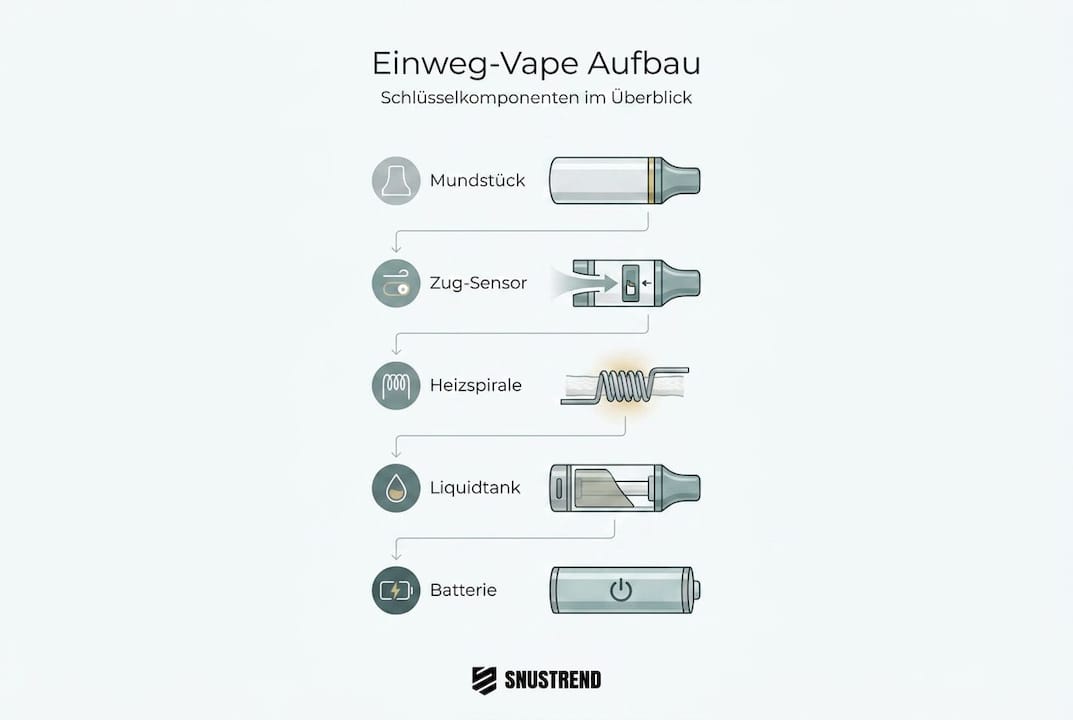
This table clearly shows that each component has a clearly defined task. If one of them fails or is used incorrectly, the entire experience suffers. For example, anyone reading the beginner's guide to vaping will understand why the system is set up this way.
Typical user mistakes and how to avoid them
- Blocking the airflow: Many hold the device in a way that covers the vent at the base. This significantly disrupts the airflow and leads to weaker vapor or no vapor at all.
- Pulling too hard or too quickly: An overly intense puff draws more air than the wicking material can resupply with liquid. The result is a dry, scratchy, bitter taste known as a “dry hit.”
- Puffs that are too long: Puffs lasting over three to four seconds heat the coil too intensely. The liquid is consumed faster, and the flavor changes negatively.
- Storing the device in hot environments: High temperatures, for example in a car during summer, can make the liquid thinner and affect the sensor electronics.
A calm, even puff of two to three seconds generally provides the best result. It sounds simple, but it makes a real difference.
What distinguishes disposable vapes from other vapes
Not every vape device is the same. Anyone who places a disposable vape next to a pod system or a mod will quickly realize: the differences are fundamental. Not just externally, but also in philosophy, usage, and daily practicality.
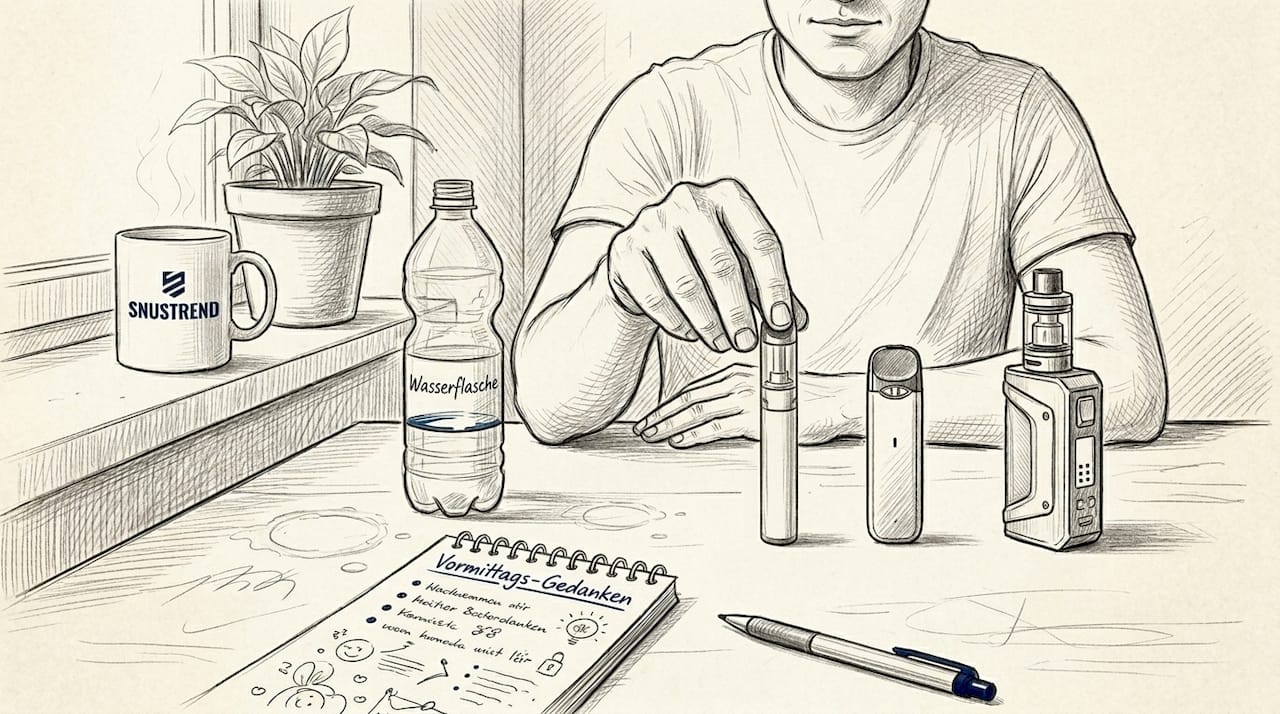
Comparison: Disposable vape vs. Pod system vs. Mod
| Feature | Disposable vape | Pod system | Mod |
|---|---|---|---|
| Maintenance | None | Low (coil change) | High (regular cleaning) |
| Refilling | Not possible | Yes, with e-liquid | Yes, individually |
| Coil change | Not possible | Yes | Yes |
| Battery charging | No (for classic models) | Yes | Yes |
| Beginner friendliness | Very high | Medium | Low |
| Cost per use | Higher long-term | Cheaper long-term | Cheapest long-term |
| Portability | Very high | High | Medium to low |
| Device lifespan | One-time | Months to years | Years |
Disposable vapes are designed for a predetermined design lifespan; there is no user coil replacement or refilling as a standard mechanism. This is not a flaw, but a design decision. These devices are intended to be uncomplicated, from the first use to disposal.
When does a disposable vape make sense?
Disposable vapes are excellent for certain situations and user types:
- Beginners without prior knowledge: No setup, no learning curve. Unpack and get started.
- On the go or traveling: No need to carry e-liquid bottles or charging cables.
- Occasional users: For those who don't vape daily, an expensive device with maintenance requirements is often not worth it.
- Quickly trying out new flavors: New aromas can be tested without investing in an entire liquid system.
- As a backup device: In case the main device is charging or under repair, a disposable device serves as a practical stopgap.
For genuine vape beginner advice, it is worth knowing both worlds before committing. Those who vape daily and in larger volumes will save money in the long term with a rechargeable system.
Why coil change and refilling are not intended
This is a question that occupies many users. Couldn't manufacturers just build a refillable disposable housing? Technically, many things would be possible. But the concept of a disposable device consciously thrives on its enclosed nature. The liquid is factory-dosed and tailored to the battery capacity. The coil is geometrically optimized for the viscosity of precisely that liquid. Refilling with a different liquid would throw the entire system out of balance.
Furthermore, the vape terminology overview serves as an important foundation: terms such as “impedance” (resistance of the coil) or “wicking speed” describe values that are fixed at the factory in a disposable device. With a mod, the user can adjust these parameters themselves. This makes mods more powerful, but also more complex.
Pro tip: Do not take excessively long puffs of more than four seconds. Short, controlled puffs protect the coil and provide more consistent vapor throughout the device's lifespan.
Expert nuances: What influences vapor and flavor
A disposable vape can taste perfect at the start and suddenly become weaker or strange after a hundred puffs. This has concrete technical reasons that are not random.
Capillary forces and liquid resupply
The wicking material transports liquid to the coil purely through capillary forces, i.e., physical suction forces at the molecular level. There is no pump, no active mechanism. Disposable vapes typically use passive liquid supply without a pump; therefore, liquid resupply can vary depending on time and position.
Specifically, this means: if you hold the device upside down or use it very rapidly in succession, the wicking material cannot pull up enough liquid in the short term. The next puff then hits a semi-dry coil. Result: a bitter or burnt taste, also known as a dry hit.
Overview of factors influencing vapor and flavor
- Handling and positioning: Holding it upright ensures that the liquid can flow evenly. A tilted or inverted position slows down the capillary action.
- Inhalation technique: Drawing slowly and evenly gives the wicking material time to transport liquid. Hasty puffs overtake the supply.
- Outside temperature: Cold makes e-liquid more viscous. In winter or cold environments, vapor production may be weaker until the device reaches body temperature.
- Storage: Direct sunlight and heat change the chemical composition of the liquid. Storage at room temperature and away from light is ideal.
- Device age and fill level: The emptier the reservoir, the drier the wicking process becomes. The last puffs of a device are almost always less intense than the first.
Expert note: Because disposable devices usually cannot dynamically adjust their power, the balance of liquid management, coil material, and airflow is permanently tuned into the system. User mistakes are therefore particularly noticeable.
That is the crucial difference to a mod: with an advanced device, the user can adjust the output if the liquid becomes viscous or the coil ages. In a disposable device, everything is fixed. Therefore, it is worth optimizing your own technique instead of waiting on the device.
Avoiding dry hits: Practical tips
A dry hit is not only unpleasant, it also signals that the coil is overheating. Anyone who experiences this regularly should consider the following:
- Let the device stand upright for a few minutes before the first use so that the liquid is evenly distributed in the wicking material.
- Take short breaks of at least thirty seconds between puffs, especially during intensive use.
- If the flavor changes, the liquid is usually almost exhausted. Then the device should be disposed of.
Pro tip: If you put the device aside briefly after the first bad puff and wait a few minutes, you give the wicking material time to soak again. Sometimes the flavor noticeably improves afterwards.
You can find more on how to handle your devices safely in the safety aspects of vapes on the Snustrend blog.
Legal and environmental aspects in Switzerland
Disposable vapes are available in Switzerland, but the legal situation is not static. Anyone who consumes while being informed knows not only the technology but also the legal framework and their responsibility towards the environment.
Current legal situation: What applies since 2024?
Since 2024, the following applies in Switzerland: Nicotine-containing e-cigarettes and vapes may only be sold to persons aged eighteen and older. This was an important innovation within the framework of the revised Tobacco Products Act. Sale to minors is thus officially prohibited, and responsible retailers verify the age of their customers.
Furthermore, there are different regulations at the cantonal level. Disposable e-cigarettes are being discussed or partially banned depending on the canton; at the same time, the problem of waste and improper disposal is being addressed. The debate is not closed, and it is very possible that other cantons will introduce new regulations in the coming years.
You can find more about the current ban discussions in Switzerland on the Snustrend blog.
Environmental issue: An underestimated topic
Disposable vapes contain plastic, electronic parts, and a lithium battery. None of these materials belong in household waste. Nevertheless, thousands of devices end up in normal trash cans, in parks, or on sidewalks every day.
What to consider regarding disposal:
- Disposable vapes are considered e-waste and must be disposed of accordingly.
- In many Swiss municipalities, there are collection points for electronic devices and batteries.
- Retailers that sell electronic devices are legally required to take back old devices.
- Some manufacturers and shops offer take-back programs.
Statistical perspective: Estimates from European countries show that up to sixty percent of all discarded disposable vapes are disposed of improperly. This is not just an environmental problem, but also a societal signal. The battery in a disposable device contains enough lithium to support recycling processes if it is disposed of correctly.
Those who want to learn more about environmentally conscious vaping can find valuable information on the topic of sustainability in vapes.
Tips for responsible disposal
- Never throw them in the regular household trash.
- Use the device until it is empty if possible, to prevent liquid from leaking.
- Bring them to the responsible municipal collection point or back to the retailer.
- Inform yourself about local regulations in your canton, as these can vary.
Our conclusion: What users should really know about disposable vapes
There is a tendency in the vaping world: disposable devices are either marketed as trendy lifestyle products or dismissed as a cheap entry-level item. Neither gets to the heart of the matter. The truth, as is often the case, lies somewhere in between and deserves a more honest look.
Disposable vapes are technically more mature than their reputation. If you buy a good device from a reliable source, you get a coordinated system that has real strengths for certain usage scenarios. Simplicity is not a flaw, but a deliberately chosen design feature. For the occasional user, the traveler, or the newcomer, a disposable device is often the most honest solution.
However, for those who vape a lot every day, the disadvantages outweigh the benefits in the long run: higher cost per puff, more waste, fewer customization options. Here, a pod system or a simple mod would be the better choice. This decision is not a matter of quality or status, but simply of efficiency and everyday suitability.
What particularly concerns us at Snustrend: most user errors do not arise from a lack of knowledge about the device, but from unrealistic expectations. A disposable device is not a mod. It is not intended to be one. Those who understand this are disappointed less often and use their device better.
Reflected usage also means: taking disposal seriously. Not out of moral conviction, but because it is practically the right thing to do. The infrastructure in Switzerland allows for correct disposal without much effort. Throwing an empty disposable device into the e-waste collection point takes no longer than throwing it into the wrong bin.
The purchase decision itself should be an informed one: brand, liquid quantity, nicotine content, flavor, and then use and dispose of the device consciously. No hype, no self-deception. Just a product that fulfills its purpose when you understand what it was made for.
Discover more now: Alternative products and advice at Snustrend
You now have a well-founded insight into the mechanics and use of disposable vapes. Knowing about the design, influencing factors, and the legal situation helps you make better decisions when buying and in everyday life. Now the question arises: Which product is specifically right for you?

At Snustrend you will find a wide selection of vapes, snus, and snuff products for every need. Whether you are looking for an Elfbar or Vozol for a quick start, or would like to try something completely different such as the traditional Pöschl Schmalzler Südfrucht: the range is wide, the prices are fair, and shipping to Switzerland is fast. For those who are still unsure which product best suits their usage behavior, it is worth taking a look at current new products and special offers on the site.
Frequently asked questions about disposable vapes
How long does a disposable vape last on average?
The usage duration typically ranges from a few hundred to about 600 puffs, depending on the liquid volume and battery size. The design lifespan is fixed at the factory; an extension by refilling or recharging is not provided.
Why does the vapor sometimes taste burnt or weak?
This is usually due to improper handling, such as taking puffs that are too long, the liquid being empty, or unfavorable storage in the cold. Passive liquid supply via capillary action without a pump means that the liquid supply cannot keep up during fast or long puffs, which leads to a dry hit.
Are disposable vapes allowed in all Swiss cantons?
Some cantons are discussing restrictions or bans; the legal situation is constantly evolving. Different regulations may apply depending on the canton; a nationwide ban on sales to minors has been in effect since 2024.
Can I reuse or recharge my disposable device?
No, disposable vapes are technically not designed for refilling or recharging and should be disposed of professionally. The specified design lifespan does not provide for user coil changes or refilling as a standard mechanism.
Recommendation
- Vape terminology explained: Overview, trends and practical knowledge – Snustrend - Snus, Vapes & Snuff
- Sustainability in vapes: Tips for environmentally conscious vaping – Snustrend - Snus, Vapes & Snuff
- Smart vaping at SNUSTREND: Apps, tracking & AI – Snustrend - Snus, Vapes & Snuff
- Vaping tips: Vaping safely and enjoying flavors – Snustrend - Snus, Vapes & Snuff
- Step-by-step nicotine pouch guide: safe, discreet use – HitSnus






Share:
Snuff Guide: Usage, Selection and Safety
Flavors in Vaping: Understanding Enjoyment, Impact, and Regulation