

Vaping is often misunderstood as a harmless alternative to smoking or merely a passing trend. In reality, it is a distinct method with specific mechanisms, device types, and legal frameworks. This guide provides a sound explanation of what vaping truly is, how the technology works, and which aspects are important for adults in Switzerland. You will learn everything about device types, legal requirements, health comparisons to smoking, and practical tips for a safe start.
Table of Contents
- Key insights into vaping
- What is vaping and how does it work
- Device categories for vaping: from beginner to expert
- Legal regulations for vaping in Switzerland
- Health aspects of vaping compared to smoking
- Practical tips for a safe and informed entry into vaping
- Discover vaping products at Snustrend
- Frequently asked questions about vaping
Key Insights
| Point | Details |
|---|---|
| Operating principle without combustion | With vaping, the liquid is heated rather than burned, creating an aerosol instead of smoke. |
| Overview of device categories | There are disposable vapes, pod systems, and other types with varying handling and maintenance requirements. |
| Swiss regulation | In Switzerland, laws protect young people and limit nicotine consumption through age restrictions and sales regulations. |
| Risk profile and environment | Vaping is considered less harmful than smoking but carries its own risks and environmental burdens, particularly from disposable vapes. |
What is vaping and how does it work
Vaping is based on a simple principle: a heating coil heats a liquid to approximately 200 to 250 degrees Celsius. This temperature is sufficient to vaporize the liquid, consisting of propylene glycol, vegetable glycerin, flavorings, and optionally nicotine, without burning it. This is exactly where the crucial difference from smoking lies: no combustion means no smoke, no tar, and no carbon monoxide. Instead, an aerosol is created, which is then inhaled.
E-liquids consist mainly of two carrier substances. Propylene glycol provides the so-called "throat hit," the scratchy sensation in the throat that many former smokers appreciate. Vegetable glycerin creates the visible clouds of vapor and a smoother flavor. Flavorings give the vapor its characteristic taste, ranging from tobacco and fruits to desserts. Nicotine is optional, though it is frequently added to satisfy the craving for the addictive substance.
No combustion means fewer toxic residues in the vapor.
The advantage of this technology is obvious: by avoiding combustion, significantly fewer carcinogenic substances are produced. Studies show that vapor contains considerably fewer toxic compounds compared to tobacco smoke. Nevertheless, vaping is not risk-free, as we will discuss in detail later. The safety of vapes depends heavily on quality and usage.
Pro Tip: Properly adjusting the wattage and airflow on your device not only significantly improves the flavor but also reduces the formation of potentially harmful substances. Excessively high temperatures can break down flavorings and create unwanted compounds. Experiment with lower settings to find your personal balance between vapor volume and flavor.
Important differences between vapor and smoke:
- Vapor is created through vaporization at controlled temperatures, while smoke is created through uncontrolled combustion above 600°C
- Vapor does not contain combustion byproducts like tar, carbon monoxide, or polycyclic aromatic hydrocarbons
- Vapor leaves less odor and residue on clothing and in rooms
- The composition of vapor is predictable and based on the ingredients in the liquid
Device categories for vaping: from beginner to expert
The world of vaping devices is divided into three main categories, which differ significantly in complexity, performance, and target audience. Each type has specific pros and cons that should influence your choice.
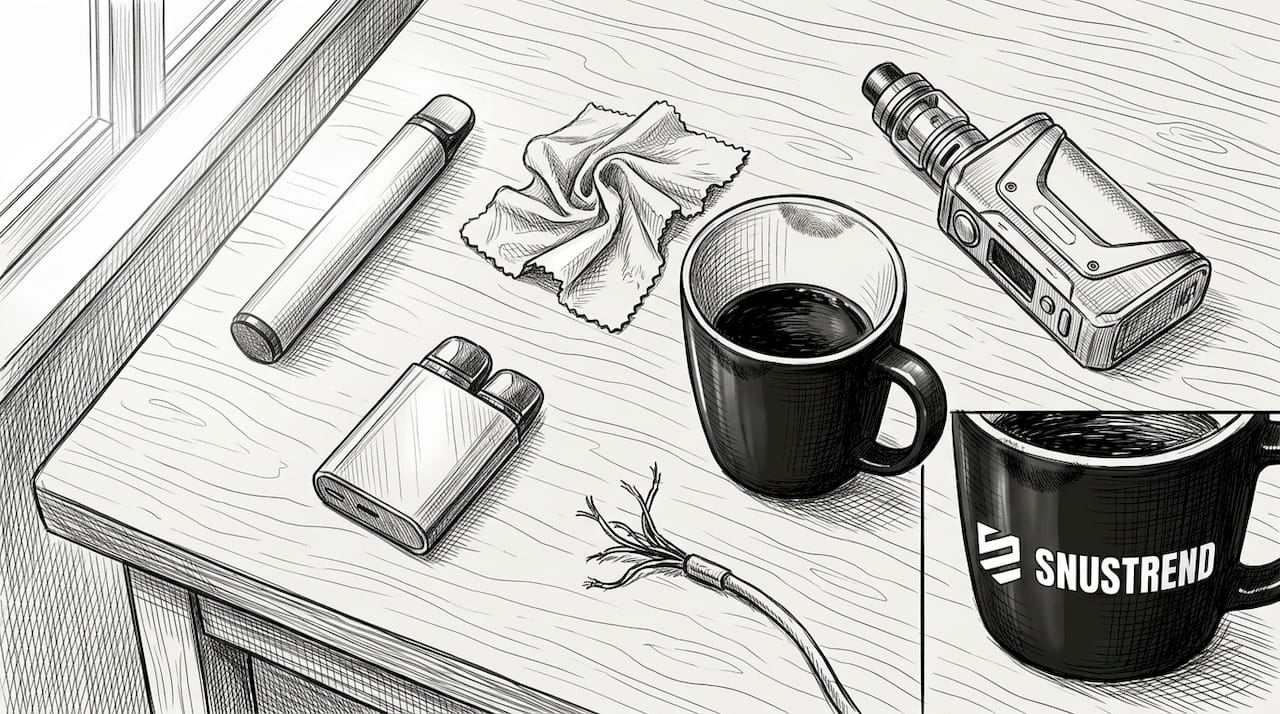
Disposable vapes are the simplest option. These compact devices come pre-filled with liquid and a battery, are ready to use immediately, and are disposed of after approximately 500 to 600 puffs. They require no maintenance or technical understanding. This simplicity is exactly what makes them attractive to curious users, but it also carries significant drawbacks. The high nicotine concentration and constant availability encourage rapid dependency, especially among young people. Furthermore, disposable vapes generate massive amounts of electronic waste, as batteries and electronic components end up in the trash after only a short period of use.
Pod systems offer a middle ground between simplicity and sustainability. These devices consist of a rechargeable battery unit and interchangeable or refillable pods that contain the liquid. They are compact, discreet, and ideal for everyday use. The operation remains simple: insert the pod, turn on the device, and vape. Many models offer adjustable power and various coil options, allowing you to customize your vaping experience. Pod systems are excellent for beginners who want to vape long-term without having to deal with complex technology.
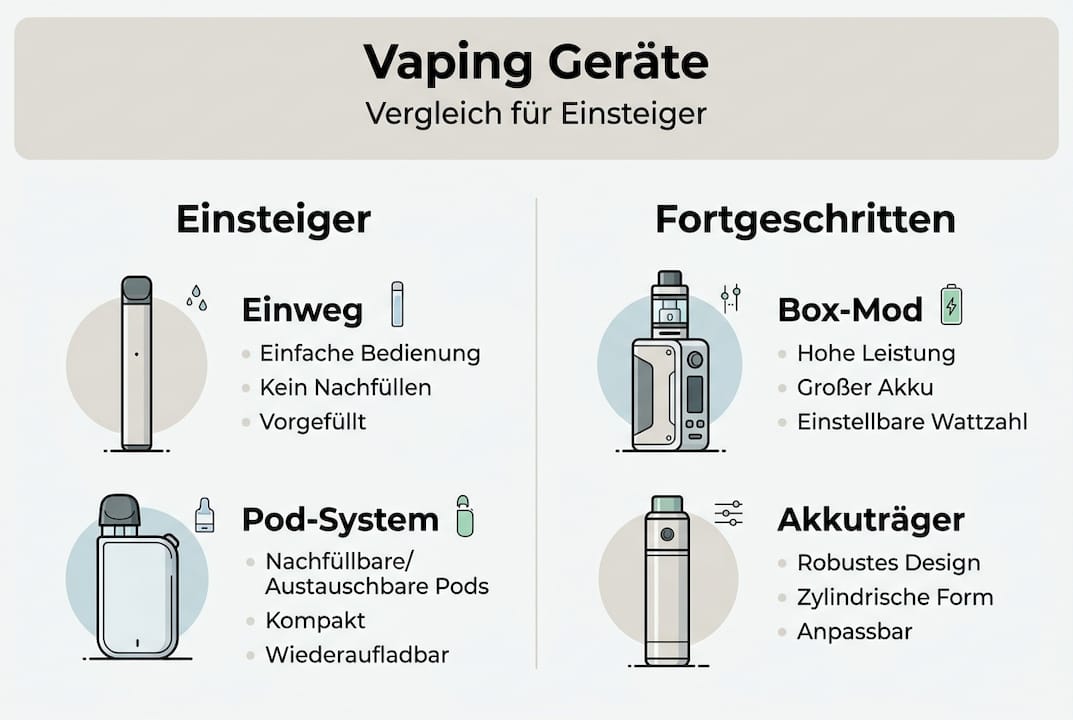
Box mods and battery carriers are aimed at experienced vapers who want maximum control. These powerful devices allow for precise adjustments to wattage, voltage, and temperature. They are combined with separate atomizers that often use self-wound coils. The vapor production is significantly higher, as is the liquid consumption. Box mods require technical knowledge and regular maintenance, but in return, they offer unparalleled flexibility in terms of flavor and vapor volume.
| Device Type | Battery Capacity | Handling | Long-term Costs | Vapor Volume |
|---|---|---|---|---|
| Disposable Vape | Integrated, 280-500 mAh | Ready to use, no maintenance | High due to constant repurchasing | Medium |
| Pod System | 400-1500 mAh, rechargeable | Simple, pod replacement | Medium, pods and coils | Medium to high |
| Box Mod | 1500-5000+ mAh, replaceable batteries | Complex, adjustments required | Low with good care | Very high |
Pro Tip: If you want to switch from smoking, choose a pod system with mouth-to-lung (MTL) draw resistance. This simulates the draw behavior of a cigarette and makes the transition easier. Start with a nicotine strength of 12 to 18 mg/ml to satisfy the craving without overwhelming yourself. Expert advice will help you find the right device and the correct nicotine strength.
Pros and cons of device types:
- Disposable vapes: Pro: easiest use; Con: environmental impact and risk of addiction due to high nicotine availability
- Pod systems: Pro: balance of simplicity and sustainability; Con: limited performance compared to mods
- Box mods: Pro: maximum control and vapor performance; Con: steep learning curve and higher maintenance effort
Legal regulations for vaping in Switzerland
Since 2021, Switzerland has regulated vaping products through the Tobacco Products Act, which sets clear boundaries to protect young people and control the market. The minimum age for sale and use is 18 years, and the maximum nicotine concentration in e-liquids is limited to 20 mg/ml. These regulations are based on European standards and are intended to hinder access for minors.
Youth protection is at the heart of the legislation. Retailers must verify the age of their customers, both in brick-and-mortar stores and online. Violations are punished with significant fines. Advertising for nicotine-containing products is subject to strict restrictions, especially in media that could reach young people. Sponsoring events with young audiences is prohibited.
Currently, there is intensive discussion in Switzerland regarding a ban on disposable vapes. The Council of States has addressed the issue, as these devices are particularly popular among young people and cause significant environmental problems. The debate revolves around balancing individual freedom and collective protection. Proponents of a ban argue for addiction prevention and environmental protection, while opponents emphasize the importance of vaping as a cessation aid for smokers. You can find more details on the current discussion in our article on the ban on disposable vapes in Switzerland.
Youth protection and environmental responsibility are central to vaping regulation.
Another problem is inferior products that ignore safety and declaration regulations. Cheap vapes from insecure sources can have incorrect nicotine labels, contain heavy metals, or have technical defects that lead to overheating. When purchasing, look for reputable dealers and brand-name products that comply with Swiss standards. The importance of accurate nicotine levels cannot be overestimated, as incorrect labels can lead to overdosing or insufficient effects.
Key legal requirements:
- Sale and supply only to persons aged 18 and over with age verification
- Maximum nicotine concentration of 20 mg/ml in e-liquids
- Ban on advertising in media with high youth reach
- Mandatory labeling for ingredients and health warnings
- Notification requirement for new products to authorities before market introduction
Health aspects of vaping compared to smoking
The health effects of vaping are the subject of intensive scientific research. The most important finding: vaping is significantly less harmful than smoking, but not risk-free. Public Health England estimates that e-cigarettes are about 95% less harmful than conventional cigarettes. This figure is based on the analysis of harmful substances in vapor compared to tobacco smoke.
The main difference lies in the absence of combustion products. Tobacco smoke contains over 7,000 chemical compounds, at least 70 of which are carcinogenic substances like tar, benzene, and formaldehyde in high concentrations. Vapor either does not contain these substances at all or contains them in negligibly small amounts. Carbon monoxide, which hinders oxygen absorption in the blood during smoking, is completely absent in vapor. This explains why many switchers quickly notice an improvement in their lung function and physical fitness.
Nevertheless, vaping carries its own risks. Nicotine remains a highly addictive substance, regardless of the method of intake. The long-term effects of inhaled flavorings are not yet fully understood. Some flavorings that are safe in food can form problematic compounds when heated and inhaled. Diacetyl, a butter flavoring, has been found in some liquids and is suspected of causing lung disease. Reputable manufacturers have now stopped using such substances.
| Harmful substance | Tobacco smoke | E-cigarette vapor | Reduction |
|---|---|---|---|
| Tar | High (10-30 mg per cigarette) | None | 100% |
| Carbon monoxide | High (10-20 mg per cigarette) | None | 100% |
| Formaldehyde | High | Very low (with correct use) | 95%+ |
| Nicotine | Variable | Variable (controllable) | Neutral |
| Heavy metals | Present | Traces (dependent on coil quality) | 90%+ |
Studies show better success in smoking cessation with e-cigarettes than with nicotine replacement therapy.
Health pros and cons of vaping:
- Pro: Drastic reduction of carcinogenic combustion products compared to cigarettes
- Pro: No exposure to tar, which lowers the risk of lung disease and COPD
- Pro: Controllable nicotine intake allows for gradual reduction of dependency
- Con: Nicotine dependency remains or can develop
- Con: Unknown long-term effects of inhaled flavorings and carrier substances
- Con: Risk of respiratory tract irritation, especially at high temperatures
For smokers who cannot or do not want to quit, vaping represents a significantly less harmful alternative. The health differences between vaping and smoking are considerable. For non-smokers, however, vaping is not a recommended option, as it can establish nicotine dependency.
Practical tips for a safe and informed entry into vaping
Getting into vaping requires more than just buying a device. Informed decisions regarding nicotine strength, device choice, and usage behavior make the difference between a successful smoking alternative and new problems.
Start with moderate nicotine strengths. Studies show that 70% of beginners choose moderate levels between 6 and 12 mg/ml to control their cravings without overwhelming themselves. If you were a heavy smoker, 12 to 18 mg/ml may be necessary at first. Values that are too low will lead you to vape too much, while values that are too high will cause nausea and headaches. Experiment carefully and adjust the strength after a few weeks.
Avoid disposable vapes for several reasons. They are expensive in the long run, harmful to the environment, and encourage impulsive consumption behavior. The high nicotine concentration and constant availability can quickly lead to a stronger dependency than intended. Instead, invest in a high-quality pod system or a mod that you can maintain and adjust. You can find more information in our beginner's guide for vaping in Switzerland.
Regular maintenance and cleaning are crucial for safety and flavor. Coils wear out after about one to three weeks, depending on usage and liquid. Burnt coils not only taste bad, but they can also release harmful substances. Clean the tank weekly with warm water, dry all parts thoroughly, and check seals for damage. Batteries should only be charged with the supplied charger and never left unattended overnight.
Pro Tip: Give yourself time to find the right nicotine strength and the right flavor. What seems perfect at first may be too strong or too weak after a few weeks. Your body adjusts, and your taste develops. Many successful switchers reduce their nicotine strength gradually over months until they reach 3 or 0 mg/ml. This process requires patience but pays off in the long run.
Dos and Don’ts for vaping beginners:
- Do: Buy from reputable retailers with transparent product information and proof of quality
- Do: Start with a simple, user-friendly device like a pod system
- Do: Inform yourself about the correct nicotine choice for beginners
- Don’t: Buy no-name products without proof of origin or safety certificates
- Don’t: Vape in enclosed spaces with children or non-smokers without their consent
- Don’t: Neglect the maintenance of your device, as this leads to poor taste and safety risks
Responsible handling protects your health and the environment. Dispose of batteries and devices properly at e-waste collection points. Keep liquids out of reach of children; nicotine is highly toxic if swallowed. Respect non-smokers and do not vape in places where it could disturb others.
Discover vaping products at Snustrend
Now that you have built up sound knowledge about vaping, the question arises: Where can you find high-quality products that meet your needs? Snustrend offers a carefully selected range of vaping products for beginners and experienced vapers in Switzerland.
For those switching from smoking, products like the O’S TOBACCO Vape 750 Bliss are particularly suitable, as its authentic tobacco flavor makes getting used to it easier. If you are looking for a bit of variety, the O’S TOBACCO Vape 750 Disco is an interesting alternative with a balanced flavor profile. Both options offer reliable performance and are ideal for getting started.

Snustrend does not only carry vapes, but also alternative tobacco products such as Pöschl Schmalzler Südfrucht Snuff for users who want to explore different options. The website offers detailed product information, transparent pricing, and fast shipping throughout Switzerland. Expert advice will help you find the right product for your individual needs.
Frequently asked questions about vaping
How does vaping differ from smoking?
Vaping vaporizes liquids at controlled temperatures of around 200 to 250°C, whereas smoking burns tobacco at over 600°C. As a result, vaping does not produce combustion products like tar, carbon monoxide, or most of the carcinogens found in tobacco smoke. The vapor consists mainly of propylene glycol, vegetable glycerin, flavorings, and optionally nicotine, without the thousands of toxic compounds found in smoke.
Which nicotine strengths are suitable for me?
The appropriate nicotine strength depends on your previous smoking habits. Heavy smokers who consumed more than a pack a day often start with 12 to 18 mg/ml. Moderate smokers usually find the right balance with 6 to 12 mg/ml. Occasional smokers or people who want to reduce nicotine intake choose 3 to 6 mg/ml. Experiment carefully and adjust the strength after a few weeks if you notice that you are vaping too much or too little.
Are disposable vapes legal in Switzerland?
Yes, disposable vapes are currently legal in Switzerland as long as they meet legal requirements: sale only to those aged 18 and over and a maximum nicotine concentration of 20 mg/ml. However, a ban is currently being discussed, as these devices are particularly popular among young people and cause significant environmental and addiction problems. The Council of States has addressed the issue, but a final decision is still pending.
How do I dispose of my vape battery correctly?
Vape batteries and devices are considered e-waste and must be disposed of properly. Take them to official collection points for electronic waste, which are available in many municipalities and stores. Never throw them in the household trash, as lithium-ion batteries pose fire and environmental risks. Many retailers also take back old devices and ensure environmentally friendly recycling of the components.
What are the long-term health risks?
The long-term effects of vaping have not yet been fully researched, as the technology has only been widespread for about 15 years. Known risks include nicotine addiction, possible irritation of the airways, and unknown effects of long-term inhaled flavorings. However, studies clearly show that vaping is significantly less harmful than smoking. For smokers, switching is a risk reduction; for non-smokers, vaping remains an unnecessary health risk. You can find more details in our article on the safety of vapes.
Can vaping help with quitting smoking?
Yes, several studies show that e-cigarettes are more effective at helping people quit smoking than traditional nicotine replacement therapies like patches or gums. The reason lies in the similar handling and the immediate nicotine hit, which satisfies cravings better. However, a structured approach is important: choose the right nicotine strength, reduce it gradually, and use vaping as a transition, not as a permanent substitute. Professional support significantly increases the chances of success.
Recommendation
- Vape beginner's guide Switzerland 2026: starting safely – Snustrend - Snus, Vapes & Snuff
- Safety of vapes 2026: understanding risks and vaping safely – Snustrend - Snus, Vapes & Snuff
- Smart Vaping at SNUSTREND: Apps, Tracking & AI – Snustrend - Snus, Vapes & Snuff
- Vape liquids explained: quality, effects, and trends 2026 – Snustrend - Snus, Vapes & Snuff






Share:
What sets Siberia Snus apart? Strength and quality explained
Popular vape flavors: 50+ examples for 2026