


TL;DR:
- Terms like disposable, pod, and liquid are now critical in Switzerland from a tax and legal perspective.
- The draw style (MTL, RDL, DTL) influences usage, costs, and device selection.
- Understanding the terminology leads to more informed and cost-effective purchasing decisions.
Anyone who vapes in Switzerland quickly realizes that terms like "disposable," "pod," "MTL," or "RDL" are no longer just marketing speak. Since the new Tobacco Products Act of October 1, 2024, these terms have direct tax and legal consequences. A disposable vape is taxed differently than a pod system, and the tank volume determines whether a product can even be legally sold. Knowing the terminology helps you make better purchasing decisions, save money, and buy in a legally compliant manner. This guide explains all important vape terms clearly and practically for experienced vapers in Switzerland.
Table of Contents
- Legal framework shapes understanding of terms: Disposable, Pod & Liquid
- The most important vaping styles: MTL, DTL & RDL compared
- Further vape terms and their significance for 2026 trends
- Important terms for safe and sustainable vape consumption
- Context: Why terminology is more important for vapers today than ever
- Your next step: Discover products and apply knowledge
- Frequently asked questions about vape terminology
Key Takeaways
| Point | Details |
|---|---|
| Law impacts terms | Terms like disposable and pod now have concrete tax and product-specific relevance due to Swiss legislation. |
| Differentiating vaping techniques | MTL, DTL, and RDL designate different draw techniques with significant differences for hardware, experience, and liquid choice. |
| Understanding technical and trend terms | Current terms like coil, salt nic, and shortfill determine access to innovation, safety, and sustainable consumption. |
| Safety and environment count | Safety features and environmental aspects are not just terms; they decisively influence usage, legal status, and product design. |
Legal framework shapes understanding of terms: Disposable, Pod & Liquid
Vaping terms are never neutral. In Switzerland, a product's format directly determines which tax applies and which volume limit is in effect. This is no small matter; it influences price, availability, and daily selection.
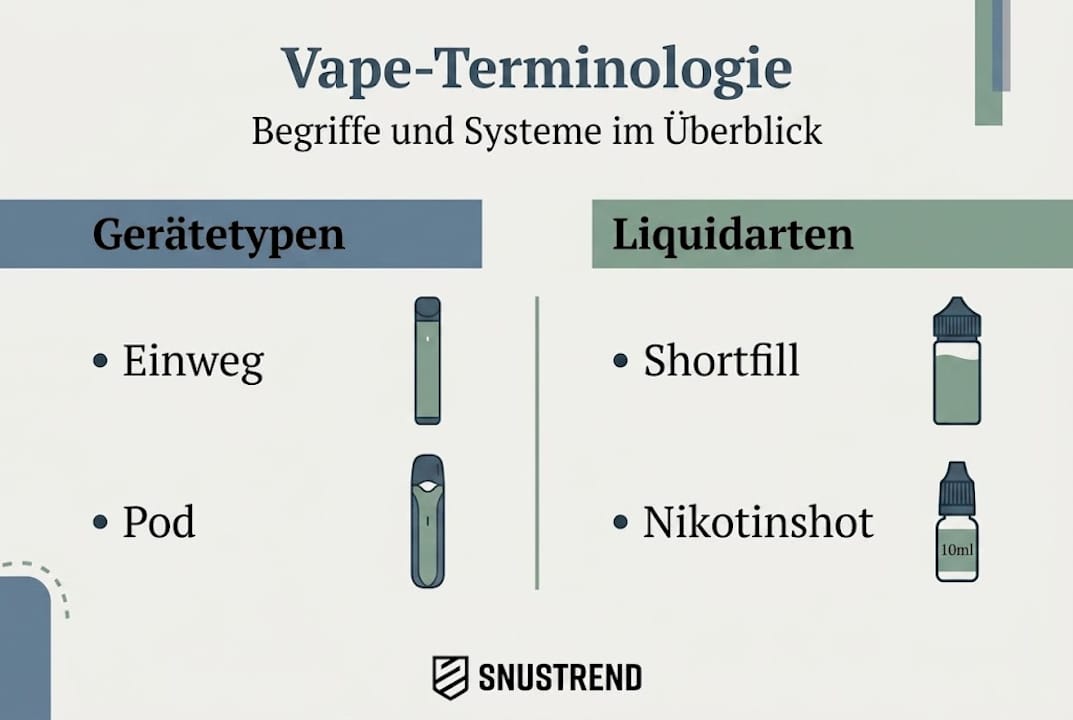
Disposable refers to a pre-filled e-cigarette that is discarded after use. No refilling, no recharging in most cases, no replacing parts. Products like Elfbar or Vozol fall into this category. They are easy to use but tax-burdened more heavily: the tax rate is CHF 1.00 per milliliter for nicotine-containing disposable products.
Pod refers to a cartridge system that is either pre-filled (prefilled pod) or refillable. Prefilled pods are similar to disposable products but legally belong to a separate category with a lower tax rate of CHF 0.20 per milliliter. Refillable pods offer more flexibility since you choose the liquid yourself.
Liquid is the refill fluid for open systems. It typically consists of propylene glycol (PG), vegetable glycerin (VG), flavorings, and optionally nicotine. Liquids are also subject to the tax rate of CHF 0.20 per milliliter, provided they contain nicotine. Nicotine-free liquids are exempt from this tax, which can be an important purchasing aspect.
The regulation significantly shifts the practice of vape terminology: what was once just a product category is now a tax-legal classification with direct cost consequences.
| Product type | Tank volume (nicotine) | Tax rate |
|---|---|---|
| Disposable | max. 2 ml | CHF 1.00/ml |
| Prefilled Pod | max. 2 ml | CHF 0.20/ml |
| Liquid (refill) | unlimited | CHF 0.20/ml |
| Nicotine-free product | unlimited | no tax |
The 2 ml restriction for disposable products with nicotine is particularly relevant. Products previously available with 5 ml or more must now either be reformulated or offered as nicotine-free to remain legal.
Important points at a glance:
- Nicotine content and format together determine the tax rate
- Disposable products are taxed five times higher than pods or liquids
- Prefilled nicotine pods may hold a maximum of 2 ml
- Nicotine-free products are not subject to volume or tax restrictions
- Those who know liquid tax rates can save significantly by switching systems
Pro Tip: Those who vape regularly and do not want to go without nicotine will fare better in the long run with a refillable pod system and their own liquid than with disposable products, simply due to the fivefold tax difference per milliliter.
The most important vaping styles: MTL, DTL & RDL compared
In addition to legal terms, there is a second level of terminology that describes the actual vaping experience. This concerns technique, bodily sensation, and device selection. The three central terms are MTL, DTL, and RDL.
MTL (Mouth To Lung) literally means "mouth to lung." You draw the vapor into your mouth first, hold it briefly, and then inhale it into your lungs. This corresponds exactly to the smoking behavior of a traditional cigarette. MTL devices have a restricted airflow, produce little vapor, and are particularly suitable for beginners or people switching from cigarettes. They operate with higher nicotine concentrations, often as salt nic (nicotine salt), and consume less liquid. MTL is the most frequent recommendation for getting started with vaping.

DTL (Direct To Lung) means "direct to lung." The vapor is pulled directly into the lungs without a stopover in the mouth, similar to a deep breath. DTL devices have a wide airflow, produce large clouds of vapor, and are preferred by experienced vapers who engage in so-called cloud chasing. They require lower nicotine concentrations because absorption is more efficient. Sub-ohm devices (coils under 1 ohm) are typical for DTL.
RDL (Restricted Direct Lung) is the hybrid between both worlds. The term describes a restricted direct draw that offers more resistance than DTL but is more open than MTL. RDL as a hybrid between MTL and DTL has gained significant importance in recent years because many modern devices offer adjustable airflow systems. Users can use these to switch between different draw techniques.
| Feature | MTL | RDL | DTL |
|---|---|---|---|
| Airflow | restricted | medium | open |
| Vapor volume | low | medium | high |
| Nicotine strength | high (12-20 mg) | medium (6-12 mg) | low (0-6 mg) |
| Typical users | beginners, switchers | advanced | experienced vapers |
| Coil resistance | above 1 ohm | 0.5 to 1 ohm | below 0.5 ohm |
For Swiss vapers, the choice of draw technique also has indirect cost consequences. MTL devices consume less liquid, which is noticeably felt at a tax rate of CHF 0.20 per milliliter. DTL devices consume significantly more liquid per session, which increases monthly costs.
Further important differences:
- MTL is suitable for salt nic liquids with high nicotine content
- DTL requires free-base nicotine in low concentrations
- RDL devices are often the most versatile because they support both styles
- The basic terms of vaping help choose the right hardware from the start
The choice between MTL, RDL, and DTL is not a question of taste alone. It influences which liquid, which nicotine content, and which device you need, and thus directly impacts total costs.
Further vape terms and their significance for 2026 trends
The vaping industry is developing quickly. In addition to the basic terms, there is a growing number of technical terms that are relevant for daily vaping and purchasing decisions. Here are the most important ones at a glance.
-
Coil is the heating element in an e-cigarette. It vaporizes the liquid through electrical resistance. The resistance of a coil (measured in ohms) determines whether a device is suitable for MTL, RDL, or DTL. Coils must be replaced regularly, typically every one to two weeks with regular use.
-
Salt Nic (Nicotine Salt) is a chemically modified form of nicotine that is absorbed into the blood faster and more efficiently than free-base nicotine. Salt nic is used primarily in MTL devices and allows for higher nicotine concentrations without the harsh throat hit of free-base nicotine.
-
Sub-ohm refers to devices with a coil resistance below 1 ohm. These devices produce more vapor, require more power, and consume more liquid. They are typical for DTL vapers and cloud chasers.
-
Cloud Chasing is the deliberate generation of the largest possible clouds of vapor, often as a hobby or competition. It requires specialized sub-ohm devices, low-nicotine liquids with a high VG ratio, and a lot of experience. In Switzerland, cloud chasing in public spaces is restricted by vaping bans.
-
Prefilled means pre-filled. A prefilled pod or cartridge comes directly filled with liquid and is replaced after use. This category is subject to tax and volume rules for pods in Switzerland.
-
VG/PG ratio describes the mixing ratio of Vegetable Glycerin (VG) and Propylene Glycol (PG) in a liquid. High VG content produces more vapor and a smoother taste. High PG content intensifies the flavor and the throat hit. For MTL devices, ratios like 50/50 are common; for DTL, 70/30 or 80/20 in favor of VG is more common.
“In Switzerland, terms like disposable and pod are not just marketing, but directly determine tank volume and tax rate. Anyone who doesn't know this will, in case of doubt, pay more."
Pro Tip: When purchasing vape liquids, always check the VG/PG ratio. An 80/20 VG liquid in an MTL device can lead to wick clogging because the thick VG is not drawn in quickly enough.
For 2026, clear trends are emerging. Smart vaping, meaning devices with app connectivity, enables puff counting, nicotine tracking, and individual settings via smartphone. New flavors like complex fruit-menthol combinations or dessert profiles continue to gain popularity. At the same time, pressure is increasing on the industry to offer more sustainable products.
Important terms for safe and sustainable vape consumption
Safety and sustainability are two topics often underestimated in the vaping world. Yet, there are a whole range of technical terms that cover exactly these aspects and are particularly relevant for Swiss vapers.
Leakproof refers to devices or pods that use special seals and construction to prevent liquid from leaking uncontrollably. Leaking liquid is not only annoying but can cause nicotine irritation upon skin contact. High-quality devices explicitly highlight this feature.
Childproof describes packaging and devices with child-safety mechanisms. In Switzerland, child-resistant packaging for nicotine-containing products has been legally required since October 2024. When purchasing, one should look for this feature, especially if children live in the household.
Airflow refers to the air supply of a device. Adjustable airflow allows you to switch between MTL, RDL, and DTL. Too little airflow leads to a harsh, unpleasant draw. Too much airflow dilutes the taste. The right setting is a matter of personal taste and the coils used.
Shortfill is a liquid that is bottled nicotine-free and deliberately leaves room for a nicotine shot. A nicotine shot is a highly concentrated nicotine solution (usually 18 mg/ml) added to the shortfill liquid to reach the desired nicotine strength. This system is particularly interesting in Switzerland because nicotine-free shortfills are not subject to tax and are available in quantities larger than 2 ml.
Important safety terms at a glance:
- Leakproof: Protection against leaking liquid, especially during transport
- Childproof: Legally required child safety for nicotine-containing products
- Airflow: Air supply regulation for an optimal vaping experience
- Shortfill: Nicotine-free liquid with room for a nicotine shot
- Nicotine shot: Concentrated nicotine solution for individual dosing
- Overcharge protection: Electronic safeguard against overcharging the battery
- TPD-compliant: Complies with European Tobacco Products Directives
Pro Tip: The shortfill-nicotine shot system offers a real cost advantage in Switzerland. A 50 ml shortfill without nicotine incurs no liquid tax, and a nicotine shot for 2 ml is taxed only with CHF 0.40. Compared to a disposable product with 2 ml and CHF 2.00 tax, this is a significant difference.
Sustainability is also becoming increasingly important in the vaping sector. Reusable devices generate less electronic waste than disposable products. In Switzerland, there are specific sustainability tips for vapers that help reduce the ecological footprint. Disposable products contain lithium batteries and plastic, which must be disposed of separately. Those who opt for a safe vaping setup protect both the environment and their budget simultaneously.
Context: Why terminology is more important for vapers today than ever
In the past, choosing an e-cigarette was a matter of taste and technology. Today, it is also a question of taxes, laws, and risk minimization. This is a fundamental shift that many vapers have not yet fully internalized.
At Snustrend, we observe daily that users purchase products without knowing the difference between a prefilled pod and a disposable product. The result: they pay CHF 1.00 per milliliter instead of CHF 0.20 without realizing it. That is not a small difference; that is a factor of five.
The regulatory developments in Switzerland clearly show: those who consider terminology to be a trivial matter lose their freedom of choice. On the other hand, those who understand what a shortfill is, why RDL devices are more flexible, or how nicotine salts work, not only buy more cost-effectively but also more consciously. By 2026, terminology in Switzerland will no longer be an academic topic. It will be a practical tool for everyone who vapes.
Your next step: Discover products and apply knowledge
You now know the differences between disposable, pod, and liquid, understand MTL, RDL, and DTL, and know why terms like shortfill or nicotine shot offer real added value in Switzerland. Now it's about putting this knowledge into practice.

At Snustrend, you will find a wide selection of products that perfectly match your new level of knowledge. Whether you are looking for a high-quality MTL system or want to try a trendy disposable product like the OS Tobacco Vape 750 Bliss, we offer both at fair prices with fast shipping to Switzerland. And for those who appreciate classic alternatives alongside vapes, you can discover a proven option from our snuff range with the Pöschl Schmalzler Südfrucht. Apply your knowledge directly and choose consciously.
Frequently asked questions about vape terminology
What exactly does the term "pod" mean in the Swiss vape context?
Pod refers to a prefilled or refillable cartridge system, which is subject to strict volume and tax rules for pods under the new Swiss law, specifically a maximum tank volume of 2 ml for nicotine-containing products and a tax of CHF 0.20 per milliliter.
Which distinction between MTL, DTL, and RDL is particularly important?
MTL, DTL, and RDL differ in draw technique, vapor volume, and device choice; RDL as a hybrid offers medium draw resistance and is particularly versatile because it combines both styles.
How do taxes and laws influence the use of terms for vapes in Switzerland?
Terms like disposable, pod, or liquid are tax- and law-specifically defined in Switzerland; disposable products are subject to a tax rate five times higher than that for pods or liquids, which has a direct impact on the purchase price.
Which trends are shaping vape terminology for 2026?
Smart vaping, sustainable systems, and new flavor worlds are shaping vape-related terminology, while Swiss regulation continues to actively shape product categories and terminology in 2025.
Recommendation
- Smart Vaping at SNUSTREND: Apps, Tracking & AI – Snustrend - Snus, Vapes & Snuff
- Vape liquids explained: Quality, effect, and trends 2026 – Snustrend - Snus, Vapes & Snuff
- What is vaping: an understandable guide for beginners – Snustrend - Snus, Vapes & Snuff
- Vape safety 2026: Understanding risks and vaping safely – Snustrend - Snus, Vapes & Snuff






Share:
Understanding Nicotine Strength: Effects, Selection & Tips for Snus and Vapes
Choosing the Right Vape Flavors: Tobacco-Free Enjoyment