


In short:
- The correct vape workflow is based on clear steps: goal, draw style, device, coil, and liquid. Following this sequence avoids beginner mistakes and helps you find the right setup. In Germany, age restrictions apply, and legal limits and safe handling are essential.
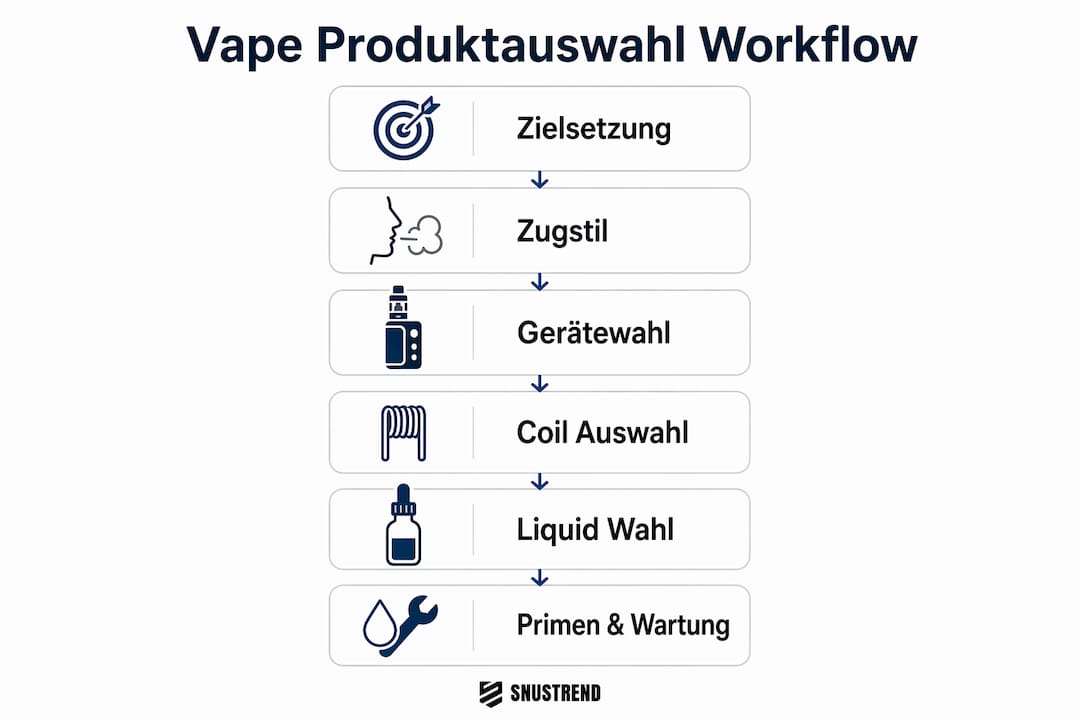
The most effective way to select the right vape product follows a clear process: define your goal, determine your draw style, choose the device type, match the coil and power, select the liquid, then test and maintain. Anyone who adheres to this vape product selection workflow from the start will buy the right thing the first time and avoid common beginner mistakes like devices that are too complex or incorrect nicotine dosage.
The six steps at a glance:
-
Step 1: Clarify your goal. Smoking cessation, nicotine reduction, or pleasure/vapor? Your goal determines everything else.
-
Step 2: Define your draw style. A tight draw like a cigarette (MTL) or an open, direct lung hit (DL)?
-
Step 3: Choose the device type. Disposable, pod system, starter kit, or adjustable mod?
-
Step 4: Match coil and power. Resistance and wattage must suit your draw style and liquid.
-
Step 5: Select the liquid. Determine the PG/VG ratio, nicotine type (freebase or nicotine salt), and strength.
-
Step 6: Test, prime, and maintain. Saturate the coil, break in the power, and establish a maintenance routine.
Important in advance: In Germany, there is a minimum age of 18 for the purchase and use of vape products. The nicotine content in liquids is legally limited to ensure safety. Vapes are not a risk-free product, but they are a lower-harm alternative for adults looking to switch from tobacco.
Table of Contents
- How is a vape device constructed and what influences the purchase?
- Which device type suits which goal?
- How do you choose the right liquid?
- How do you assemble the right setup step by step?
- What to do in case of problems: coil changes, leaks, and burnt taste
- What does getting started cost and how long does the transition take?
- What must you consider in Germany regarding legal and safety aspects?
- Important findings
- What beginners really underestimate when switching
- Snustrend makes product selection easier
- Useful sources and further links
How is a vape device constructed and what influences the purchase?
A vape device consists of four core components: battery (or mod), tank or pod, coil, and airflow control. Each of these components directly affects how the device feels and what matters during the purchase.
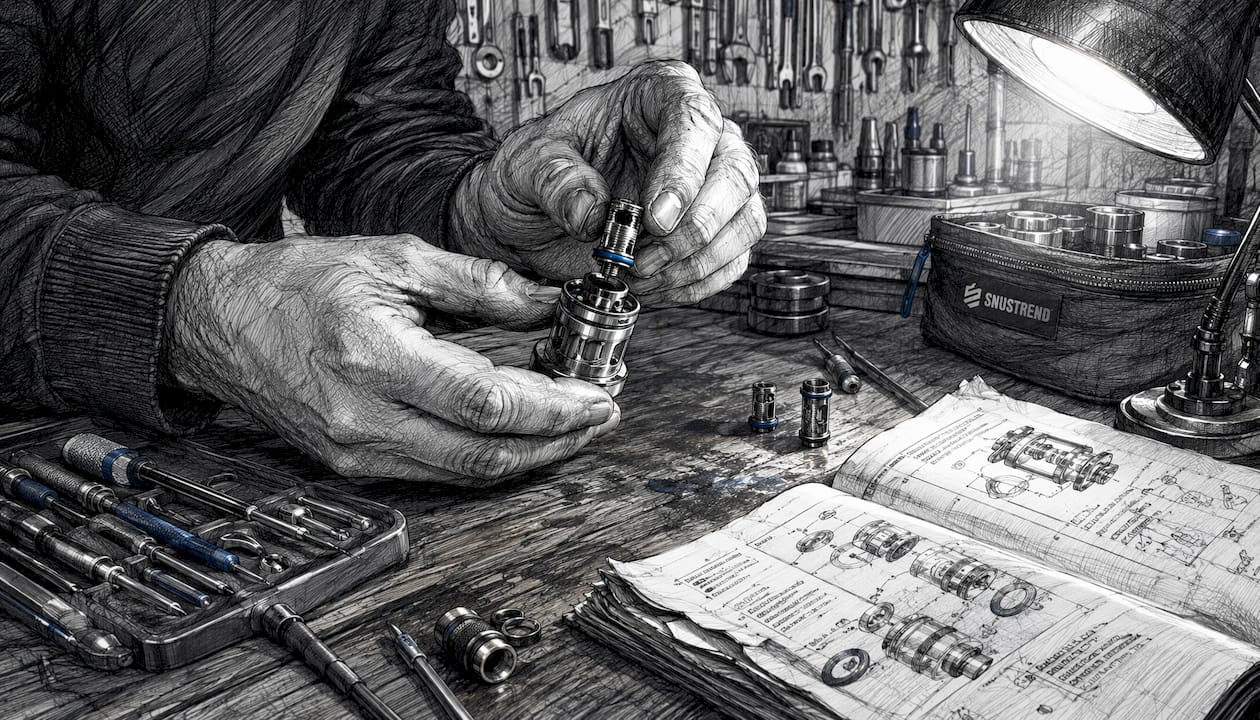
The battery provides the power. Capacity in milliampere-hours (mAh) determines how long you can vape between charges. Anyone on the go needs at least 1,000 mAh. Those vaping at home can get by with less, as long as a charging cable is close at hand.
The tank or pod holds the liquid. Pods are usually sealed and easy to swap. Tanks are refillable and offer more flexibility in liquid choice. For beginners, pods are usually more practical as they are easier to operate.
The coil is the heart of the device. It heats the liquid and creates the vapor. Its resistance (measured in ohms) and the required power (watts) must match. A coil with high resistance (over 1 ohm) is suitable for a tight MTL draw and low power. Low-resistance coils (under 0.5 ohms) create more vapor, require more power, and fit the DL draw.
The airflow regulates how much air enters during the draw. Little airflow results in a tight, cigarette-like draw. High airflow makes the draw more open and vapor-rich.
Battery capacity and draw style must be considered together. An MTL pod with 800 mAh easily lasts for a daily requirement because it works with low power. A DL device at 50 watts will drain the same battery in just a few hours. Anyone who doesn't know this will buy the wrong device and be without vapor by midday.
Pro-tip: Always pay attention to coil compatibility when purchasing. Not every coil fits every tank. Check before buying whether replacement coils for your device are available in Germany.
Which device type suits which goal?
The answer depends on the goal. Someone who wants to replace cigarettes needs a different device than someone who simply wants to enjoy flavors.
- Smoking cessation: MTL pod system with auto-draw, simple operation, no button needed.
- Nicotine reduction: Refillable pod system or starter kit, so that nicotine strength can be lowered gradually.
- Pleasure/Vapor/Cloud: Adjustable mod with sub-ohm tank, DL draw, high power.
| Device Type | Ease of use | Maintenance | Price range (approx.) | Draw style |
|---|---|---|---|---|
| Disposable Vape | Very high | None | €5 per piece | MTL |
| Pod system (closed) | High | Low (pod change) | €20–40 device | MTL |
| Starter kit (open) | Medium | Medium (coil, refilling) | — | MTL to RDL |
| Mod with tank | Low | High (coil, cleaning) | — | RDL to DL |
MTL vs. DL is the most important decision before buying a device. MTL (Mouth-to-Lung) means: draw vapor into the mouth first, then into the lungs. This corresponds to the smoking sensation of a cigarette. DL (Direct Lung) means: inhale directly into the lungs, like a deep breath. MTL devices work with higher resistance, less power, and are suitable for higher-nicotine liquids. DL devices produce more vapor but require lower nicotine strengths because the intake per draw is higher.
As a rule of thumb for those switching: start with a simple MTL pod system with auto-draw. No button, no adjustments, no overthinking. Just draw. Complex, adjustable mods often lead to operator error and frustration for beginners.
How do you choose the right liquid?
Three decisions determine whether the liquid fits you and your device: the PG/VG ratio, the nicotine type, and the nicotine strength.

PG/VG ratio: PG (propylene glycol) carries the flavor and creates a noticeable throat hit. VG (vegetable glycerin) produces more vapor, tastes slightly sweet, and is thicker. A liquid with a high PG content (50/50 or 60/40 PG/VG) fits MTL devices with restricted airflow. Highly viscous liquids with a lot of VG (70/30 or more VG) will leak through tight pods and can clog coils.
Freebase vs. Nicotine salt: Freebase nicotine is the classic form. It acts faster at higher strengths but can create a harsh throat hit at over 12 mg/ml. Nicotine salts (Nic Salts) are chemically milder, provide a smooth draw even at 20 mg/ml, and satisfy nicotine cravings faster. For those switching from heavy tobacco use, nicotine salts are therefore usually the better choice.
Nicotine strength: Base this on your previous tobacco consumption. Concrete starting values are useful: Up to 10 cigarettes per day, 6–9 mg/ml (freebase) or 10–12 mg/ml (nicotine salt) is recommended; for 10–20 cigarettes, 12–18 mg/ml (freebase) or 18–20 mg/ml (nicotine salt); from 20 cigarettes, 18 mg/ml (freebase) or 20 mg/ml (nicotine salt). An appropriate dosage is recommended to avoid withdrawal symptoms.
Pro-tip: Highly viscous liquids with a lot of VG need a low-resistance coil and more power to ensure the cotton is sufficiently saturated. For an MTL pod system, it is best to choose a 50/50 liquid. For a sub-ohm tank with a 0.2-ohm coil, take a liquid with at least 70% VG.
On flavor selection: People switching from tobacco often grab tobacco flavors first. This makes sense because the taste is familiar. After a few weeks, it's worth switching to fruit or menthol flavors, as many switchers then find tobacco flavors less pleasant. The most popular flavors in Germany are fruit (mango, watermelon, blueberry), menthol, and candy flavors.
How do you assemble the right setup step by step?
The complete process follows the principle: goal first, technique last. Whoever starts with the technique buys the wrong thing. Whoever starts with the goal selects the right device without detours.
Step by step to the finished setup
- Define the goal. Do you want to quit completely, reduce gradually, or just enjoy without tobacco? Switching completely right away has the highest success rate; gradual replacement requires more planning.
- Determine draw style. Do you smoke cigarettes with a tight draw? Then MTL. Do you want lots of vapor? Then DL. Unsure? Start with MTL.
- Select device type. Beginners should choose a pod system or starter kit. No mods for the first round.
- Check coil and power. What resistance does the manufacturer recommend for this device? Is the power within the recommended range? Never operate above the maximum.
- Select liquid. PG/VG suitable for the device, nicotine strength based on tobacco consumption, nicotine type based on draw style (nicotine salt for MTL, freebase for DL).
- Prime and test. Insert coil, fill with liquid, wait at least 5–10 minutes before taking the first draw.
Decision tree for common profiles
- Heavy smoker (20–30 cigarettes/day): 18 mg/ml (freebase) or 20 mg/ml (nicotine salt) + MTL pod with auto-draw. For more than 30 cigarettes, 18–20 mg/ml (freebase) or over 20 mg/ml (nicotine salt), possibly with more frequent draws.
- Moderate smoker (10–20/day): 12–18 mg/ml (freebase) or 18–20 mg/ml (nicotine salt) + pod system or starter kit.
- Light smoker (up to 10/day): 6–9 mg/ml (freebase) or 10–12 mg/ml (nicotine salt) + simple pod system.
- Enjoyment without nicotine: 0 mg/ml liquid + DL device with sub-ohm coil.
Checklist before purchase
- Is the battery capacity sufficient for daily needs?
- Does the coil resistance fit the draw style?
- Are replacement coils available in Germany?
- Is the liquid viscosity compatible with the coil?
- Is there a warranty and return option from the retailer?
Pro-tip: Buy a sample size of the liquid (10 ml) for your first purchase before ordering a large bottle. Flavors taste different in vapor than they do in the bottle.
What to do in case of problems: coil changes, leaks, and burnt taste
The two most important maintenance measures are regular coil changes and careful priming when filling. Anyone who does both consistently rarely has serious problems.
Coil change intervals: With daily vaping, the coil should be changed every 7–14 days. Those who vape sweet liquids with lots of VG have to change more often because caramelization clogs the coil faster.
Common problems and their causes:
- Burnt taste (Dry Hit): Coil not sufficiently primed, liquid level too low, power too high.
- Leaking/Seeping: Tank overfilled, airflow opening not closed during transport, coil not screwed in tightly.
- Weak flavor: Coil worn out, liquid too thin for the coil, power too low.
- Battery problems: Contacts dirty, battery too old, charging cable defective.
Fixing a dry hit
- Stop vaping immediately.
- Remove the coil and check if the cotton is burnt.
- If yes: change the coil.
- Insert new coil, fill with liquid.
- Wait at least 10 minutes.
- Start with the lowest recommended power.
- Increase power gradually.
Fixing a leak
- Stand the device upright and remove liquid from the air channel.
- Check coil: screwed in tightly?
- Do not fill the tank above the indicator.
- Close the airflow during transport.
- If leaks persist: check seals or change the coil.
What does getting started cost and how long does the transition take?
A decent starter setup usually costs a moderate amount. This is the purchase price for a pod system including the first coil and a small liquid. Afterward, there are ongoing costs for coils and liquids.
| Device Type | Purchase Costs | Coils/Month (approx.) | Liquids/Month (approx.) | Total costs/month |
|---|---|---|---|---|
| Disposable Vape | €5 per piece | N/A | N/A | €40 (depending on usage) |
| Pod system | — | €5 | — | — |
| Starter kit | €30–50 | €8–20 | — | — |
| Mod with tank | — | €10 | €20–40 | — |
Realistic timeline for the transition:
- Week 1–2: Habituation to the device, testing nicotine strength, adjusting draw style. Relapses are normal and not a failure.
- Month 1: Stable everyday life with the vape, no more tobacco. Do not lower nicotine strength yet.
- Month 2–3: First reduction of nicotine strength by one level if there is no strong craving anymore.
- Month 4–8: Gradual further reduction to the desired strength or to 0 mg/ml.
Budget tips: Do not skimp on coil quality, because cheap coils produce poor flavor and need to be changed more often. For liquid, it pays to choose a branded product with clear labeling. The device itself doesn't have to be expensive as long as spare parts are available.
What must you consider in Germany regarding legal and safety aspects?
The most important points in one sentence: In Germany, the minimum age is 18 years, the nicotine content in liquids is limited to 20 mg/ml, and retailers are required to verify age.
Legal Framework: The Tobacco Products Act (TabakerzG) transposes the EU Tobacco Products Directive (TPD) into German law. This includes labeling requirements, health warnings on packaging, and the maximum nicotine limit. Anyone purchasing online must undergo age verification.
Vapes are less harmful than tobacco but not risk-free. Their use is intended exclusively for adults and for the purpose of weaning off tobacco.
Safety instructions for everyday use:
- Never fully discharge the battery. Ideally, recharge at 20–30% to extend its lifespan.
- Regularly check the battery wrapper for tears. Remove damaged batteries from the device immediately.
- Charge only with the supplied or a compatible charger. Do not use fast chargers for devices not designed for them.
- Do not carry the device in your pocket with coins or keys, as this can cause short circuits.
- Store liquids in a cool, dark place, out of the reach of children.
Disposal: Disposable vapes contain lithium batteries and must be taken to collection points for electronic waste, not disposed of in household trash. Used coils go into residual waste. Empty liquid bottles go into plastic recycling.
In Germany, vapes may only be sold to persons over 18 years of age. Responsibility lies with the retailer, but also with the buyer.
Key Takeaways
The correct vape product selection workflow always begins with the goal, not the technology: those who coordinate their draw style, device, coil, and liquid purchase the right thing the first time, saving time and money.
| Topic | Details |
|---|---|
| Workflow sequence | Goal, draw style, device, coil, liquid, priming: this sequence prevents the most common bad purchases. |
| Nicotine strength for switchers | The nicotine strength should always be based on previous cigarette consumption (e.g., 6–9 mg/ml freebase or 10–12 mg/ml nicotine salt for up to 10 cigarettes daily, 12–18 mg/ml freebase or 18–20 mg/ml nicotine salt for heavier consumption) and gradually reduced later. |
| Priming is mandatory | New coils should rest for a few minutes after filling to avoid a burnt taste. |
| Entry-level costs | A usable pod system is in an affordable price range; ongoing costs are manageable. | Snustrend as a point of contact | Snustrend offers starter kits, liquids, and guides that directly support this workflow. |
What beginners really underestimate when switching
The biggest mistake when switching is not the wrong nicotine strength or the wrong device. It is the expectation that everything will work perfectly right away.
Vaping is a technique you learn. The first puffs feel different than tobacco. The liquid might taste strange the first time. The coil needs to be broken in. Those who know this stay calm and give the setup a fair chance.
What I keep seeing with beginners: they buy a complex device too quickly because it looks good in the shop or because someone recommended it. Then something doesn't work, and they give up. A simple MTL pod system with automatic draw activation isn't sexy, but it works reliably. And reliable is more important than anything else when switching.
The second underestimation concerns nicotine strength. Many beginners choose too low because they think less nicotine is automatically better. The opposite is often true: those who absorb too little nicotine vape more, inhale more frequently, and are still dissatisfied. A stable start with sufficient nicotine creates the foundation to truly reduce later.
Snustrend has published a guide on nicotine strength that explains these correlations well and helps with getting started.
Snustrend makes product selection easier
Anyone who goes through the workflow described above and is ready to buy needs a shop that provides the right products for every step. Snustrend offers exactly that: starter kits for MTL beginners, a wide selection of nicotine salt liquids in various strengths, replacement coils, and clear product descriptions that help with matching to your own setup.

The advantage of a specialized shop lies in its reliability: age verification is standard, all products comply with German TPD requirements, and shipping is fast. Anyone unsure which starter kit fits their profile will find further guides on device types and nicotine strengths as well as a clear product selection without information overload on Snustrend. Check out the current assortment directly at snustrend.com and start with the setup that matches your goal.
Useful sources and further links
- Determining vape nicotine content: 2026 guide (Snustrend): Practical instructions for the correct nicotine strength for beginners and switchers.
- Choosing e-cigarettes correctly: Criteria for 2026 (Snustrend): Selection workflow and purchasing criteria for different device types.
- Vape liquids explained: Quality, effect, and trends 2026 (Snustrend): In-depth information on PG/VG, flavorings, and quality characteristics.
- Quitting smoking with e-cigarettes (CannaVape): Switching strategies and nicotine strength recommendations based on cigarette consumption.
- Vape instructions and maintenance (VapesHub): Coil replacement intervals, priming rules, and battery care in detail.
- Digital e-cigarette expert consultation (VapeTrade): "Profile first" consulting approach and recommendations against overly complex entry-level devices.
- Vape guide: Differences, risks, and rules (Mozeshisha): Legal framework in Germany, TPD limits, and age verification.
This article serves as general information and does not replace individual advice. For legal or medical questions, please contact the responsible authorities or a doctor.
Recommendation
- Vaping techniques in comparison: the practical guide – Snustrend - Snus, Vapes & Snuff
- Vape terminology made easy: Overview, trends, and practical knowledge – Snustrend - Snus, Vapes & Snuff
- List of common vaping styles: Your 2026 guide – Snustrend - Snus, Vapes & Snuff
- Vape beginner's guide Switzerland 2026: starting safely – Snustrend - Snus, Vapes & Snuff






Share:
Smoke-free and nicotine products: What you really need to know
New Snus products: What matters in the assortment now