

TL;DR:
- Nicotine strength for vapes is indicated in mg/ml, while for snus it is indicated in mg/g or percentage.
- The correct strength significantly impacts enjoyment, effect, and risk dependence.
- Beginners should start with moderate levels and adjust as needed.
Nicotine strength is one of the most important properties of snus and vapes, yet it is often overlooked by many users in Switzerland. Anyone choosing a product based solely on flavor is missing a crucial factor: too much nicotine causes dizziness and nausea, while too little fails to satisfy the craving. Whether you are just starting with nicotine products or already have experience, the right strength determines enjoyment, effect, and long-term satisfaction. In this article, we explain how nicotine strength is measured in snus and vapes, what typical values are, and how you can make the right choice for yourself.
Table of Contents
- What Does Nicotine Strength Mean? Basics and Units
- How Does Nicotine Strength Affect Enjoyment and Risk?
- Comparison: Typical Nicotine Strengths for Snus and Vapes
- How to Choose the Right Nicotine Strength? A Guide for Beginners and Experienced Users
- Perspective: Why the Right Nicotine Strength Is More Than Just a Number
- Find Suitable Nicotine Products and Advice Now
- Frequently Asked Questions
Key Findings
| Point | Details |
|---|---|
| Units matter | Nicotine strengths are indicated in mg/ml for vapes, and mostly in mg/g or % for snus. |
| Individual choice needed | The appropriate nicotine strength depends on experience, goals, and product type. |
| Stay safe and informed | Excessively high nicotine strengths pose risks; moderate levels are suitable for most. |
| Comparison aids entry | Tabular comparisons and user groups help with optimal selection. |
What Does Nicotine Strength Mean? Basics and Units
Nicotine strength describes how much nicotine is contained in a product. However, the unit of measurement differs significantly depending on the product type, which can easily lead to confusion.
For vapes (also called e-cigarettes), nicotine strength is indicated in mg/ml. This means: milligrams of nicotine per milliliter of liquid. A typical 10 ml bottle with 20 mg/ml therefore contains a total of 200 mg of nicotine. The legal maximum in Switzerland and the EU is 20 mg/ml. Products with higher concentrations are not permitted.
For snus and nicotine pouches, it works differently. Here, the strength is indicated in mg/g or as a percentage (%). A product with 1% nicotine contains 10 mg of nicotine per gram. According to BAG data from the ZHAW, snus and nicotine pouch products with about 1% nicotine content are widely used in Switzerland.
These differences in labeling make a direct comparison difficult. The following table offers guidance:
| Product Type | Unit | Typical Values | Legal Maximum |
|---|---|---|---|
| Vapes / E-cigarettes | mg/ml | 3, 6, 12, 18, 20 | 20 mg/ml |
| Snus / Nicotine pouches | mg/g or % | 4 mg/g to 50 mg/g | varies by country |
Why is the unit so important? Because a user switching from a 12 mg/ml vape to snus with 12 mg/g might think the strength is the same, but they actually absorb much more or less nicotine per use, depending on the duration of use and the product.
The most important points at a glance:
- Vapes: mg/ml, legal max. 20 mg/ml
- Snus and nicotine pouches: mg/g or %, depending on the brand
- Different units require conversion when comparing
- The effect of nicotine pouches depends heavily on strength and absorption rate
A common mistake: users assume that a high percentage in snus is automatically more intense than a high-dose vape. In reality, the absorption method, duration of contact, and nicotine form (free base or nicotine salt) play an equally large role.
How Does Nicotine Strength Affect Enjoyment and Risk?
Now that the units are clear, it is worth looking at the effects. Nicotine strength is not just a number on the packaging; it directly determines how a product feels and what risks it entails.
At low strengths (e.g., 3 to 6 mg/ml when vaping), the effect is mild. The nicotine has a subtle effect, and flavor dominates the experience. This is often ideal for occasional users or people who have hardly smoked before.

Medium strengths (9 to 12 mg/ml) produce a noticeable nicotine kick. This is also where the so-called "throat hit" begins—the tingling in the throat upon inhalation, which many users value.
High strengths (18 to 20 mg/ml) are intended specifically for heavy former smokers. The addiction potential increases significantly. With excessive use, there is a risk of headaches, dizziness, and heart palpitations.
Important to know: Nicotine products like vapes and snus are less harmful than cigarettes but still addictive. The BAG recommends reducing nicotine intake overall, even if starting through alternatives.
An interesting aspect of modern vapes: many high-dose products use so-called nicotine salts instead of free base. Nicotine salts allow the nicotine to enter the blood faster and are perceived as less harsh. This means: a vape with 20 mg/ml nicotine salt may feel milder than a 12 mg/ml product with free base. This makes assessment based on numbers alone even more complicated.
Pro-tip: If you notice dizziness or nausea after vaping, the chosen strength is likely too high. Drop one level and wait a few days before adjusting again.
When considering the difference between snus and vapes, absorption speed also plays a role: snus acts more slowly than a vape but lasts longer. Anyone who also wants to know how to classify snus in comparison to cigarettes will find specific numbers there.
Comparison: Typical Nicotine Strengths for Snus and Vapes
Now for the specific values. The following table shows typical nicotine strengths for both product categories and organizes them by target group:
| Strength | Snus/Nicotine Pouches | Vapes (mg/ml) | Target Group |
|---|---|---|---|
| Low | 4 to 8 mg/g | 3 to 6 | Beginners, occasional users |
| Medium | 9 to 16 mg/g | 9 to 12 | Former light smokers |
| High | 17 to 30 mg/g | 18 to 20 | Former heavy smokers |
| Very High | Over 30 mg/g | max. 20 | Experienced snus users |
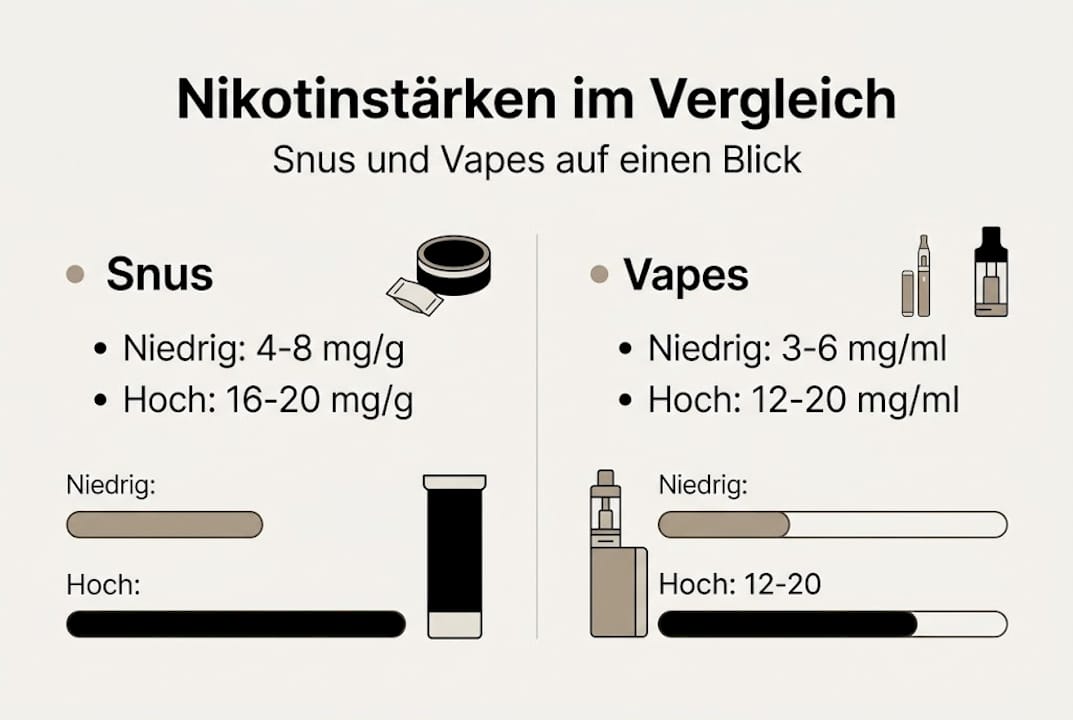
According to ZHAW data from the BAG, especially people under 35 in Switzerland regularly consume snus and nicotine pouches with a nicotine content of around 1%.
The four most important steps for comparison:
- Check the product's unit (mg/ml or mg/g or %)
- Assess your own usage history (smoker, occasional user, newcomer)
- Consider the product type (vape, snus, nicotine pouch)
- Start with the lowest appropriate strength and increase if necessary
An important note for beginners: studies show that 70% of beginners choose moderate levels when using nicotine alternatives. This is no coincidence. Moderate strengths offer a pleasant experience without the risk of unpleasant side effects.
Anyone looking for the most popular products can find a current overview of brands like Velo, Siberia, and Elfbar, including typical strength ranges, in the Top Nicotine Products in Switzerland.
How to Choose the Right Nicotine Strength? A Guide for Beginners and Experienced Users
Finding the right strength is not an exact science. But there are clear criteria that help in making a good decision.
The following steps help with selection:
- Clarify your starting point: Did you smoke before, and if so, how much? Heavy smokers need higher strengths to satisfy cravings.
- Determine the product type: Vape or snus? Absorption paths differ, so you need different values for similar effects.
- Start with moderate values: Beginners with no smoking history are best off starting with 6 mg/ml for vapes or 6 to 9 mg/g for snus.
- Adjust slowly: If the product is not effective enough, increase by one level. If it is too intense, drop back one level.
- Define your goal: Are you trying to quit, looking for an alternative, or just looking for enjoyment? Those wishing to quit can gradually reduce the strength.
70% of beginners using nicotine alternatives consciously choose moderate values and report better experiences than those who immediately start with high strengths.
Pro-tip: Keep a short log of your usage for two weeks. Note the strength, product type, and how you feel afterward. This helps identify patterns and optimize targeted usage.
Anyone wanting to compare between different product categories, for example, IQOS, nicotine pouches, or snus, can find a structured overview in the Comparison: Nicotine Pouches and Snus.
Additional criteria for selection:
- Consider time of day and frequency of use
- Prefer high-quality brands with clear information
- Check product descriptions for the form of nicotine (nicotine salt or free base)
- If unsure, examine high-quality alternatives before reaching for strong products
Perspective: Why the Right Nicotine Strength Is More Than Just a Number
In the world of snus and vape products, there is a lot of talk about flavor. Mint, berry, citrus—these are the topics that trigger debates. Nicotine strength, on the other hand, often remains in the background. That is a mistake.
Our experience shows: those who start with a strength that is too high often quit the experiment quickly. Those who start too low doubt the product's effectiveness. Both lead to frustration, not the desired result.
The truly interesting question is not "How much nicotine is good?" but "How much do I need for my goal?" This requires self-reflection that many people do not perform in everyday life. However, those who consciously address this question have significantly better chances of a sustainable and pleasant consumption experience.
Anyone looking for high-quality snus alternatives in the right strength will find a good starting point for a more conscious selection.
Find Suitable Nicotine Products and Advice Now
With the right knowledge of nicotine strengths, you can choose exactly what suits you. At Snustrend, you will find a wide selection of snus, vapes, and nicotine pouches in various strengths and flavors, from mild entry-level products to strong variants for experienced users.

Whether you want to try a fresh vape like the O’S TOBACCO Vape 750 Bliss or discover a traditional variant with the classic Pöschl Snuff Südfrucht: all products come with clear information on nicotine strength. This allows you to buy informed, without having to guess. Fast shipping and low prices make Snustrend the primary destination for tobacco alternatives in Switzerland.
Frequently Asked Questions
How many mg of nicotine are considered high for vapes in Switzerland?
In Switzerland, nicotine strengths from about 12 mg/ml are considered high. The legal maximum is 20 mg/ml, and this value is considered very strong and is primarily suitable for former heavy smokers.
How to choose the right nicotine strength for snus?
Beginners should start with moderate strengths between 6 and 10 mg/g and adjust based on the effect. 70% of beginners using nicotine alternatives consciously choose medium values for a more pleasant experience.
What unit is used for nicotine strength in snus?
For snus, nicotine strength is indicated in mg/g or as a percentage. According to BAG data, products with about 1% nicotine content are particularly common in Switzerland.
Is a higher nicotine strength automatically better for cravings?
Not necessarily. Excessively high dosages can cause side effects and worsen the experience. According to Addiction Prevention Liechtenstein, nicotine products are indeed less harmful than cigarettes, but they are still addictive, which is why conscious dosing remains important.
Recommendations
- Choosing Nicotine Alternatives: 70% of beginners use moderate values – Snustrend - Snus, Vapes & Snuff
- Vape Brand Overview 2026: 15% more freedom of choice for vapers – Snustrend - Snus, Vapes & Snuff
- Snus vs Vapes – Comparison, Advantages & Buying Guide | Snustrend – Snustrend - Snus, Vapes & Snuff
- Nicotine Pouches: Benefits, Effects and Usage 2026 – Snustrend - Snus, Vapes & Snuff






Share:
Vaping vs. Smoking: Differences, Risks, and Opportunities
Vape Terminology Explained: Overview, Trends, and Practical Knowledge