

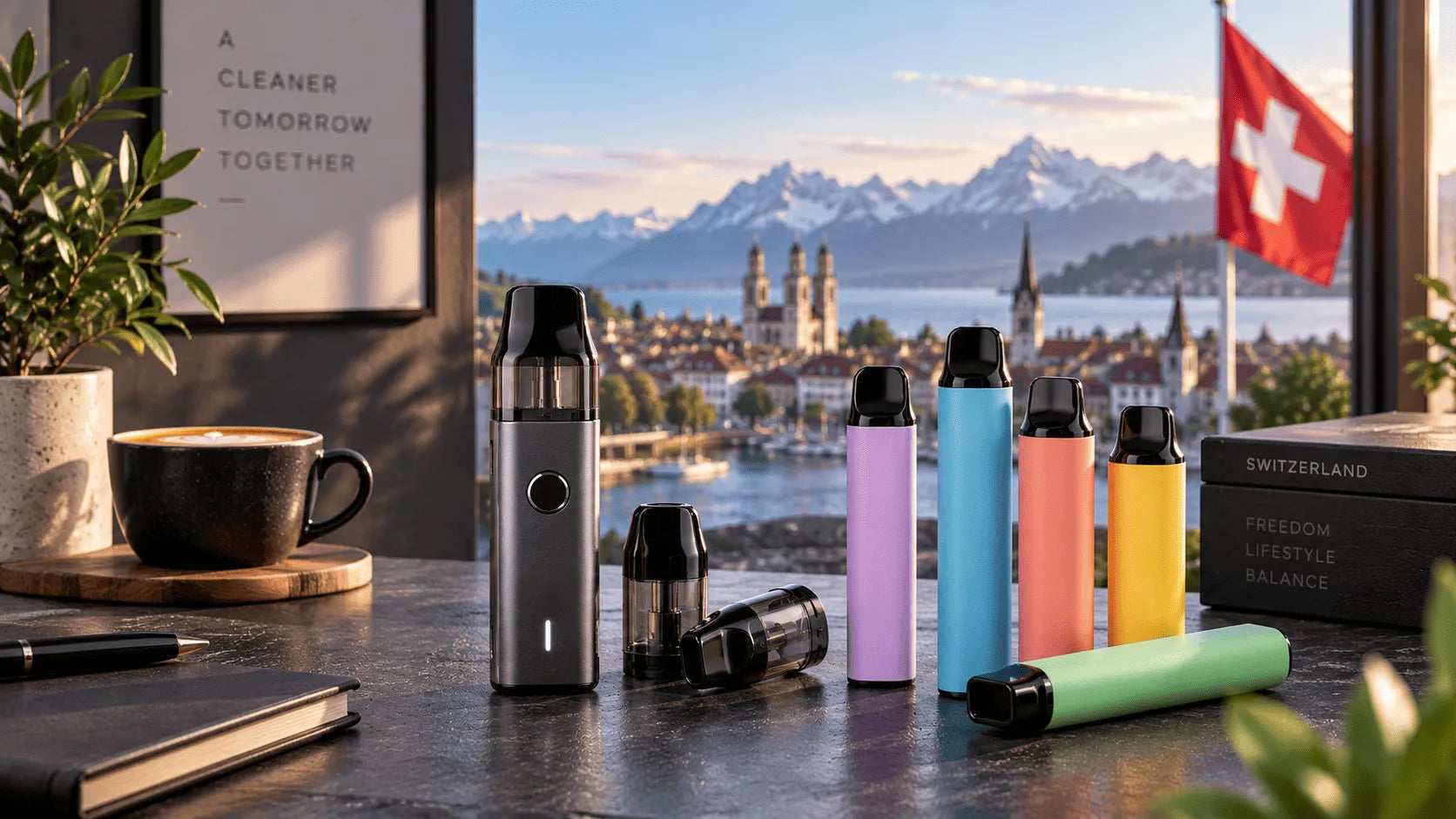
Disposable vape or rechargeable pod system – which is better value in Switzerland, financially, practically and environmentally? In this comparison you will learn how both systems work, roughly what they cost per year, which rules apply and who each system suits.
What is a disposable vape?
A disposable vape is a pre-filled, ready-to-use device. The battery is charged, the tank is filled, and there are no buttons or settings: you draw on the mouthpiece and the automatic draw activation switches the device on. Once the liquid is used up or the battery is flat, the whole device is thrown away. In Switzerland, the tank of a disposable vape may hold no more than 2 ml – enough for around 600 puffs. Well-known brands include Elf Bar and Aroma King.
Advantages
- No barrier to entry: unpack and go, no prior knowledge needed.
- Compact and light: handy on the go or as a backup device.
- Intense flavour: many disposables use sweet flavours and nicotine salt.
Disadvantages
- High running costs: the most expensive way to vape in the long run – partly because of the CHF 1.00 per ml tax.
- Lots of e-waste: every device contains a lithium-ion battery and plastic.
- No flexibility: nicotine strength and airflow usually cannot be adjusted.
- Cantonal bans: disposable vapes are banned in Valais and Geneva.
What is a pod system?
A pod system consists of a rechargeable battery (usually via USB-C) and a replaceable tank, the pod. There are two variants:
- Pre-filled pod systems such as the Elf Bar ELFA Pro: you attach ready-filled pods to the battery. Important: these devices are rechargeable pod systems, not disposable vapes.
- Open pod systems: you fill the tank yourself with your preferred e-liquid and change the pod or coil from time to time.
Advantages
- Lower running costs: liquids are taxed at CHF 0.20 per ml instead of CHF 1.00 per ml like disposables.
- Less waste: the battery is recharged hundreds of times; only pods or coils are replaced.
- Wide choice: many liquids, nicotine strengths and flavours.
- Adjustable: many devices offer a display, power control and airflow control.
Disadvantages
- Some maintenance: the tank needs regular refilling and the coil should be changed every 1–3 weeks depending on use.
- Upfront purchase: the starter kit costs a little more, once, than a single disposable.
Tax: the big difference per millilitre
Since 1 October 2024, Switzerland has levied a tax on e-cigarettes: CHF 1.00 per ml on disposable e-cigarettes (including nicotine-free) and CHF 0.20 per ml on nicotine-containing liquids and refills, each plus 8.1 % VAT. A 2 ml disposable therefore contains CHF 2.00 tax – the same as a 10 ml bottle of nicotine liquid that lasts five times as long. Details in our article Vape tax in Switzerland.
Cost comparison: a one-year calculation
The following example shows the order of magnitude. The assumptions are rounded; your consumption and prices may differ.
| Scenario A: disposable vapes | Scenario B: open pod system | |
|---|---|---|
| Assumed consumption | 1 device per week | 3 × 10 ml liquid and 2 replacement pods/coils per month |
| Prices (assumption) | approx. CHF 10.– per device | liquid CHF 7.50 per 10 ml, pod/coil approx. CHF 4.–, kit approx. CHF 30.– one-off |
| Cost per month | approx. CHF 43.– | approx. CHF 30.50 |
| Cost in year 1 | approx. CHF 520.– | approx. CHF 396.– |
| From year 2 | approx. CHF 520.– | approx. CHF 366.– |
Price verdict: In this example, the pod system including the starter kit becomes cheaper from the third month and then saves around CHF 150.– per year. Pre-filled pods cost a little more than refilling pods yourself, but usually less than disposables.
Environment and disposal in Switzerland
Disposable vapes contain raw materials such as lithium and copper that are lost if disposed of incorrectly. In Switzerland they count as e-waste and must be returned to a retailer or a collection point – not put in household waste. With pod systems the battery stays in use for a long time and only small parts are replaced, which significantly reduces e-waste.
What are the legal rules?
- E-cigarettes (with and without nicotine) may only be sold to people aged 18 and over, including online.
- Disposable vapes are (still) allowed nationally but banned in the cantons of Valais and Geneva. More in our article Disposable vape bans in the cantons.
- Disposables may hold no more than 2 ml and may not be extended with additional tanks (Federal Supreme Court, 14 April 2026). Hybrid or big-puff devices can therefore no longer be sold.
Conclusion: which suits you?
If you only vape occasionally or need a backup device for trips, a disposable vape is practical – provided it is allowed in your canton.
If you vape regularly and want to save money and produce less waste, a pod system is the better choice. You will find suitable liquids at Elf Bar ELFLIQ, for example. For the basics, see our beginner’s guide to vaping in Switzerland. If you do not smoke, do not start vaping.
Note: Nicotine products are for adults aged 18 and over only. Nicotine is addictive.

Share:
Buying an e-cigarette in Switzerland: a beginner’s guide
Nicotine salt e-liquid vs freebase e-liquid: difference and effect