


In short:
- The nicotine content of a vape is determined by multiplying the concentration by the liquid volume. German and European laws limit the concentration to 20 mg/ml and the filling quantity to 10 milliliters. When selecting and calculating, the type of nicotine and the hardware are crucial for the effect.
The nicotine content of a vape product is determined by multiplying the nicotine concentration in mg/ml by the liquid volume in ml. The result indicates the absolute amount of nicotine in the entire product. Two factors play a decisive role here: the type of nicotine (freebase or nicotine salt) and the hardware used. The legal maximum limit in Germany and the EU is 20 mg/ml. Therefore, to determine the vape nicotine content, one needs to know more than just the number on the packaging.
Which legal regulations influence the nicotine content in vape liquids?
The legal framework is clear. The EU Tobacco Products Directive (TPD) and the German Tobacco Products Act stipulate that the nicotine concentration may not exceed 20 mg/ml. This limit applies to all refill liquids, pre-filled pods, and disposable vape products. No manufacturer may legally sell higher concentrations in the EU.
What many vapers do not know: The 20 mg/ml is a legal maximum, not a recommendation. Many users confuse this maximum value with the individual dosage recommendation, which leads to overdosing. Those who smoke little daily generally do not need this concentration.
The TPD also regulates the filling volume of refill containers to a maximum of 10 ml. Disposable vapes and pre-filled pods are also subject to this volume limit. This has a direct impact on the total amount of nicotine per product.
An overview of the most important legal points:
- Maximum nicotine concentration: 20 mg/ml for all liquids and pods
- Maximum filling volume for refill containers: 10 ml
- Labeling requirement: Nicotine content must be stated on the packaging
- Disposable vapes: Subject to the same concentration limits
- Nicotine-free liquids: Not restricted by the TPD nicotine regulation
Those who buy products that exceed these limits are operating outside the legal framework. This also applies to imports from non-EU countries.
How do you calculate the nicotine content of a vape product?
The basic formula is simple: Calculating nicotine content means multiplying the nicotine concentration (mg/ml) by the liquid volume (ml). The result is the total amount of nicotine in milligrams.

A concrete example makes this tangible. A pod with a 2 ml filling volume and 20 mg/ml nicotine concentration contains 40 mg of nicotine in total. A 10 ml bottle with 6 mg/ml provides 60 mg of nicotine in total. The concentration alone says little; the volume is also decisive.
Many packages display the nicotine content in percent instead of mg/ml. The conversion is quite simple: 1% corresponds to 10 mg/ml. Therefore, a liquid with 2% nicotine contains 20 mg/ml. This conversion rule prevents errors in purchasing and consumption.
Step-by-step calculation
- Read nicotine concentration: Stated on the packaging in mg/ml or percent.
- Convert percent: Percentage value × 10 = mg/ml (e.g., 1.8% = 18 mg/ml).
- Read volume: Take the filling quantity in ml from the product description.
- Multiply: Concentration (mg/ml) × volume (ml) = total nicotine (mg).
- Assess result: Compare with your own requirements and device configuration.
Overview of typical product combinations
| Product | Concentration | Volume | Total Nicotine |
|---|---|---|---|
| Disposable Pod (small) | 20 mg/ml | 2 ml | 40 mg |
| Refill bottle | 6 mg/ml | 10 ml | 60 mg |
| Nicotine shot | 20 mg/ml | 10 ml | 200 mg |
| MTL Pod | 18 mg/ml | 1.5 ml | 27 mg |
Pro-tip: Nicotine shots are not vaped pure. They are mixed with nicotine-free liquid to lower the final concentration. A 10 ml shot with 20 mg/ml in 90 ml of base results in a final concentration of 2 mg/ml in the finished 100 ml liquid.
What role do nicotine salt and freebase play in the effect?
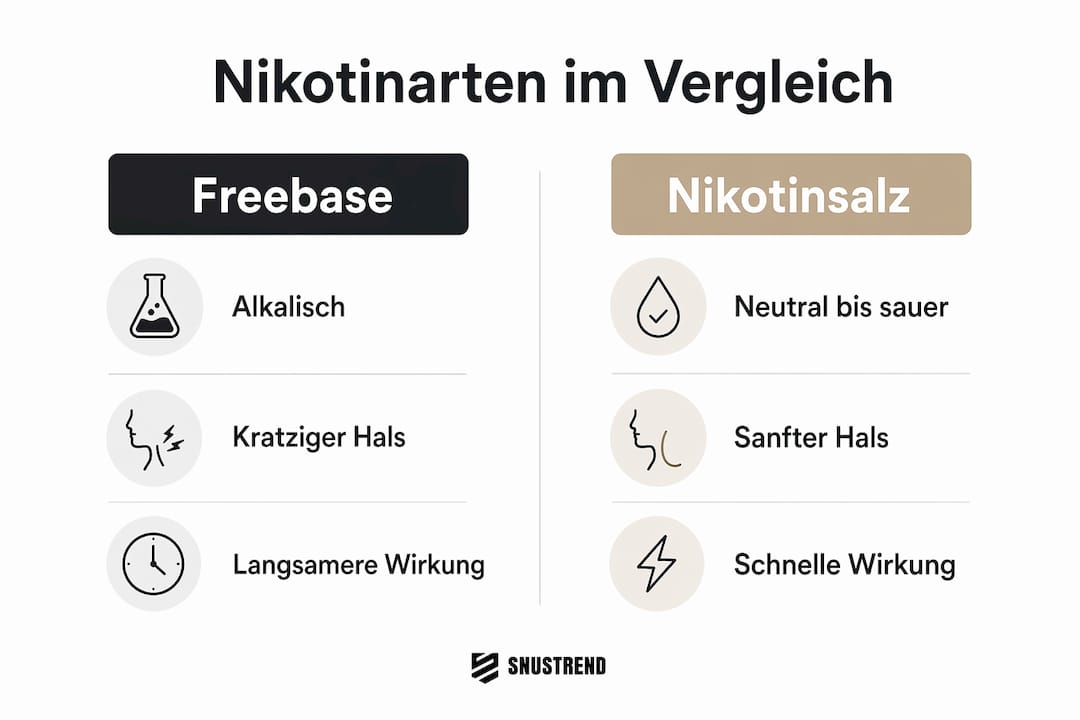
Nicotine appears in vape liquids in two chemically different forms. Freebase nicotine is the classic form, alkaline in pH value and noticeably scratchy in the throat at higher concentrations. Nicotine salt is created by combining freebase nicotine with an organic acid, which lowers the pH value and makes the throat hit significantly smoother.
The decisive difference lies in the absorption speed. Nicotine salts are absorbed by the body faster than freebase nicotine at the same concentration. This makes them particularly attractive for those switching from smoking because the feeling of satisfaction sets in faster.
Comparison: Freebase vs. Nicotine salt
| Feature | Freebase Nicotine | Nicotine Salt |
|---|---|---|
| pH value | Alkaline | Neutral to slightly acidic |
| Throat hit | Strong at high concentration | Smooth even at 20 mg/ml |
| Absorption speed | Slower | Faster |
| Typical concentration | 0–12 mg/ml | 10–20 mg/ml |
| Suitable device | MTL and Sub-Ohm | MTL, tight pods |
For those switching from smoking, industry guidelines recommend nicotine salt liquids with 18–20 mg/ml for heavy consumption (20 or more cigarettes daily). Moderate smokers can manage with 10–18 mg/ml, and light smokers with 6–12 mg/ml. These values serve as a guide, not as a hard rule.
Pro-tip: If you switch from freebase to nicotine salt, you should not increase the concentration at first. Nicotine salt subjectively feels stronger at the same mg/ml specification because it is absorbed faster. Only after a week of getting used to it can the actual requirement be better assessed.
The throat hit depends not only on the concentration but also heavily on the pH value of the nicotine form. This explains why 20 mg/ml of nicotine salt is pleasantly vapeable, while 20 mg/ml of freebase would be hardly tolerable for most vapers. Anyone who wants to understand nicotine types cannot ignore this difference.
How does hardware influence actual nicotine absorption?
Hardware is the most underestimated factor in vaping. Nicotine absorption depends heavily on the device, coil resistance, and power setting. One and the same liquid acts very differently on different devices.
The difference between MTL (Mouth-to-Lung) and DTL (Direct-to-Lung) is fundamental. MTL devices simulate the draw of a cigarette: tight airflow, less vapor per draw, higher nicotine concentrations make sense. DTL devices (also called sub-ohm devices) produce large amounts of vapor with wide airflow.
The most important hardware factors at a glance:
- Coil resistance: Lower resistance (under 1 ohm) vaporizes more liquid per draw, which increases effective nicotine absorption.
- Wattage output: Higher wattage means more vapor and more nicotine delivery per draw.
- Airflow: Restrictive airflow leads to a more concentrated draw with more nicotine absorption.
- Draw frequency: Those who draw more frequently and for longer take in more nicotine than someone taking short puffs.
The average nicotine absorption per draw with a vape is 0.04–0.07 mg. A draw on a normal cigarette delivers 0.10–0.20 mg. Vapes therefore deliver less nicotine per draw, but many vapers draw more frequently.
Sub-ohm devices are suitable exclusively for low nicotine concentrations of 0–6 mg/ml freebase. Those who vape 20 mg/ml nicotine salt in a sub-ohm device risk nausea and dizziness due to overdosing. This is not a sign of poor product quality, but of an incorrect hardware-liquid combination.
Pro-tip: When switching to a new device, reduce the nicotine strength by one level initially. Those who switch from a tight MTL pod to a more open system often notice that the usual concentration suddenly feels too strong.
Practical guide: How to determine your optimal nicotine content
Finding the right nicotine content is not done by guessing. The right combination of nicotine form, concentration, and hardware requires a structured approach.
Step-by-step to your own determination
- Assess smoking habit: How many cigarettes daily? Heavy smokers start with higher concentrations, light ones with lower.
- Determine device: MTL or sub-ohm? This determines the sensible concentration range.
- Choose nicotine type: Those switching usually benefit from nicotine salt because of the smoother throat hit.
- Choose starting concentration: Based on industry recommendations (6–20 mg/ml depending on smoking behavior).
- Observe for a week: Document body reactions before making adjustments.
- Adjust: Reduce concentration if feeling dizzy or nauseous. Increase or adjust draw frequency if craving cigarettes.
“The right nicotine strength is the one where you feel neither withdrawal symptoms nor side effects like dizziness or headaches.”
Body reactions are reliable signals. Nausea, dizziness, and a scratchy feeling in the throat indicate too high a dosage. Observe for at least a week before making an adjustment. Anyone who switches after three days cannot make a reliable statement about their own needs.
Common errors in determining nicotine content primarily concern misunderstandings about nicotine types and incorrect hardware combinations. Another classic mistake: lowering nicotine strength too quickly because one thinks they need less. The body needs time to adjust. Anyone who reduces too quickly often reaches for a cigarette again.
When is professional advice useful? In the case of persistent withdrawal symptoms despite vaping, strong physical reactions to all tested concentrations, or the desire to quit nicotine entirely. A doctor or pharmacist can help develop a structured withdrawal plan. Gradually lowering the nicotine strength is a proven method for this.
Important takeaways
Correctly determining the vape nicotine content requires a combination of accurate calculation, knowledge of the nicotine type, and coordination with the hardware used.
| Topic | Details |
|---|---|
| Basic formula | Nicotine concentration (mg/ml) × volume (ml) = total nicotine in mg |
| Legal limit | 20 mg/ml is the EU-wide maximum for all liquids and pods |
| Nicotine types | Nicotine salt acts smoother and faster than freebase at the same concentration |
| Hardware influence | Sub-ohm devices require low concentrations (0–6 mg/ml), MTL devices can handle more |
| Adjustment process | Vape with one strength for at least one week before making changes |
What I have really learned after years of vaping
I still remember my first month with a vape well. I had bought a sub-ohm device and a 12 mg/ml freebase liquid because I thought that would be appropriate for a former smoker of 15 cigarettes a day. After the second puff, I had a headache and dizziness. I thought vaping wasn't for me.
The mistake wasn't the nicotine, but the combination. Sub-ohm plus 12 mg/ml freebase is an overdose. I know that today. Nobody explained that to me back then, and I wouldn't have looked it up either because I thought the number on the bottle said everything.
What really surprised me: 18 mg/ml nicotine salt in a tight MTL pod felt significantly more pleasant to me than 6 mg/ml freebase in a sub-ohm device. Same nicotine absorption, completely different experience. This shows how little the mg/ml number alone tells you.
My honest advice for beginners: Do not buy a sub-ohm device as your first device if you are coming from smoking. Start with a tight MTL pod, choose nicotine salt, and give yourself a week. Anyone who still craves cigarettes after a week should increase the concentration. Anyone who gets dizzy should lower it. The principle is that simple. You have to be that patient with it.
— Lukas
Nicotine products and guides at Snustrend
Anyone who wants to specifically control their own nicotine content needs products with clear labeling and reliable quality. Snustrend offers a wide selection of vape products, nicotine alternatives, and accessories for beginners and experienced vapers.

For anyone who would like to try other forms of nicotine besides vaping, taking a look at Pöschl Schmalzler Südfrucht in the Snustrend shop is worth it. Anyone who wants to delve deeper into the world of nicotine strengths will find concrete help with device selection in the E-cigarette guide from Snustrend. Fast shipping and clear product information make getting started easier.
FAQ
What does mg/ml mean for vape liquid?
mg/ml indicates how many milligrams of nicotine are contained in one milliliter of liquid. A liquid with 10 mg/ml therefore contains 10 mg of nicotine per ml of liquid.
How much nicotine is in a disposable vape?
That depends on the concentration and filling quantity. A typical disposable vape with 2 ml and 20 mg/ml contains 40 mg of nicotine in total.
What is the difference between nicotine salt and freebase in a vape?
Nicotine salt has a lower pH value, acts smoother in the throat, and is absorbed faster by the body. Freebase nicotine is more alkaline and noticeably scratchy at high concentrations.
Which nicotine strength is right for beginners?
Those switching from 20 or more cigarettes daily best start with nicotine salt liquids between 18 and 20 mg/ml in an MTL device. Light smokers can manage with 6–12 mg/ml.
Why does my vape feel weak despite the high mg/ml rating?
This is usually due to the hardware. Sub-ohm devices with high airflow and high wattage vaporize a lot of liquid per puff, which increases the nicotine delivery per puff despite the lower concentration. With MTL devices with restricted airflow, the nicotine delivery per puff is lower, which is why higher concentrations are necessary.
Recommendation
- Understanding Nicotine Content: Effects and Risks 2026 – Snustrend - Snus, Vapes & Snuff
- Popular Vape Flavors: 50+ Examples for 2026 – Snustrend - Snus, Vapes & Snuff
- List of Common Vaping Styles: Your Guide 2026 – Snustrend - Snus, Vapes & Snuff
- Understanding Nicotine Strength: Effects, Selection & Tips for Snus and Vapes – Snustrend - Snus, Vapes & Snuff






Share:
Wildkraut Energy Sniff: Caffeine Nasal Powder Tested
List of popular vape devices: Swiss buying guide 2026