


In short:
- Switching from tobacco to vaping reduces exposure to harmful substances by up to 95 percent and significantly increases the chances of quitting smoking. For beginners, simple pod systems and high-strength nicotine salt liquids are recommended to avoid relapses. Consistently avoiding "dual use" and approaching the transition with patience are key to successfully quitting smoking.
Switching from tobacco to vaping is defined as completely replacing tobacco cigarettes with electronic vaporizers that deliver nicotine without combustion. Anyone looking to switch from cigarettes to e-cigarettes has solid reasons for doing so: Vaping reduces exposure to harmful substances by up to 95% compared to tobacco smoke. And the success rate for quitting smoking is demonstrably higher. Nevertheless, vaping is not a risk-free product. This guide explains what really counts in the vape vs. tobacco comparison, what equipment you need, and which mistakes lead to a failed transition.
What are the health differences between tobacco smoke and vapor?
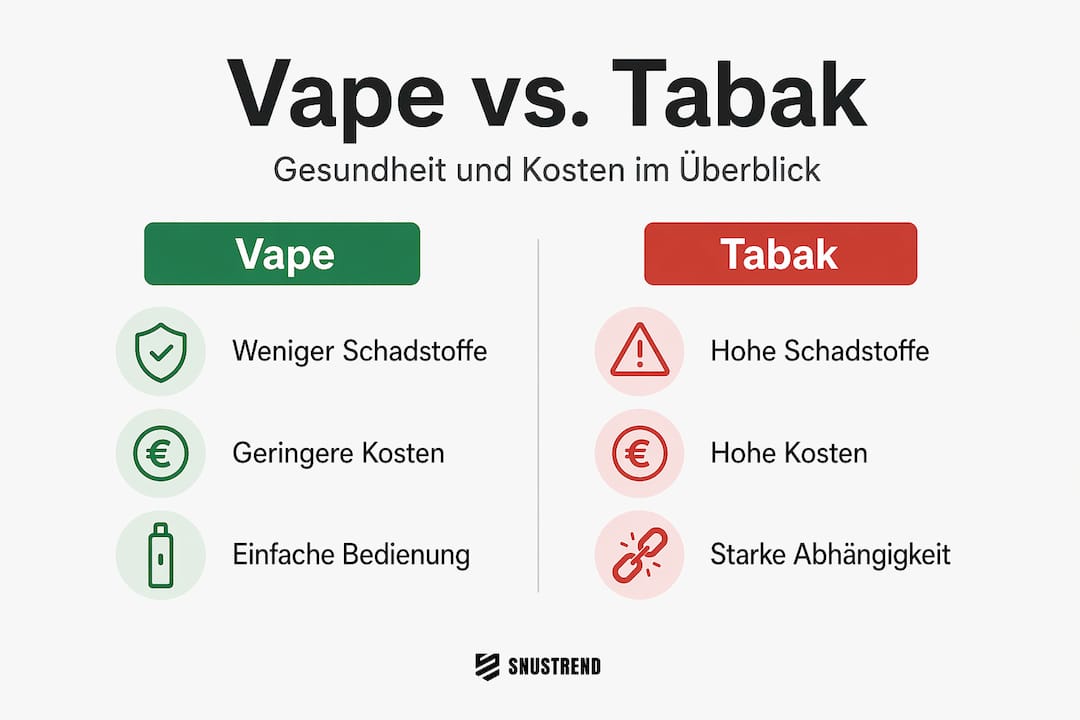
Tobacco smoke is created through combustion at over 800 °C, producing more than 7,000 chemical compounds, including tar, carbon monoxide, and numerous carcinogens. Vapor, on the other hand, is produced at 160–220 °C through pure vaporization. No combustion process means: no tar, no carbon monoxide.
That sounds straightforward. But there are limitations you should be aware of.
- Harmful substances in vapor: Vapor also contains propylene glycol, glycerin, and—depending on the liquid—flavorings that can form byproducts when heated. The amount is significantly lower than in tobacco smoke, but not zero.
- Nicotine remains nicotine: E-cigarettes deliver nicotine just like tobacco cigarettes. The addiction persists. The difference lies in the accompanying harmful substances, not the nicotine itself.
- Long-term data is missing: Scientists expressly warn against prematurely giving the all-clear. Long-term studies on 20 or 30 years of vaping simply do not exist yet. The current assessment is provisional.
- No argument for non-smokers: Anyone who has never smoked should not start vaping. The benefit applies exclusively to active smokers looking to switch.
Conclusion: The vape vs. tobacco comparison clearly favors vaping for active smokers. But "less harmful" is not the same as "harmless."
The data on abstinence is particularly relevant. A study of 886 participants showed that 18% of vapers were smoke-free after one year, compared to 10% for those using patches. That is nearly double the success rate. Nicotine-containing e-cigarettes increase the chance of successfully quitting smoking by 20–40% compared to traditional nicotine replacement products. These figures clarify why 90% of German e-cigarette users are current or former smokers.
What do you need for the switch to vaping?
Anyone looking to switch from cigarettes to e-cigarettes faces a selection of products that may seem overwhelming at first glance. However, the decision is not that complex if you know what is important.
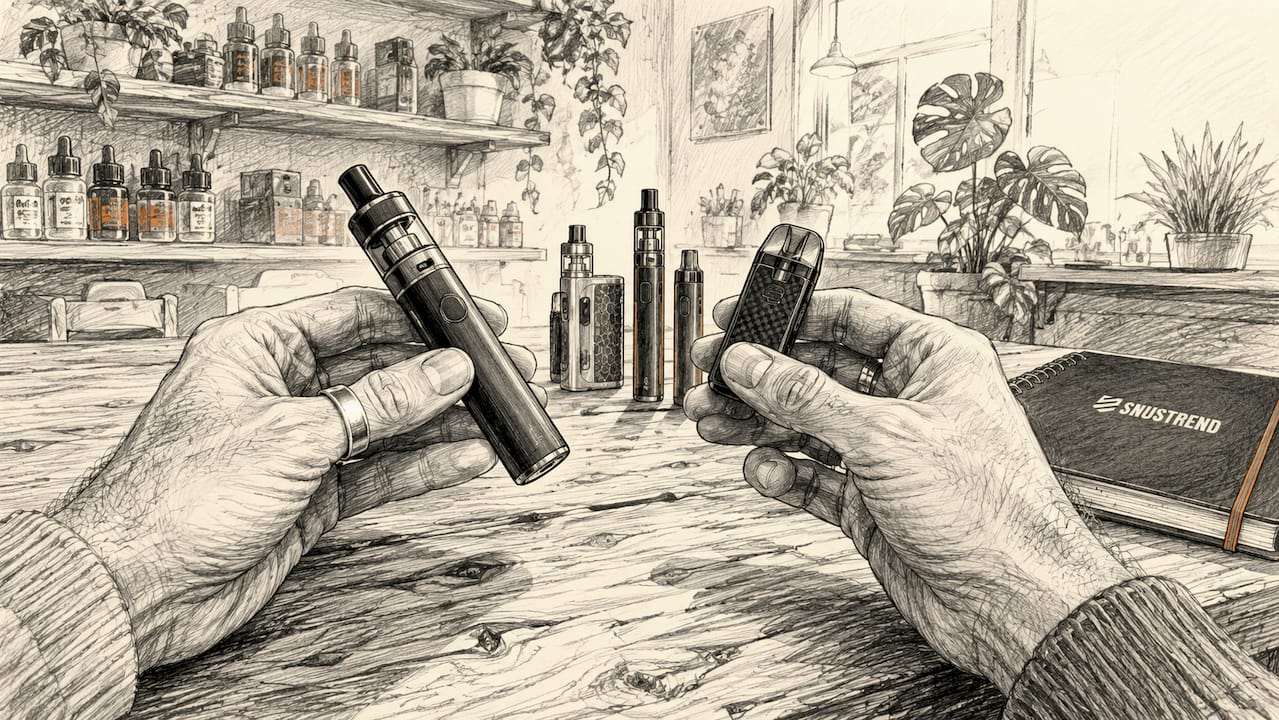
Device types for beginners
| Device type | Description | Suitable for |
|---|---|---|
| Pod system | Compact, simple, often with pre-filled pods | Beginners, heavy smokers |
| Vape pen | Slim device, refillable | Intermediate experience |
| Disposable vape | Pre-filled, no charging required | Occasional users, testing |
MTL pod systems with about 1,000 mAh battery capacity are the best choice for most people switching. They are easy to use, mimic the draw of a cigarette, and cost between 25 and 40 euros to purchase. Complex devices with many settings overwhelm beginners and increase the risk of relapse.
Liquids: Freebase or nicotine salt?
Choosing the liquid is at least as important as choosing the device. Nicotine salt liquids are chemically modified to transport nicotine into the blood faster. This simulates the nicotine kick of a cigarette much better than classic freebase liquids. For heavy smokers, this is the crucial difference between success and relapse.
Freebase liquids are better suited for experienced vapers who prefer lower nicotine strengths and place more value on vapor volume and flavor. For starting out, the rule is: nicotine salt first, freebase later.
Pro tip: Choose a nicotine strength of 12–20 mg/ml nicotine salt when starting if you smoked more than ten cigarettes a day. Doses that are too low are the most common reason for relapsing to tobacco cigarettes.
Costs at a glance
Financially, the situation has changed. Due to tax increases in Germany, the liquid tax is 0.32 euros per milliliter. The former clear cost advantage over tobacco cigarettes has thus shrunk significantly. Nevertheless, vaping remains cheaper for many who switch, especially when factoring the purchase price of 25–40 euros for a good beginner device against monthly cigarette consumption.
How to switch gradually and what to avoid
Switching from tobacco to vaping is not an event, but a process. Understanding this gives you a decisive advantage.
-
Choose the right nicotine strength. Heavy smokers need 12–20 mg/ml nicotine salt to start. Anyone who begins with 6 mg/ml after having smoked a pack a day will not satisfy their cravings, which almost always leads to a relapse.
-
Adjust draw technique. Vaping works differently than smoking. MTL (mouth-to-lung) vaping requires longer, slower draws that first collect the vapor in the mouth and then pull it into the lungs. The short, hard pull of a cigarette doesn't work with a vape. This adjustment takes at least two weeks.
-
Consistently avoid dual use. Those who vape and smoke at the same time neutralize most of the health benefits of the switch. Dual use is the most common trap when transitioning. The goal is complete replacement, not supplementation.
-
Try out flavors. Anyone sticking to tobacco flavor is missing out on one of the biggest advantages of vaping. Fruit, menthol, and dessert flavors can make the switch psychologically easier because they combine the ritual of smoking with a new experience.
-
Plan for patience. Physical and psychological habits take time. Reaching for a cigarette is not just addiction; it is also a habit. Anyone who gives up after three days because it doesn't "feel right" has underestimated the process.
Pro tip: Put away all tobacco cigarettes on the day of the switch. Anyone who keeps a pack in the house will smoke it. No supply means no temptation.
The first two weeks are crucial
The initial phase is the most critical. The craving for a cigarette is strongest in the first 14 days because the body is still conditioned to tobacco smoke. If you have the right nicotine strength and use a reliable device during this phase, you will get through it. Those struggling with too little nicotine or a bad device will fall back into smoking. Therefore, it is worth not cutting corners on devices and liquids. Snustrend explains more about how to choose the right device in its own guide.
What alternatives are there for switching with vapes?
Vaping is not the only option for smokers who want to get away from tobacco. There are other smoke-free products that can serve as a supplement or alternative.
- Nicotine pouches: Small bags that are placed between the gum and lip. They contain nicotine but no tobacco and no smoke. Brands like Velo are widely available in Switzerland. Pouches are well-suited for situations where vaping is not possible, such as in the office or on a plane.
- Snus: Traditional Swedish tobacco product that is used orally. Snus contains tobacco but no combustion product. The cancer risk is lower than with cigarettes, but higher than with nicotine pouches. In the EU, snus cannot be sold legally outside of Sweden, but it is available in Switzerland.
- Nicotine patches and gums: Classic nicotine replacement therapy. Effective, but according to studies, less effective than e-cigarettes for complete smoking cessation.
Comparison of smoke-free alternatives
| Product | Tobacco-free | Smoke-free | Contains nicotine | Suitable as a transition aid |
|---|---|---|---|---|
| E-cigarette | Yes | Yes | Yes | Very good |
| Nicotine pouch | Yes | Yes | Yes | Good |
| Snus | No | Yes | Yes | Conditional |
| Nicotine patch | Yes | Yes | Yes | Moderate |
Nicotine pouches and snus can facilitate the transition when vaping is not feasible in certain situations. They are not a complete substitute for vaping as a transition strategy, but they make sense as a supplement. Anyone who wants to learn more about smoke-free nicotine methods will find a structured overview at Snustrend. For a broader perspective on tobacco alternatives in general, it is also worth taking a look.
Key takeaways
Switching from tobacco to vaping is the most effective method available for active smokers to reduce exposure to harmful substances, but it requires the correct nicotine strength, draw technique, and the consistent avoidance of dual use.
| Topic | Details |
|---|---|
| Harm reduction | Vaping reduces exposure to harmful substances by up to 95% compared to tobacco smoke. |
| Abstinence rate | 18% of vapers were smoke-free after one year, compared to 10% for patch users. |
| Nicotine strength | Heavy smokers should start with 12–20 mg/ml nicotine salt to avoid relapses. |
| Avoid dual use | Smoking and vaping simultaneously neutralizes the health benefits of the switch. |
| Alternatives | Nicotine pouches and snus complement the switch but do not completely replace vaping as a strategy. |
My honest assessment after years of dealing with harm reduction
I have observed many smokers who have tried to switch. And I'll be direct: most fail not because of willpower, but because of false expectations and poor preparation.
The biggest misconception is that vaping should feel exactly like smoking immediately. It doesn't. The draw is different, the flavor is different, the ritual is different. Anyone who doesn't accept that gives up after a week. Those who accept it and continue anyway usually get the hang of it after two weeks.
What really concerns me is the communication surrounding this topic. E-cigarettes are primarily a transition tool, not a lifestyle product. The goal should be complete nicotine freedom, not a permanent move from one addiction to the next. Those who keep that in mind use vaping for what it is: a tool, not a goal.
And one more thing that is rarely said: doctors are often poorly informed in this area. Many advise against e-cigarettes across the board because they are not familiar with the studies or want to play it safe. Nicotine dosage is critical, and a stable transition experience requires targeted guidance. Those who have a doctor who understands this are lucky. Those who don't must inform themselves, and thoroughly.
For non-smokers, the advice is: stay away. No argument justifies starting vaping without a history as a smoker. The benefit applies exclusively to switching away from tobacco smoke.
— Lukas
Snustrend supports your switch with the right selection
Anyone seriously looking to take the step from tobacco to vaping needs reliable products, not experiments with cheap equipment. Snustrend offers a wide selection of vapes, liquids, and smoke-free alternatives like nicotine pouches and snus for the Swiss market.

Whether you are looking for a compact pod system to start with or need nicotine pouches as a supplement for everyday life, Snustrend carries brands like Elfbar and Vozol as well as pouches from Velo in various strengths. Those who want to begin their switch with a smoke-free tobacco product will also find snuff tobacco as an entry-level option in a handy pack size. Fast shipping and clear product information make the first step easier.
FAQ
Is vaping really healthier than smoking?
Vaping is considered significantly less harmful than smoking because no combustion process occurs, eliminating tar and carbon monoxide. However, long-term data is still lacking, which is why vaping is not classified as risk-free.
Which nicotine strength is right for those switching?
Heavy smokers should begin with 12–20 mg/ml nicotine salt liquid. Doses that are too low often lead to relapses because the craving is not sufficiently satisfied.
What is dual use and why is it problematic?
Dual use means vaping and smoking at the same time. This neutralizes most of the health benefits of the transition and should be consistently avoided.
How long does it take to get used to e-cigarettes?
The adjustment period is at least two weeks. During this phase, both the draw technique and the psychological habit of smoking must be changed.
Can nicotine pouches support the switch?
Yes, nicotine pouches are well-suited as a supplement in situations where vaping is not possible. As a standalone strategy, they are less effective than e-cigarettes.
Recommendation
- Vape beginner's guide Switzerland 2026: start safely – Snustrend - Snus, Vapes & Snuff
- Changing Vape Flavors: Step-by-Step Guide – Snustrend - Snus, Vapes & Snuff
- Vape Terminology Made Easy: Overview, Trends and Practical Knowledge – Snustrend - Snus, Vapes & Snuff
- Vaping vs. Smoking: Differences, Risks and Opportunities – Snustrend - Snus, Vapes & Snuff






Share:
Nicotine addiction: how it develops and what lies behind it
Nicotine pouches in the Swiss market: Trends 2026