


TL;DR:
- One in three smokers in Switzerland is considering switching to e-cigarettes.
- Vaping is significantly less harmful than smoking because it does not produce combustion products.
- Long-term risks of vaping are still unclear, but there is a lower health risk compared to smoking.
One in three people in Switzerland who smoke has seriously considered switching to e-cigarettes at some point. But between advertising messages, studies, and half-truths, it is difficult to keep a clear head. Is vaping really safer? Does it help with quitting? And what about snus as a third option? This article clears up the most common misconceptions, explains the biological differences between vaping and smoking, presents current study data, and provides you with concrete guidance if you are looking for an alternative in Switzerland.
Table of Contents
- Mechanisms of Vaping and Smoking: What Happens in the Body?
- Health Risks and Benefits in Comparison
- Vaping, Smoking, and Alternatives: Who Really Benefits?
- Practical Application: Switching, Dosage, and User Experiences in Switzerland
- Categorization: What Experts Rarely Say and What Really Matters
- Vaping, Snus & Snuff: Discovering Swiss Alternatives
- Frequently Asked Questions About Vaping and Smoking
Key Findings
| Point | Details |
|---|---|
| Fewer pollutants in vaping | Vaping generates up to 95% fewer pollutants than smoking. |
| Risk reduction for smokers | Switching from cigarettes to e-cigarettes can reduce health risks. |
| Lack of long-term data | The long-term effects of vaping have not yet been conclusively researched. |
| Nicotine remains addictive | All nicotine-containing products carry a potential for addiction, including alternatives like snus. |
Mechanisms of Vaping and Smoking: What Happens in the Body?
To compare the topic on a sound basis, it is important to understand how both products affect the body. The difference begins with the physics: smoking is based on combustion, while vaping is based on vaporization. This sounds technical, but it has massive consequences for health.
When smoking, tobacco is heated to temperatures between 600 and 900 degrees Celsius. The combustion of organic substances creates over 7,000 chemical compounds, including at least 70 known carcinogens such as benzene, formaldehyde, and polycyclic aromatic hydrocarbons. These substances reach the lungs directly and enter the bloodstream from there. Vaping heats a liquid containing nicotine, propylene glycol, glycerin, and flavorings into vapor, without combustion, in contrast to smoking, which burns tobacco at 600 to 900 degrees Celsius and produces thousands of harmful chemicals.
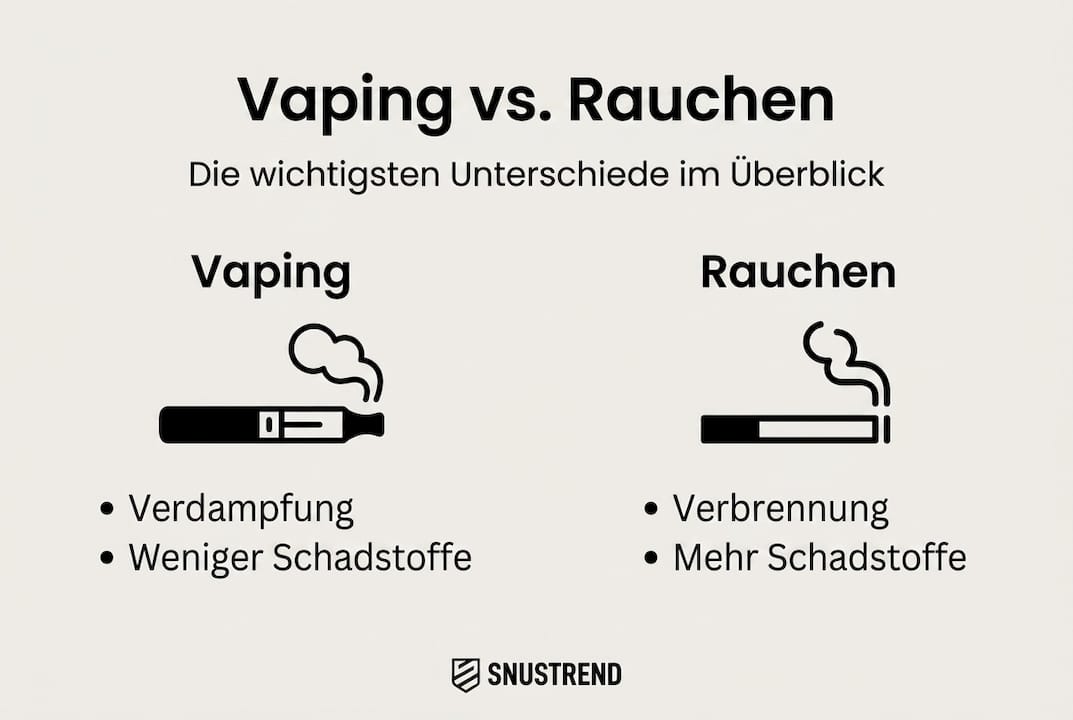
When vaping, the so-called e-liquid is heated to about 150 to 250 degrees Celsius. This does not produce smoke, but rather an aerosol consisting of tiny droplets. The composition of a typical liquid includes propylene glycol, vegetable glycerin, nicotine, and flavorings. No tar, no combustion products. However, this does not mean that the aerosol is harmless. Certain flavorings can turn into irritating gases when heated, and propylene glycol can dry out the airways.
| Feature | Vaping | Smoking |
|---|---|---|
| Process | Vaporization | Combustion |
| Temperature | 150 to 250 degrees Celsius | 600 to 900 degrees Celsius |
| Main ingredients | Liquid, nicotine, flavorings | Tobacco, tar, chemicals |
| Pollutant levels | Significantly lower | Very high |
| Secondhand smoke | Little aerosol | Heavy smoke |
The British health authority Public Health England estimated that vaping produces about 95 percent fewer harmful substances than tobacco smoke. This figure is often cited and is an important reference point, even if it is not a guarantee of safety. Anyone interested in nicotine alternatives should use these differences as a foundation, not as a license to act recklessly.
Another important point: nicotine itself is present in both products and creates the addiction. However, the danger in smoking lies less in the nicotine and more in the combustion products. This is an important distinction that many smokers are unaware of.
Health Risks and Benefits in Comparison
Now that the mechanism is clear, the question arises of how risky or safe these products really are. Differentiation is needed here, as sweeping statements help no one.
For smoking, the data is unambiguous: it causes lung cancer, COPD (chronic obstructive pulmonary disease), heart disease, and strokes. The World Health Organization classifies tobacco smoke as one of the leading preventable causes of death worldwide. For vaping, the situation is more complex. Long-term studies are simply lacking because e-cigarettes have not been on the market long enough.
However, current research data show: COPD risk increases by 30%, and the risk of asthma has an odds ratio of 1.2 to 1.36 due to fine particles and flavorings in vaping. This is real, but significantly lower compared to the risks of smoking. At the same time, studies confirm that vaping produces up to 95% fewer pollutants than tobacco smoke.
Typical risks and side effects at a glance:
- Smoking: Lung cancer, COPD, heart attack, stroke, tooth damage, accelerated skin aging
- Vaping: Irritation of the airways, dry mouth, possible pneumonia from low-quality liquids, nicotine addiction
- Both: Nicotine addiction, high blood pressure, sleep disturbances with high consumption
“Harm reduction through vaping is real and scientifically provable, but it does not replace the complete cessation of nicotine consumption. The greatest health gain occurs when smokers quit completely, rather than using both products in parallel.”
Particularly important is the distinction between cancer risk and general lung risk. With smoking, the risk of cancer is massively increased by tar and carcinogens. With vaping, tar is absent, but inflammatory reactions in the airways are possible. Anyone who wants to understand more about the effects and risks of nicotine will find a detailed breakdown there.
Pro tip: Anyone who both smokes and vapes—so-called dual use—is taking the worst of both worlds. Studies show that dual users do not experience significant risk reduction. The complete switch to vaping provides the greatest benefit, not parallel usage.
A look at the top nicotine products in Switzerland shows which products are currently in particularly high demand and how the Swiss market is developing.
Vaping, Smoking, and Alternatives: Who Really Benefits?
With an understanding of the risks, the question arises as to who actually benefits from switching to alternatives. The answer depends heavily on the starting situation.
The greatest beneficiaries are heavy smokers who have consumed cigarettes daily for years and have not yet managed to successfully quit. For this group, vaping can function as a bridge. Vaping increases abstinence rates among smokers with an adjusted risk ratio of 1.57 to 2.96, especially among vulnerable groups such as people with mental illness or low income.
Who benefits most, who benefits least?
- Heavy smokers (more than 15 cigarettes daily): Greatest benefit from switching to vaping as a smoking cessation aid
- Occasional smokers: Moderate benefit, but a risk that vaping prolongs consumption instead of ending it
- Dual users (smoking and vaping simultaneously): Hardly any risk reduction; a complete switch is necessary
- Nicotine addicts without smoking habits: No benefit; vaping would establish a new dependency
- Non-consumers and young people: Clearly advised against; no health benefit, only risks
Snus is another option often mentioned in the same breath. It is an oral tobacco placed under the lip. Snus is considered smokeless and offers no clear advantages over cigarettes, but carries its own risks such as oral lesions, gum problems, and strong nicotine addiction. A direct comparison of snus and vapes clearly shows the differences between both products.
Anyone considering snus as an alternative nonetheless should know that it is legal in Switzerland, but largely banned in the EU. It is worth reading more about how snus can be used as an alternative to smoking and what the limitations are.
Pro tip: If you switch to vaping, you should establish a step-by-step plan for nicotine reduction from the beginning. Start with a strength that reflects your previous consumption and reduce it every four to six weeks. The goal is to be nicotine-free, not just to use a different product.
Practical Application: Switching, Dosage, and User Experiences in Switzerland
Anyone who wants to try an alternative after comparing them will wonder how the change works in practice. And this is where many fail, not because the products are bad, but because the entry is unstructured.
In Switzerland, according to current data, 21.5% of adults use nicotine, mostly in the form of cigarettes. Vapes are rarely used as a targeted cessation aid to date, even though the potential is there. Many who switch pick up vapes without a clear strategy and end up in dual use, i.e., the parallel consumption of both products.
The first step is choosing the right nicotine strength. A rule of thumb: anyone who smokes a pack of cigarettes a day starts with a liquid containing 12 to 18 mg of nicotine per milliliter. Those who smoke less choose 6 to 9 mg. Choosing too low a strength leads to withdrawal symptoms and a relapse to the cigarette.
The nicotine replacement trends in Switzerland show that users are increasingly opting for products with clear dosage information. This is a good sign, as control over one's own consumption is the first step toward reduction.
Avoid typical mistakes when switching:
- Choosing a nicotine strength that is too low, leading to smoking more cigarettes than before
- Vaping and smoking simultaneously without a clear goal for quitting
- Buying cheap devices with inferior liquids that can release pollutants
- Starting the switch without a schedule, thereby endlessly delaying the process
- Choosing flavorings that are too reminiscent of sweets, unconsciously increasing consumption
Legally, in Switzerland, it should be noted: e-cigarettes and liquids have been regulated since 2023. Nicotine-containing liquids may only be sold to persons over 18 years of age. Disposable vapes are increasingly under pressure; learn more about the regulation of disposable vapes in Switzerland. Anyone wanting to buy current nicotine products in Switzerland should rely on reputable dealers who take age verification and product transparency seriously.
Categorization: What Experts Rarely Say and What Really Matters
After the objective comparison, an honest look from an expert perspective is worthwhile. And it turns out to be more uncomfortable than many expect.
The debate about vaping is politically charged. In Great Britain and among harm reduction organizations, vaping is considered the clearly better option compared to smoking. In Switzerland, the official stance is more cautious: vaping is not harmless, long-term data is missing, and the risk for young people is real. Prevention.ch emphasizes that quitting smoking completely remains the best recommendation, while harm reduction approaches can make sense for already addicted adults.
What experts rarely say openly: harm reduction is not an automatic process. Anyone who switches from cigarettes to vaping without ever reducing the nicotine strength has merely changed the delivery system, not ended the addiction. The real gain only occurs when the switch is understood as a step toward more control and, ultimately, freedom from nicotine.
The risk of relapse during dual use is systematically underestimated. Many users believe they are reducing their consumption, while in reality they are consuming more nicotine than before. Anyone using snus alternatives in 2026 or other products as a supplement should do so with a clear plan, not as a permanent solution.
Vaping, Snus & Snuff: Discovering Swiss Alternatives
Those ready for alternatives can discover them in specialized Swiss retailers. At Snustrend, you will find a carefully curated selection of tested vapes, snus products, and snuff for adults in Switzerland.

Whether you want to start with a classic vape like the O’S Tobacco Vape 750 Bliss or experiment with a traditional "Südfrucht" snuff: the product descriptions are clear, the nicotine information is transparent, and shipping is fast. Snustrend is aimed at adults who want to decide on an informed basis, not at beginners without prior knowledge. Explore the assortment and find the solution that fits your plan to quit.
Frequently Asked Questions About Vaping and Smoking
Is vaping less harmful than smoking?
Vaping is considered significantly less harmful, as up to 95% fewer pollutants are created compared to smoking tobacco. However, long-term data is still missing, which is why vaping should not be classified as harmless.
Can vaping help with quitting smoking in Switzerland?
Vaping increases abstinence rates among smokers with an ARR of 1.57 to 2.96, especially in combined cessation programs. It is not a miracle cure, but effective support for motivated smokers.
What risks does vaping have for the lungs?
COPD risk increases by 30% and the risk of asthma has an odds ratio of 1.2 to 1.36 due to fine particles and flavorings. The long-term consequences are not yet fully known.
Is snus a healthy alternative to smoking?
Snus is smokeless, but it carries its own risks, such as oral lesions and strong addiction. Snus is considered smokeless, but it offers no clear advantages over cigarettes and is not generally recommended.
Recommendation
- Vape safety 2026: Understanding the risks and vaping safely – Snustrend - Snus, Vapes & Snuff
- Snus vs. vapes – comparison, benefits & buying guide | Snustrend – Snustrend - Snus, Vapes & Snuff
- What is vaping: an understandable guide for beginners – Snustrend - Snus, Vapes & Snuff
- Smart vaping at SNUSTREND: Apps, tracking & AI – Snustrend - Snus, Vapes & Snuff
- Is Being a Social Smoker Safer for You? | Garden State Medical Group | Garden State Medical Group






Share:
The Best Elfbar Alternatives: Comparison for Vapers & Snus Users
Understanding Nicotine Strength: Effects, Selection & Tips for Snus and Vapes