


TL;DR:
- Nicotine pouches are tobacco-free but still contain nicotine-based substances.
- The potential for addiction and risks to cardiovascular and oral health remain.
- They are legally available in Switzerland; the age limit is 18 years.
Nicotine pouches have become a true trend product in Switzerland. More and more adults are turning to these small, discreet pouches as an alternative to cigarettes or traditional snus. However, a widespread misconception persists: anyone who thinks "tobacco-free" automatically means "risk-free" is mistaken. According to medical experts, the risks are primarily related to nicotine and the cardiovascular system, not just combustion products. This article explains what nicotine pouches really are, how to use them correctly, what risks exist, and what the legal situation is in Switzerland.
Table of Contents
- Fundamentals: What are nicotine pouches and how do they work?
- Application and duration: How do you use nicotine pouches correctly?
- Risks and side effects: What should users know?
- Regulation and availability: What is the situation in Switzerland?
- Editorial perspective: Why the trend towards tobacco-free nicotine pouches is not automatically safe
- Nicotine pouches and alternatives in the Swiss online market
- Frequently asked questions about nicotine pouches
Key takeaways
| Point | Details |
|---|---|
| Tobacco-free does not mean risk-free | Nicotine pouches contain no tobacco but still carry health risks. |
| Individual use | Use and duration of effects vary depending on the product and personal experience. |
| Cardiovascular risk remains | Even tobacco-free nicotine products can strain the cardiovascular system. |
| Observe the legal situation | Specific regulations apply in Switzerland for the purchase and possession of nicotine pouches. |
| Informed choices are advantageous | The decision to use nicotine pouches should be based on informed, careful criteria. |
Fundamentals: What are nicotine pouches and how do they work?
Nicotine pouches are small, white portion pouches that contain nicotine but no tobacco. They are placed between the gum and the upper lip and release nicotine slowly into the body through the oral mucosa. This works entirely without smoking, vaping, or chewing. It is precisely these characteristics that make them so attractive to many adults: they are odorless, leave no smoke, and can be used discreetly in many everyday situations.
What is inside? A classic nicotine pouch consists of the following components:
- Nicotine (synthetically derived or extracted from tobacco plants, but without tobacco leaves)
- Cellulose fibers as filler material
- Flavorings such as menthol, citrus, berry, or mint
- Humectants for a pleasant consistency
- pH regulators to optimize nicotine absorption
The decisive difference from classic snus: Traditional snus actually contains tobacco leaves and tobacco plant parts. Nicotine pouches, on the other hand, are completely tobacco-free. At first glance, this sounds less harmful. But the active ingredient is identical: nicotine.
How exactly does absorption work? As soon as the pouch is placed under the lip, the moisture in the mouth begins to release the nicotine from the pouch. This is absorbed directly into the bloodstream through the oral mucosa. The process starts faster than with nicotine patches but is slightly slower than with smoking. Many users describe a slight tingling sensation in the mouth area, especially with higher nicotine strengths.
Even without tobacco, nicotine is an addictive substance and can have health implications, even if the product contains no tobacco.
Anyone wanting to learn more about the exact mode of action of nicotine pouches will find an in-depth overview there. And for those wondering what different nicotine levels really mean, a closer look at the differences in strength is worth it.
Nicotine pouches are marketed in very different nicotine strengths. Common specifications are in milligrams per pouch, for example, 4 mg, 8 mg, 12 mg, or even 20 mg and more. For beginners, a low strength is recommended to get to know the tingling and the effect without starting immediately with strong products. Well-known brands in Switzerland include Velo, Lyft, ZYN, and On!. The product range is constantly growing, both in terms of flavors and strength levels.
Another relevant aspect is the moisture level of the pouches. There are both dry and slightly moist variants. Dry pouches spread more slowly in the mouth but release nicotine more evenly. Moist pouches, on the other hand, act faster but can be harsher on the gums. These differences are relevant for personal product selection.
Application and duration: How do you use nicotine pouches correctly?
The application is very simple. Nevertheless, many beginners make typical mistakes that make the experience unnecessarily unpleasant. Here is a clear, step-by-step guide:
- Remove a pouch from the can and hold it between your thumb and index finger.
- Slide the pouch under your upper lip, as centrally as possible or slightly to the side above your front teeth.
- Leave the pouch alone, do not chew or move it. This unpleasantly intensifies the tingling and accelerates the release uncontrollably.
- Enjoy the effect and leave the pouch in place for the recommended duration.
- Remove the pouch and dispose of it in the trash. Many cans have a practical compartment in the lid for this.
How long should a nicotine pouch stay in the mouth? That depends heavily on the product. Depending on the source and product, the specifications vary significantly. The following table provides a realistic overview:
| Brand | Typical duration | Nicotine strength (example) | Intensity |
|---|---|---|---|
| Velo | 15 to 30 minutes | 4 mg to 10 mg | Medium |
| ZYN | 20 to 40 minutes | 3 mg to 9 mg | Light to Medium |
| Lyft | 10 to 30 minutes | 4 mg to 16 mg | Medium to Strong |
| On! | 10 to 20 minutes | 2 mg to 8 mg | Light |
| Siberia | 20 to 45 minutes | up to 43 mg | Very Strong |
You can tell the effect is wearing off when the tingling subsides and the pouch becomes softer and loses its flavor. Many users quickly develop a feel for this. Anyone unsure which strength suits them will find helpful guidance in nicotine strength tips for beginners.
Common application mistakes:
- Moving or chewing the pouch too much, which leads to excessive nicotine release
- Choosing strengths that are too high for a start, which can trigger nausea or dizziness
- Leaving the pouch in the mouth for too long, thereby irritating the gums
- Using multiple pouches at once, which can lead to overdose symptoms
Pro tip: Anyone trying a nicotine pouch for the first time should start with a maximum strength of 4 mg and leave the pouch in for no longer than 15 minutes. This allows you to safely assess your personal tolerance without risking unpleasant side effects.
Another practical tip: Do not use nicotine pouches immediately after eating. The oral mucosa is more sensitive then, and the taste of the meal can distort the perception. You should also wait a moment after brushing your teeth, as fluoride can slightly influence absorption.
Risks and side effects: What should users know?
Nicotine pouches are not candy. Anyone who uses them regularly should know and take the health risks seriously. The European Society of Cardiology makes it unequivocally clear: nicotine without tobacco is neither non-toxic nor harmless to the cardiovascular system.
Core risks when using nicotine pouches:
- Addiction potential: Nicotine is addictive, regardless of the product format. Anyone who uses nicotine pouches regularly can develop physical and psychological dependence.
- Cardiovascular effects: Nicotine temporarily increases blood pressure and heart rate and places long-term stress on the vascular system.
- Oral mucosa irritation: Frequent use can lead to gum irritation, dry mouth, or redness.
- Nausea and dizziness: A frequent problem, especially with too high a dose or for beginners.
- Swallowing difficulties: If too much nicotine liquid is swallowed unintentionally.
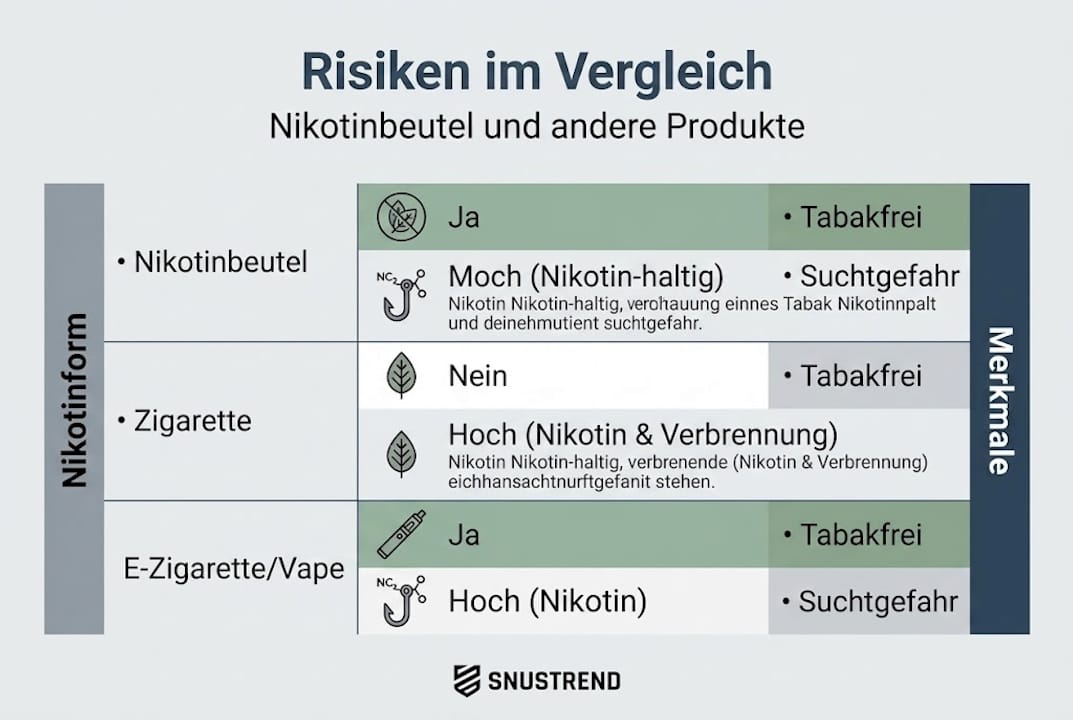
How do nicotine pouches compare to other products?
| Product type | Tobacco included | Combustion products | Addiction potential | Cancer risk |
|---|---|---|---|---|
| Cigarette | Yes | Yes | Very high | Very high |
| Snus (traditional) | Yes | No | High | Medium |
| Nicotine pouches | No | No | High | Not yet fully researched |
| Nicotine patch | No | No | Medium | Very low |
| Nicotine gum | No | No | Medium | Very low |
This table makes one thing clear: although nicotine pouches are less harmful than cigarettes, they are by no means harmless. The addiction potential remains high, and the long-term effects on the oral mucosa and blood vessels have not yet been conclusively researched.
Key metric: The European Society of Cardiology emphasizes that no nicotine-containing product can be classified as safe for the cardiovascular system. People with pre-existing conditions such as high blood pressure or heart rhythm disorders, in particular, should be especially careful.
Anyone wanting to delve deeper into the effects and risks of different nicotine strengths will find a comprehensive breakdown there. The relationship between dose and risk is crucial for informed use.
Finally, an important note: nicotine pouches are definitely not suitable for young people, pregnant women, or nursing mothers. If you have existing heart disease or are taking medication, you should consult a doctor beforehand.
Regulation and availability: What is the situation in Switzerland?
The legal situation surrounding nicotine pouches is inconsistent in Europe. In Germany, the sale and trade of tobacco-free nicotine pouches are not permitted, while Switzerland has its own regulations. This is important information for consumers in Switzerland.
What applies specifically in Switzerland?
- Nicotine pouches are generally available in Switzerland and can be purchased legally
- There is an age limit: nicotine products may only be sold to adults 18 and older
- The products are subject to Swiss food and commodity law
- Advertising for nicotine products is strictly restricted
- Import restrictions may apply, especially for personal imports from EU countries
Compared to Germany, where the legal situation effectively prevents sales, consumers in Switzerland have significantly more choices. Anyone wishing to stay informed about current nicotine replacement trends in Switzerland will find a good overview of market development there.
Pro tip: When buying nicotine pouches in Switzerland, always look for reputable retailers. Products from dubious sources may contain incorrectly declared nicotine strengths or unknown ingredients. Reputable online shops provide complete product information, nutritional values, and the correct nicotine content.
What to look for when buying?
- Complete product labeling with nicotine content in mg per pouch
- Listing of ingredients on the packaging
- Age verification during purchase (a sign of a reputable retailer)
- Preference for well-known brands that are approved in several countries
- Reading reviews from other buyers
Anyone who wants to see the best nicotine products in Switzerland 2026 compared will find current recommendations there. Availability in the Swiss online market is often significantly better than in brick-and-mortar stores, both in terms of variety and pricing.
Editorial perspective: Why the trend towards tobacco-free nicotine pouches is not automatically safe
We are currently witnessing an interesting development in Switzerland: nicotine pouches are often marketed as a clean, modern, and safe alternative. This is problematic—not because the products are inherently worse than cigarettes, but because "tobacco-free" is equated with "harmless" in the minds of many consumers. That is simply not true.
The cardiovascular risk from nicotine remains regardless of the product format. Younger adults who have never smoked, in particular, are starting with nicotine pouches and underestimating the addiction potential. Anyone without nicotine tolerance can slide into dependency with even low strengths without noticing it at first.
Our recommendation: Anyone who uses or wants to test nicotine pouches should make a conscious decision and stay informed. Finding a true alternative to nicotine-containing products is ultimately healthier. For those who want to avoid tobacco, tips on high-quality tobacco alternatives offer a good starting point for a conscious choice.
Nicotine pouches and alternatives in the Swiss online market
At Snustrend, you will find a wide range of nicotine products and alternatives specifically tailored to the Swiss market. Whether you are looking for nicotine pouches from well-known brands or prefer classic snuff alternatives: the selection is large, the prices are fair, and shipping is fast.

For those who would like to explore classic snuff products in addition to nicotine pouches, it is worth taking a look at Pöschl's Südfrucht snuff or the popular Gletscherprise snuff variety. All products are offered with complete product labeling and age verification so that you can shop safely and in an informed manner.
Frequently asked questions about nicotine pouches
Are nicotine pouches really tobacco-free?
Yes, nicotine pouches generally do not contain any tobacco, but rather pure nicotine. Nevertheless, the health risk remains, as nicotine represents a significant strain on the cardiovascular system even without tobacco.
What are the risks associated with consuming nicotine pouches?
Nicotine is toxic and can be addictive. Tobacco-free products also pose a proven risk to the cardiovascular system and should not be classified as harmless.
How long does a nicotine pouch last?
Depending on the product, the effect usually lasts for 10 to 60 minutes. The tingling sensation and the nicotine effect subside as soon as the pouch is used up and the release has stopped.
Is it legal to possess and purchase nicotine pouches in Switzerland?
Nicotine pouches are available and legal in Switzerland. Unlike in Germany, where the sale is not permitted, Switzerland has its own regulations with age limits, which is why reputable retailers should be preferred.
Recommendation
- Nicotine Pouches: Benefits, Effects, and Use 2026 – Snustrend - Snus, Vapes & Snuff
- Understanding Nicotine Content: Effects and Risks 2026 – Snustrend - Snus, Vapes & Snuff
- Understanding Hybrid Nicotine: Gentle enjoyment with a strong effect – Snustrend - Snus, Vapes & Snuff
- Understanding Nicotine Strength: Effects, Selection & Tips for Snus and Vapes – Snustrend - Snus, Vapes & Snuff






Share:
Buy snus in Switzerland: Safe, affordable & legal
Snuff explained: varieties, usage, and money-saving tips for Switzerland