


TL;DR:
- Snuff is a traditional, smoke-free form of tobacco that is growing in popularity in Switzerland.
- The product range includes diverse flavors and premium brands, often available at lower prices online.
- Risks such as dependency and mucous membrane irritation exist; careful use is important.
Snuff is back, and more prominently than many would have expected. What grandfathers knew on farms is experiencing a true renaissance in Switzerland, driven by new aromas, discreet consumption, and a growing interest in smoke-free products. Anyone looking for snuff tobacco today will find a surprisingly wide assortment: from fruity-menthol fresh to spicy-intense, from classic tins for a few francs to premium editions from renowned brands. Whether you are a beginner wondering how snuff even works, or an experienced consumer looking for the best varieties and prices, this article provides clarity.
Table of Contents
- What Snuff Actually Is: Definition and Tradition
- Production, Ingredients, and Well-Known Brands
- Consumption and Trends: Who and How Through the Nose?
- Prices, Buying Online, and Saving Tips for Swiss Consumers
- Tobacco-Free Alternatives, Risks, and Myths in Comparison
- Personal View: Snuff as a Lifestyle, But Not Without Limits
- Discover and Enjoy Snuff in Many Ways: Try It Now
- Frequently Asked Questions About Snuff
Key Findings
| Point | Details |
|---|---|
| Snuff is smoke-free | Snuff offers tobacco enjoyment without combustion and is consumed primarily through the nose. |
| Variety of flavors | Numerous varieties are available on the market, ranging from menthol to fruit to herbal. |
| Prices and saving tips | Snuff is available starting at CHF 4.50; additional savings can be made online with bulk discounts. |
| Tobacco-free options exist | Alternatives like Snuffy White allow for enjoyment completely without tobacco. |
| Conscious consumption is crucial | Risks such as nasal mucosa irritation and nicotine addiction must be considered, especially among young people. |
What Snuff Actually Is: Definition and Tradition
To understand the diversity and unique features of snuff, a basic definition is crucial. Snuff is not a new phenomenon. In fact, it is one of the oldest forms of tobacco consumption, with a history dating back centuries.
Snuff tobacco is a finely ground tobacco powder that is consumed nasally and therefore functions fundamentally differently than smoked tobacco or snus. The term “Schnupf” is colloquial for snuff tobacco, known in English-speaking countries as “snuff.” It is absorbed directly through the nasal mucosa, which allows nicotine to enter the bloodstream quickly and produces a rapid effect.
Historically, snuff was particularly widespread among European noble circles in the 17th and 18th centuries. Gold snuff boxes were considered a status symbol. Later, consumption moved into rural social classes and was long considered old-fashioned. Today, snuff products are experiencing a modern reinterpretation: contemporary aromas, practical packaging, and a new generation of consumers who consciously want to avoid smoke.
“Reaching for the snuff box is a gesture that connects generations, whether in the hayloft of the past or at the desk of today.”
The application sounds simple but requires some practice. Sniffing slowly avoids irritation, and the consistency of the tobacco varies greatly from dusty-dry to slightly sticky, depending on the product and brand. Anyone who starts with a small amount and inhales gently will avoid the most common beginner mistakes, such as sneezing or mucous membrane irritation.
For anyone wanting to dive even deeper into the world of smoke-free tobacco products: a direct comparison is worth it, for example regarding the effect of snus in comparison, which delivers nicotine in a similar way without combustion but is taken orally.
Production, Ingredients, and Well-Known Brands
With this understanding of snuff, it is worth looking at the production and variety of types. What exactly is in a snuff box, and how are the different aromas created?
The production of snuff tobacco follows a multi-stage process: Raw tobaccos of the Virginia, Burley, and Orient varieties are ground, mixed into semi-finished products, and then subjected to cold fermentation. This is followed by final blending with aromas such as menthol or fruit additives before the finished product is packaged. This process explains why high-quality products offer a consistent, aromatic experience, while cheap imitations often taste flat and monotonous.
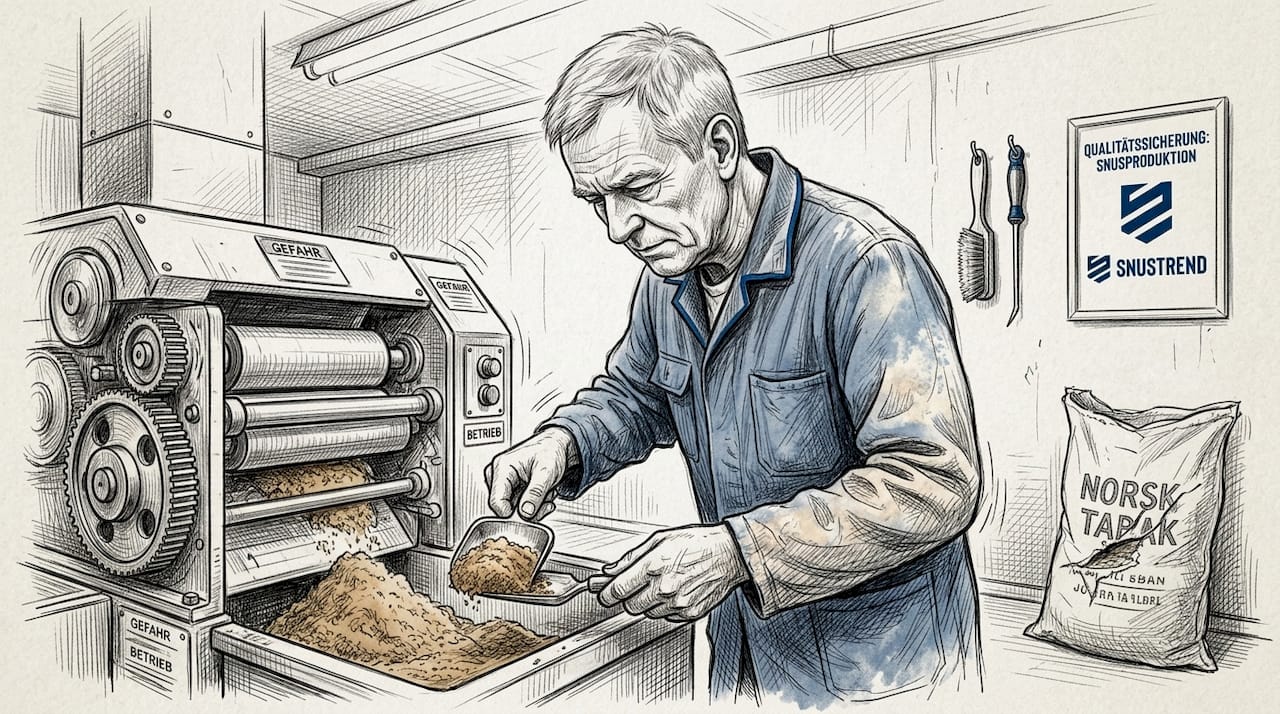
Fermentation is a decisive step. It influences the nicotine content, the pH value, and thus the rate of absorption through the mucous membrane. A lower pH value, as is the case with many dry English varieties, leads to a slower release of nicotine. Moist, alkaline varieties like certain Scandinavian types deliver nicotine more quickly.
The variety of flavors in snuff tobacco is impressive: menthol and eucalyptus dominate as the freshest options, while fruit varieties like apricot, raspberry, cherry, and orange provide sweeter profiles. Spicy notes with anise or wintergreen appeal more to experienced consumers. Brands like Gawith, JBR, and Pöschl have established themselves as market leaders.
| Brand | Variety | Flavor | Consistency |
|---|---|---|---|
| Gawith | Apricot Original | fruity, sweet | fine, dry |
| JBR | Blue | menthol, fresh | medium-fine |
| JBR | Red | spicy, intense | medium-fine |
| Pöschl | Ozona | menthol, cooling | fine to slightly moist |
| Gawith | Santo Domingo | earthy, tobacco-like | coarse |
Pro-tip: When trying a new variety, you should always start with a small amount, such as a pinch on the back of the hand, and only inhale once the consistency and smell are to your liking. This saves disappointment and protects the mucous membrane.
For those who want to test concrete products: Gawith Apricot Snuff is particularly popular among beginners because the fruit flavor is pleasantly mild. For menthol lovers, Pöschl Ozona Snuff is a fresh, proven option.
Consumption and Trends: Who and How Through the Nose?
Current figures and usage habits show how popular snuff actually is today. And the statistics are surprising.
Statistics: 4.5% of the Swiss population aged 15 and over consume smoke-free tobacco products. Snuff tobacco alone accounts for 3.2%, with a significantly higher share among young men between 15 and 34 years old: in that demographic, the figure is 13.5%.
This figure is remarkable because it shows that snuff is by no means a relic of the past. The increase from 2.5% in 2018 to 4.5% in 2025 for smoke-free products overall is a clear signal of a structural change in consumption behavior. It is also interesting that 23% of users use two or more smoke-free products in parallel, an indication of experimental consumers who actively compare aromas and product types.
Why do adults choose snuff today? Several factors play a role:
- Smoke-free: No smoke, no smell on clothes or in the room.
- Discretion: A small tin fits in any pocket and can be used anywhere without being noticed.
- Variety of flavors: Fruit, menthol, herbs, spice—the selection is wider than with most other tobacco products.
- Price advantage: Compared to cigarettes or certain nicotine pouches, snuff is often significantly cheaper.
- Accessibility: No fire, no device, no charging required.
The trend toward multi-product use is particularly exciting. Many consumers combine snuff with snus or nicotine pouches, depending on the situation. Snuff is used indoors, at work, or in a restaurant because it does not produce vapor clouds. Consumption has therefore shifted from a stubborn “either-or” to a flexible product mix.
Current developments in trends in nicotine replacement also show that manufacturers are increasingly relying on new aromas and limited special editions to attract new consumer groups. This significantly increases the willingness to experiment in the market.
Prices, Buying Online, and Saving Tips for Swiss Consumers
In addition to taste and brands, price also counts for many consumers. How can you save when buying?
In Switzerland, typical prices for snuff tobacco are between CHF 4.50 and 7.50 per tin containing 6 to 10 grams. Concrete examples: Gawith Apricot costs around CHF 5.40, JBR is around CHF 7.50 per tin. Online and with bulk discounts, prices sometimes drop to CHF 4.10 per unit, which quickly becomes noticeable with regular consumption.
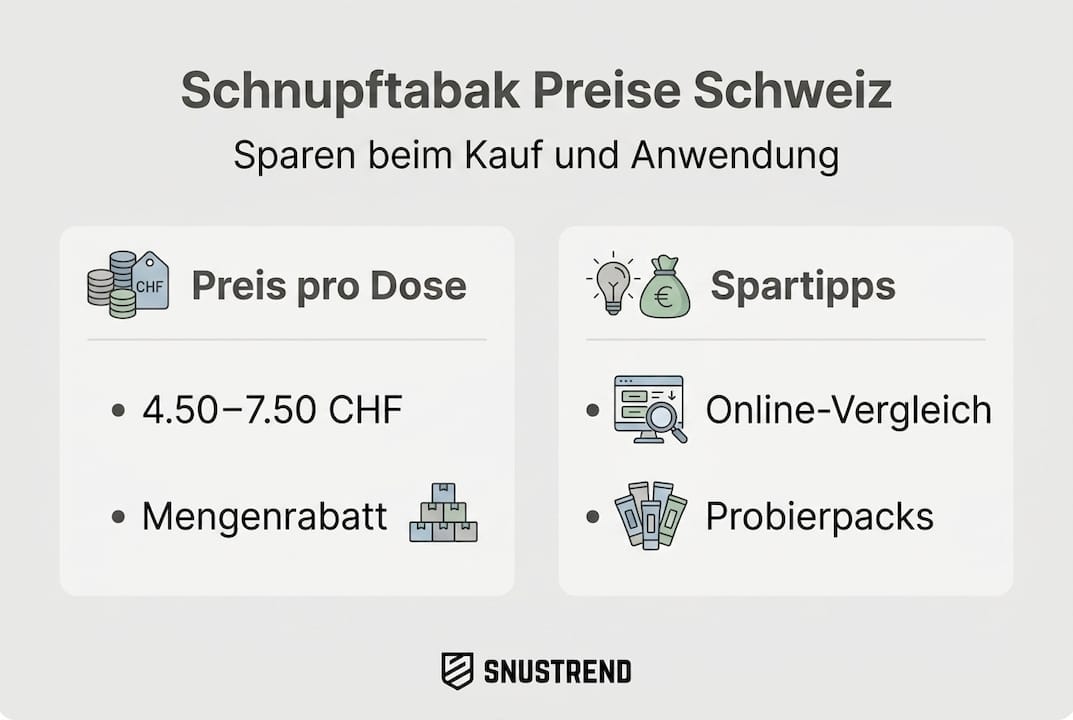
| Product | Quantity | Price per single tin | Price with bulk discount |
|---|---|---|---|
| Gawith Apricot | 10g | approx. CHF 5.40 | approx. CHF 4.80 |
| JBR Blue | 10g | approx. CHF 7.50 | approx. CHF 6.80 |
| Pöschl Ozona | 6g | approx. CHF 4.90 | approx. CHF 4.10 |
| JBR Red | 10g | approx. CHF 7.50 | approx. CHF 6.80 |
Buying online offers several clear advantages over stationary retail:
- Bulk discounts: Many online shops offer noticeable price reductions when buying 5 or 10 tins.
- Wider assortment: Only a few varieties are often available in stores. Online, you can find rare aromas and international brands.
- Price comparison: Online prices can be compared in seconds without having to run from shop to shop.
- Special offers: Many shops offer regular promotions, new customer discounts, or newsletter benefits.
- Home delivery: Particularly practical if the nearest tobacco specialty shop is far away.
When buying online, caution is advised with dubious offers. Reputable retailers require age verification before the first order. This is not a bureaucratic detour, but a legally prescribed procedure for the protection of minors. Anyone who can order without any check should be skeptical. All necessary details on age verification when purchasing are clearly regulated for Swiss consumers.
A structured overview of affordable and secure purchasing options is also provided by the guide for buying snus and snuff cheaply online, which summarizes tips on shipping, customs, and quality features.
Pro-tip: Anyone buying snuff tobacco online for the first time should start with a mix of two to three different varieties. This allows you to better estimate your personal taste without immediately ordering a large quantity of a single variety that you might not like.
Tobacco-Free Alternatives, Risks, and Myths in Comparison
In addition to tobacco products, many adults are looking for alternatives or are worried about possible risks. This section gives an honest overview without sugar-coating.
Tobacco-free options have increased. Products like Snuffy White or Energy Sniffs function similarly to classic snuff tobacco but contain no tobacco and no nicotine, or rely on caffeine and other active ingredients. Tobacco-free alternatives like Snuffy White and Energy Sniffs appeal primarily to those who appreciate the ritual aspect of taking snuff but wish to avoid nicotine.
Anyone actively searching for tobacco-free alternatives will now find a considerable selection on the Swiss market.
Nevertheless, there are clear risks that no one should keep quiet about:
- Nasal mucosa irritation: Sniffing too forcefully or using very dry products can irritate the sensitive mucous membrane. Beginners should start with small amounts.
- Nicotine dependency: Even if no smoke is produced, the nicotine content in many snuff products is substantial. A physical dependency can develop quickly.
- Gateway effect: According to current findings, snuff tobacco can act as a gateway to other tobacco products for young people, which is a serious social aspect.






Share:
Nicotine pouches: All facts, usage, and risks explained
Risks of nicotine products: facts and safe alternatives