


TL;DR:
- Regulation in Switzerland is extensive and significantly stricter than the EU average, which leads to higher production costs and prices. The system supplements international standards with national requirements, the so-called "Swiss Finish," which often does not yield proportional safety gains. Recent laws, such as the Business Relief Act, are intended to lay the foundations for more efficient, less cost-intensive regulation.
The role of regulation in Switzerland is defined as the system of government rules that simultaneously ensures consumer protection, fair competition, and innovation. This Swiss regulatory system affects every market sector, from financial services to food products, and even tobacco products and vaping. Anyone who buys, sells, or trades products in Switzerland operates within one of the densest regulatory frameworks in the world. Understanding these underlying conditions is not an academic exercise, but a practical necessity for consumers and businesses alike.
How does the role of regulation in Switzerland differ internationally?
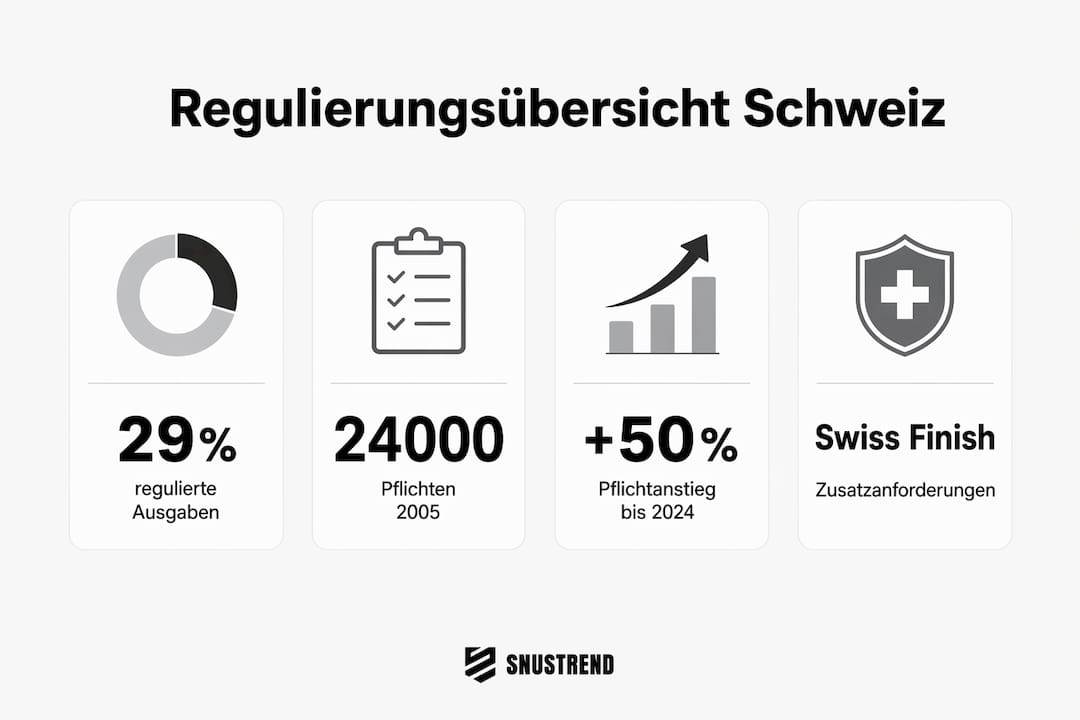
Switzerland regulates significantly more intensely than the European average. 29% of all consumer spending in Switzerland is subject to government regulation, compared to only 12% on the EU average. This means that nearly one in every three francs that Swiss consumers spend flows into a government-regulated area. This difference explains why many products in Switzerland are more expensive than in neighboring countries.

A central feature of the Swiss regulatory system is the so-called "Swiss Finish." This term describes the practice of supplementing international standards with additional national requirements, which increases administrative costs without always achieving a proportional gain in safety. A pharmaceutical company that has received approval for a drug in the EU must still undergo separate approval procedures with Swissmedic in Switzerland. The same principle applies to tobacco and vaping providers.
Economic regulation in Switzerland follows the ordoliberal tradition, which distinguishes between order policy (Ordnungspolitik) and process policy (Prozesspolitik). Order policy sets the framework conditions for fair competition, while process policy intervenes directly in market operations. Historically, Switzerland has favored order policy, but it regularly deviates from this due to the "Swiss Finish."
| Feature | Switzerland | EU Average |
|---|---|---|
| Share of regulated consumer spending | 29% (2024) | 12% (2024) |
| Swiss Finish | Yes, systematically | No |
| Regulatory authorities | Federal and cantonal | National authorities and EU Commission |
| Market access for foreign products | Additional Swiss requirements | Mutual recognition within the EU |
| Deregulation approach | Business Relief Act 2024 | Various national programs |
What challenges does regulation in Switzerland present?
The density of regulation is constantly growing. The number of entrepreneurial obligations at the federal level rose from 24,000 in 2005 to 36,000 in 2025, an increase of 50% in two decades. In concrete terms: a company founded in 2005 must observe 50% more regulations today than at the time of its inception. This increase affects accounting obligations, reporting requirements, product standards, and marketing rules alike.
The issue of deregulation is particularly difficult. Regulations build upon one another and create interactions that experts compare to a Jenga tower. Anyone who strikes a regulation risks unforeseen effects in other areas. For example: relaxing labeling requirements for tobacco products would simultaneously affect youth protection rules, customs regulations, and liability law.
Political resistance to deregulation is significant. Every existing regulation has beneficiaries who fight its removal. Industries, unions, and consumer protection organizations defend the regulations that benefit them. This makes reform slow and politically costly.
The following factors make deregulation particularly difficult in Switzerland:
- Federalism: The federal government and cantons enact parallel regulations that must be coordinated.
- Direct democracy: Public referendums can stop or delay deregulation projects.
- International integration: Swiss law must remain compatible with EU law, even without membership.
- Complex dependencies: Laws cross-reference one another, which makes isolated changes difficult.
Since the autumn of 2024, the Business Relief Act has obligated the federal government to systematically check new draft laws for potential relief and regulatory costs. This is a structural step forward because it makes the impacts of regulation visible within the legislative process before costs are incurred.
Pro tip: It is not the quantity of regulations that determines the quality of a regulatory system. Clear, coherent, and well-enforceable rules create more trust and less bureaucracy than a patchwork of individual regulations.
How does Switzerland regulate tobacco products and vaping?
The regulation of tobacco products and vaping in Switzerland has become significantly stricter since 2024. The Federal Act on Tobacco Products and Electronic Cigarettes determines which products may be sold, how they must be labeled, and who is permitted to buy them. Cantonal and federal authorities monitor the market together, including online retail.
The most important regulatory areas for tobacco and vaping include:
- Age verification: Sellers must verify the age of buyers. When buying tobacco products online, specific age verification obligations apply, requiring technical solutions such as ID checks or credit card verification.
- Product standards: Ingredients, nicotine content, and packaging are subject to strict requirements. E-cigarettes must meet safety requirements that go beyond EU standards.
- Advertising restrictions: Tobacco advertising is heavily restricted in Switzerland. Sponsorship and advertising in publicly accessible areas are prohibited.
- Disposable vapes: The ban on disposable vapes in Switzerland is one of the most recent developments and affects both retailers and consumers directly.
The supervision and regulation of vapes in Switzerland shows how the Swiss Finish also functions in this area. While the EU is still debating disposable vapes, Switzerland has already enacted concrete bans. For retailers, this means significant adjustments in their product ranges and logistics.
The impact on consumers is directly noticeable. Products that are legally available in Germany or Austria may be prohibited or regulated differently in Switzerland. Anyone buying tobacco products or vapes online must ensure that the provider complies with Swiss regulations.
What are the economic and social effects of regulation?
Regulation is not an end in itself. It is not the amount, but the quality of regulation that is decisive for functioning markets. Clear rules build consumer trust and enable companies to plan and invest for the long term. Without reliable framework conditions, markets would be dominated by information asymmetries and opportunistic behavior.
Opinion researcher Michael Hermann sums up the social ambivalence:
"Regulation can also create freedom by offering protection against risks. At the same time, it is perceived as patronizing when it goes beyond what is necessary."
This tension is particularly pronounced in Switzerland because the country has both a strong liberal economic tradition and a deep-seated need for security among the population.
Economic effects can be observed in four areas:
- Financial market: The Swiss Financial Market Supervisory Authority (FINMA) sets strict standards that strengthen trust in the Swiss financial center worldwide. This reputation attracts international investors, even if compliance costs are high.
- Logistics and trade: Companies like Migros or Coop must meet comprehensive product standards, which ensures quality but also creates market entry barriers for smaller providers.
- Tobacco and vaping market: Strict regulations protect consumers from unsafe products but simultaneously reduce product variety and increase prices.
- Digital economy: Data protection rules under the revised Data Protection Act (revDPA) build trust among users, but significantly increase the burden for startups and SMEs.
The importance of regulation is also reflected in the fact that countries with stable regulatory frameworks attract higher long-term investment. Legal certainty is a competitive advantage that Switzerland consistently utilizes despite all the criticism of the Swiss Finish.
Key findings
Regulation in Switzerland protects consumers and creates market trust, but burdens companies with a number of obligations that has risen by 50% since 2005 to 36,000.
| Point | Details |
|---|---|
| Regulatory intensity Switzerland | 29% of consumer spending is regulated, more than twice as much as the EU average. |
| Swiss Finish as a location factor | National additional requirements increase costs without always providing proportional benefits. |
| Tobacco and vaping regulation | Age verification, product standards, and the disposable vape ban have shaped the market since 2024. |
| Business Relief Act 2024 | Since the autumn of 2024, new laws must be systematically checked for regulatory costs. |
| Quality before quantity | Clear, coherent rules create more trust and competition than a high number of regulations. |
Regulation in Switzerland: My assessment after years in the market
I have been observing the Swiss regulatory framework for years from the perspective of the tobacco and vaping market, and my impression is clear: Switzerland regulates well, but too much at once. The Swiss Finish is the biggest structural problem. International standards are not adopted; instead, they are loaded with national additions that rarely provide a real safety gain but always generate costs. A provider that meets all requirements in the EU must still undergo separate procedures in Switzerland. That is not consumer protection; that is bureaucracy.
What makes me positive is the 2024 Business Relief Act. For the first time, there is a structural mechanism that makes regulatory costs visible within the legislative process itself. This is not a miracle cure, but it is a step in the right direction. The legal situation for Snus in Switzerland in 2026 serves as an example of how this approach must prove itself in practice.
What I wish for is greater international compatibility. Switzerland should recognize EU standards where they are sufficient and limit the Swiss Finish to areas where a real national added value can be demonstrated. Regulation should protect and build trust, not isolate. Societal participation through public referendums is valuable, but it must be accompanied by well-founded information so that citizens can assess the actual costs and benefits of a regulation.
— Lukas
Buy tobacco products and vapes legally at Snustrend

Snustrend offers you a wide selection of tobacco products, snus, and vapes that meet all Swiss regulatory requirements. Every product in the range complies with current legal standards, including age verification and product labeling. As a Swiss consumer, you can be sure that you are only buying products at Snustrend that are legal and tested. A popular example is Pöschl Schmalzler Südfrucht snuff tobacco, a classic product with clear origins and full legal certainty. Snustrend delivers quickly, transparently, and in accordance with the Swiss regulatory framework.
FAQ
What is the role of regulation in Switzerland?
Regulation in Switzerland defines the legal framework for the economy, consumer protection, and fair competition. It affects all markets, from financial services to tobacco products and vaping.
What does "Swiss Finish" mean?
The "Swiss Finish" refers to the practice of supplementing international standards with additional national requirements. This increases administrative costs without always yielding a proportional safety gain.
How is vaping regulated in Switzerland?
Vaping is subject to strict regulations in Switzerland regarding age verification, product standards, and marketing. Disposable vapes have been banned since the latest legal changes in 2024/2025.
Which authorities regulate tobacco and vaping in Switzerland?
Cantonal and federal authorities jointly monitor the tobacco and vaping market, including online sales. They verify age compliance, product standards, and adherence to marketing rules.
What is the Business Relief Act?
Since the autumn of 2024, the Business Relief Act has required the federal government to systematically check new draft laws for regulatory costs and potential relief. It is a structural approach to slowing the growth of regulatory density.
Recommendation
- Supervision and regulation of vapes in Switzerland – Snustrend - Snus, Vapes & Snuff
- Ban on disposable vapes in Switzerland: Innovations, background, and i – Snustrend - Snus, Vapes & Snuff
- Snus legal situation in Switzerland 2026: Legal overview – Snustrend - Snus, Vapes & Snuff
- THC Legalization Switzerland 2026: Your Compact Guide – Snustrend - Snus, Vapes & Snuff






Share:
Intensifying Vape Flavor: Your Guide for 2026
Role of vaping communities: influence and significance