


In short:
- Novel nicotine delivery systems offer a smoke-free alternative to traditional tobacco consumption. They vary in how quickly they take effect, with inhalable devices acting the fastest, though long-term data is lacking. Legally, many products are restricted in Germany, while Austria has introduced stricter regulations.
Novel nicotine delivery systems are specifically developed products for targeted, often smoke-free nicotine delivery, offering smokers a real alternative to conventional tobacco use. The technical term is "Novel Nicotine Delivery Systems" (NNDS). These products deliver nicotine via the oral mucosa, through inhalation, or transdermally (through the skin). Nicotine pouches and e-cigarettes are the most well-known examples. Both avoid combustion and thus tar and carbon monoxide. This fundamentally distinguishes them from the classic cigarette, even if they are by no means risk-free.
What novel nicotine delivery systems are currently available?
The market for alternative nicotine delivery methods has become highly differentiated in recent years. Those looking for a smoke-free option today will find a variety of products that would have been hardly imaginable ten years ago.
Nicotine pouches
Nicotine pouches are small, tobacco-free sachets placed between the gum and the upper lip. The nicotine is absorbed directly through the oral mucosa. The pouches contain either synthetic nicotine or nicotine extract from tobacco plants, but no tobacco leaf. Brands like Velo offer them in various strengths and flavors. In Germany, sales are legally problematic, as nicotine pouches are classified as a novel food ingredient, which effectively prohibits regular retail.

Nicotine toothpicks
Nicotine toothpicks are a comparatively new format. They typically contain 2–3 mg of nicotine each, although BfR data from May 2026 detected levels of up to 6 mg per toothpick. For comparison: a cigarette delivers around 10 mg of nicotine. In Germany, nicotine toothpicks are not officially approved for sale. Nevertheless, the risk of addiction is comparable to other nicotine products.
E-cigarettes and disposable vapes
E-cigarettes heat a liquid to create vapor instead of smoke. A distinction is made between two forms of nicotine: nicotine salts and freebase nicotine. Nicotine salts ensure faster absorption and a smoother throat hit, which is why they are primarily used in pod systems and disposable vapes like Elfbar or Vozol. Freebase nicotine is better suited for high-performance devices with higher vapor volume. Disposable vapes are particularly popular among beginners because they require no maintenance.
Tobacco heaters
Tobacco heaters, also known as heat-not-burn devices, heat real tobacco to approximately 350 degrees Celsius without burning it. This produces an aerosol that contains nicotine but significantly fewer combustion products than cigarette smoke. They are considered an intermediate solution for smokers who do not want to give up the tobacco experience entirely.
Pro tip: If you want to switch from cigarettes, you should first try a pod system with nicotine salt. The speed of absorption is the most similar to that of a cigarette, which makes the transition easier.
| Product type | Nicotine absorption | Tobacco contained | Combustion |
|---|---|---|---|
| Nicotine pouches | Oral mucosa | No | No |
| E-cigarette (pod) | Inhalation | No | No |
| Tobacco heater | Inhalation | Yes | No |
| Nicotine toothpicks | Oral mucosa | No | No |
| Classic cigarette | Inhalation | Yes | Yes |
How quickly does nicotine take effect with the new systems?
The speed of absorption is a decisive difference between the individual products. Understanding this allows for more conscious management of dosage and consumption rhythm.
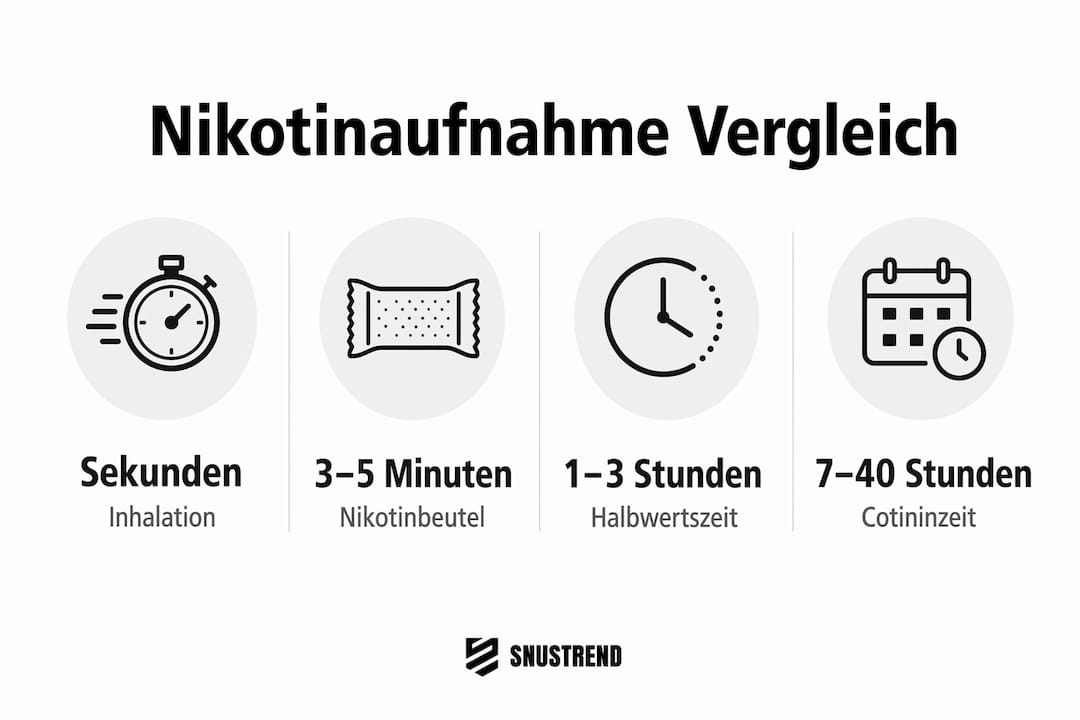
Inhaled nicotine reaches the blood within seconds and reaches the brain in less than ten seconds. This explains why smokers find cigarettes so immediately satisfying. Nicotine pouches and toothpicks take longer to act because absorption via the oral mucosa requires more time. The effect sets in after a few minutes but lasts longer.
Nicotine has a blood half-life of 1–3 hours, while its metabolite cotinine remains detectable in the body for 7–40 hours. This is the reason why drug tests usually screen for cotinine and not nicotine itself. In chronic users, cotinine can be detected in urine samples for up to 30 days.
| Absorption route | Onset of effect | Duration of effect |
|---|---|---|
| Inhalation (e-cigarette) | Seconds | 20–40 minutes |
| Oral mucosa (pouch) | 3–5 minutes | 30–60 minutes |
| Transdermal (patch) | 30–60 minutes | 16–24 hours |
The ritual also plays an important role. Many smokers miss not only the nicotine but also the act of reaching for a cigarette, lighting it, and the pause. E-cigarettes best serve this ritual, which explains their high acceptance during the transition.
Pro tip: Combine a nicotine patch for a baseline level with a fast-acting product like a nicotine pouch for acute cravings. This strategy is proven to increase the chances of successfully quitting smoking.
What are the risks and legal issues with new nicotine products?
New nicotine products are not risk-free alternatives. They avoid combustion, but not nicotine. And nicotine itself is a highly addictive substance with measurable effects on the cardiovascular system and metabolism.
Modern nicotine products are developing rapidly and remain a challenge for consumers, legislators, and public health. Long-term data for most novel systems are still entirely lacking, which is why official health authorities cannot issue blanket recommendations.
The legal situation in Germany and Austria differs significantly:
- Germany: Nicotine pouches are considered a novel food ingredient and are not permitted for sale. However, the gray market via online retailers from abroad remains active.
- Austria: The tobacco monopoly was extended to nicotine pouches and e-liquids as of April 2026. Consequently, these products are subject to tobacco tax and stricter distribution rules.
- EU level: The integration of nicotine pouches into the tobacco monopoly in Austria indicates a trend toward stricter controls, which is also foreseeable for Germany and the EU level.
Particularly critical is the marketing featuring sweet flavors and colorful designs. Expert Stefanie Eckhardt from BIÖG pointed out in May 2026 that attractive product design is deliberately aimed at young people and non-smokers, increasing the risk of addiction in these groups. This is not a coincidence, but a marketing strategy.
Those who want to learn more about specific risks for younger consumers can find a detailed overview of youth protection risks at Snustrend.
Furthermore: Long-term data on nicotine pouches, nicotine toothpicks, and newer disposable vapes is largely missing. Alternative nicotine systems are by no means risk-free and remain associated with health hazards. A critical assessment is therefore particularly important.
How to use new nicotine products sensibly?
Those who use new nicotine products consciously can reduce risks and increase benefits. This requires knowing your own consumption level and controlling it deliberately.
-
Adjust dosage: Those switching from cigarettes are best off starting with a nicotine salt liquid at 20 mg/ml. This roughly corresponds to the nicotine needs of an occasional smoker. Heavy smokers can choose higher concentrations but should reduce them gradually.
-
Use combinations: The combination of a patch and fast-acting products is a proven strategy. The patch provides a stable baseline level, while the pouch or inhaler covers acute cravings.
-
Choose the right device: Pod systems with nicotine salt are suitable for beginners and moderate users. Sub-ohm devices with freebase nicotine are intended for experienced vapers who prefer more vapor volume. The difference lies not only in taste but also in the speed of nicotine absorption.
-
Choose flavors consciously: Sweet flavors can subconsciously increase consumption because they enhance enjoyment. If you want to reduce your consumption, it is better to opt for neutral or tobacco-like flavors.
-
Buy legally: Products from the gray market have no verified quality control. Those who want to be on the safe side should buy from reputable retailers with transparent product labeling. Snustrend explains more about nicotine content and effects in a separate article.
Pro tip: E-cigarettes achieve success rates of 18–25% in smoking cessation attempts, whereas classic nicotine patches reach 10–15%. This makes vaping the currently most effective single method, but only when combined with a clear plan.
Key takeaways
Novel nicotine delivery systems offer real alternatives to the cigarette but require informed decisions regarding dosage, product choice, and the legal framework.
| Topic | Details |
|---|---|
| Product variety | Nicotine pouches, e-cigarettes, tobacco heaters, and toothpicks meet different needs. |
| Absorption speed | Inhalation acts in seconds, oral mucosa takes minutes, patches take up to an hour. |
| Legal situation | Germany prohibits nicotine pouches as a food ingredient; Austria has integrated them into the tobacco monopoly. |
| Risks | All nicotine products cause addiction; long-term data on newer systems is largely missing. |
| Transition strategy | Patches plus a fast-acting product are proven to increase chances of successfully quitting smoking. |
What I have learned after years with nicotine products
I have been observing the market for nicotine products for many years, and one thing stands out to me time and again: the debate is rarely conducted objectively. On one side are health authorities that demonize every new product across the board. On the other side is an industry that markets its products as harmless lifestyle items. Both sides are exaggerating.
The truth lies in between. Nicotine pouches and e-cigarettes are a realistically better option for adult smokers who cannot or do not want to quit compared to cigarettes. But they are no free pass. Anyone who believes a disposable vape with fruit flavor is healthy is mistaken. And anyone who thinks nicotine pouches are harmless because they produce no smoke underestimates the addictive dynamics of nicotine.
What really worries me is the speed at which new products come onto the market before long-term data is available. Regulation is always lagging behind. This is not a failure of individual authorities, but a structural problem. Austria has taken a pragmatic step by integrating nicotine pouches into the tobacco monopoly. Germany is still hesitating. I believe the Austrian approach is more sensible because it enables control without strengthening the gray market.
My advice: Inform yourself before you try a new product. Know your nicotine needs. And only buy from retailers that provide product information transparently.
— Lukas
Snustrend as a contact point for nicotine alternatives
Anyone looking for a smoke-free or low-smoke alternative will find a wide range of tested nicotine products for the Swiss market at Snustrend.

A classic example from the assortment is Pöschl Schmalzler Südfrucht Snuff, a traditional product with fruit flavoring that requires no combustion. Those who want to test it first should opt for the smaller 25g pack. Snustrend offers fast shipping, clear product information, and an assortment that ranges from snus and vapes to snuff. All products are intended for adult consumers who want to use nicotine consciously.
FAQ
What exactly are novel nicotine delivery systems?
Novel nicotine delivery systems are products that deliver nicotine without combustion, for example via the oral mucosa, by inhaling vapor, or transdermally. These include nicotine pouches, e-cigarettes, tobacco heaters, and nicotine toothpicks.
How quickly does a nicotine pouch act compared to a cigarette?
A nicotine pouch starts working after about 3–5 minutes; a cigarette acts within seconds due to inhalation. In return, the effect of the pouch lasts longer.
Are nicotine pouches legal in Germany?
No. Germany classifies nicotine pouches as a novel food ingredient, which prohibits their sale. Online trade from abroad exists as a gray market but offers no quality guarantee.
How long is nicotine detectable after consumption?
Nicotine itself has a half-life of 1–3 hours. Its metabolite cotinine remains detectable in the blood for 7–40 hours and in the urine of chronic users for up to 30 days.
Which nicotine system is best suited for quitting smoking?
E-cigarettes with nicotine salt achieve success rates of 18–25% in smoking cessation, outperforming classic nicotine patches at 10–15%. The most effective method is the combination of a patch for a baseline level and a fast-acting product for acute cravings.
Recommendation
- Understanding hybrid nicotine: smooth enjoyment with a strong effect – Snustrend - Snus, Vapes & Snuff
- Nicotine replacement trends in Switzerland: What is important in 2026 – Snustrend - Snus, Vapes & Snuff
- Consuming nicotine without smoke: An overview of methods – Snustrend - Snus, Vapes & Snuff
- Nicotine pouches in the Swiss market: Trends 2026 – Snustrend - Snus, Vapes & Snuff






Share:
Online vape purchase process: Ordering securely in Switzerland
Vaping techniques compared: the practical guide