


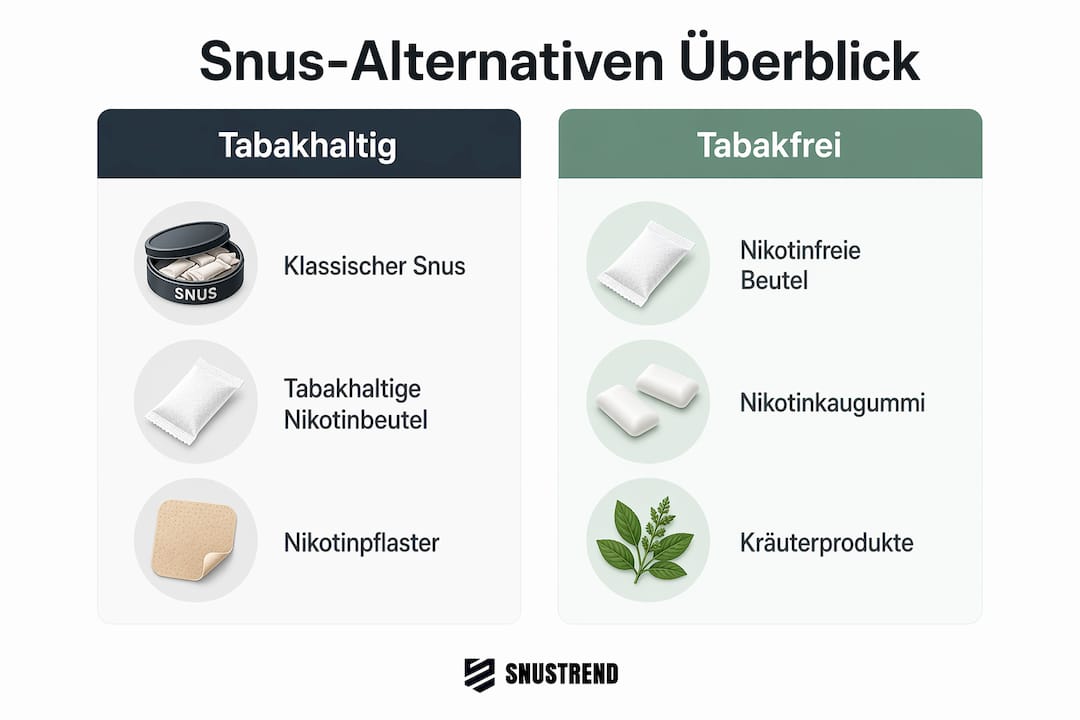
If you are looking for alternatives to snustobak.se, there is a wide range of options available in German-speaking countries: nicotine patches, tobacco-free nicotine pouches, nicotine gum, lozenges, and oral aids without nicotine. The strongest options for adults looking to reduce or replace snus are:
- Nicotine patches from the pharmacy: medically tested, controlled nicotine delivery, ideal for gradual withdrawal
- Tobacco-free nicotine pouches: tobacco-free, discreet, available in many strengths and flavors, brands include VELO, Pavo, Scooper, and Awaken Energy
- Nicotine gum and lozenges: address both oral fixation and nicotine cravings, available at pharmacies
- Nicotine-free gum and candies: no nicotine, help with the oral ritual, affordable and widely available
- Herbal products and snacks: carrots, celery, flavored toothpicks, no addictive potential
Legally speaking, classic tobacco-containing snus is largely prohibited in the EU, with the exception of Sweden. Tobacco-free nicotine pouches are available in Germany but are subject to national regulations regarding nicotine content and youth protection. According to expert opinion, medically tested nicotine replacement products from the pharmacy are considered the most effective support for quitting.
Nicotine patches: How well do they really work?
Nicotine patches are among the medically tested aids for smoking cessation and are also a proven choice for snus withdrawal. They deliver nicotine evenly through the skin, usually over 16 or 24 hours. This prevents the sharp fluctuations in nicotine levels that are typical when quitting snus.
The application is very simple: apply the patch in the morning, remove it in the evening. No dosing, no overthinking. Those who previously consumed several portions of snus daily generally start with a patch of the highest strength and reduce the dose over several weeks.
- Available in three strengths (e.g., 7 mg, 14 mg, 21 mg nicotine per 24 hours)
- No oral ritual: those who miss the feeling of the pouch under the lip need a supplement
- Combination with nicotine gum for acute moments of craving is possible and, according to experts, often more effective than a single product
- Available over the counter at pharmacies
The biggest disadvantage: the patch does not satisfy oral fixation. Those who consume snus primarily because of the ritual will not be happy with the patch alone. However, the nicotine delivery is more controlled than with almost any other product.
Tobacco-free nicotine pouches: What is really inside?
Tobacco-free nicotine pouches are the most direct alternative to classic snus. They look like snus, are placed under the lip in the same way, and release nicotine via the oral mucosa. No tobacco, no smoke, no spitting.

The difference from classic snus lies in the contents: instead of tobacco, these pouches contain nicotine salts, plant fibers, flavorings, and fillers. Depending on the formulation, nicotine salts can be absorbed very efficiently through the mucosa, which can lead to nausea or dizziness in the short term if the dose is too high. Long-term data are still largely missing, and risk profiles are inconsistent, especially for teenagers and non-smokers.
Well-known brands on the German market:
- VELO: wide range of flavors, various nicotine strengths, slim format for discreet use
- Pavo: focused on the Scandinavian taste, classic and fruity variants
- Scooper: also available as Scooper Energy with added caffeine
- Awaken Energy: relies on caffeine instead of nicotine, aimed at consumers who want to replace the nicotine kick
Pro-tip: Anyone switching from snus to nicotine pouches should initially adjust the nicotine strength to their previous snus consumption. A pouch that is too weak quickly leads to using more than necessary.
Nicotine-free pouches consist of plant fibers and contain no nicotine, but various flavorings. The recommended duration of use is 30–60 minutes per pouch. They satisfy the oral ritual, but do not help with physical nicotine addiction. Those who consume snus because of the nicotine will not be satisfied with nicotine-free pouches alone.
Legally, tobacco-free nicotine pouches are in a transitional zone in Germany: they are available but are subject to stricter national rules regarding nicotine content and packaging.
Nicotine gum and candies: Oral and effective
Nicotine gum is the second best-known nicotine replacement therapy after the patch. It addresses two problems simultaneously: physical nicotine cravings and oral fixation. Those who miss the feeling of snus in their mouth will find a direct substitute here.
The application differs from normal chewing gum: chew briefly until a slight tingling is felt, then park between the cheek and gums. This way, nicotine is absorbed through the mucosa, similar to snus. Available in various strengths, typically 2 mg and 4 mg.
- Nicotine lozenges dissolve slowly and mimic the duration of a snus pouch
- Sugar-free peppermint candies without nicotine help with the oral urge without promoting addiction
- Nicotine gum is only available at pharmacies; nicotine-free versions are available in supermarkets
- Discreet use in everyday life, at the office, or on the go is easily possible
Comparison to snus: the ritual is similar, the nicotine kick arrives slightly slower. Those who are impatient reach for the next piece too soon. That is why the correct technique is crucial, not the amount.
Herbal products and snacks: What is really the point?

Herbal chewing products and oral snacks without nicotine are aimed at consumers who want to maintain the ritual but do not want to consume nicotine or tobacco. The benefit is limited but real: they keep the mouth occupied and help to interrupt the urge for snus at certain moments.
Nicotine-free oral snacks such as carrots, celery, or cucumber are low in calories and promote oral health at the same time. Flavored toothpicks, for example with cinnamon or mint, satisfy the urge for "something in the mouth" without any potential for addiction.
- Herbal tobacco for chewing: contains no tobacco but has a texture similar to loose snus
- Flavored wooden sticks with tea tree oil or mint: cheap, available everywhere
- Sunflower seeds in shells: similar hand-to-mouth movement as with snus
- Healthy snacks as a supplement, not as a sole weaning method
Herbal products do not replace nicotine or the effect of a nicotine pouch. They make sense as a supplement in moments when one would otherwise automatically reach for snus, for example after eating or while having coffee. As a main strategy for withdrawal, they are not sufficient.
Where are the limits of snus alternatives?
Not every alternative fits every goal. Those who consume snus because of the nicotine need a nicotine-containing alternative. Those who miss the ritual need something oral. And those who want both need both.
Nicotine-free snus products are not a recommended method for weaning because they do not address the physical nicotine addiction. Those who manage without nicotine frequently reach for a cigarette or return to it in frustration. That is not a failure, but physiology.
- Nicotine patches and gum from the pharmacy show significantly higher success rates than nicotine-free products
- Tobacco-free nicotine pouches are not a low-risk entry for non-smokers: the DKFZ explicitly warns against this
- Herbal products and snacks help with the ritual, not with withdrawal
- Prescription drugs such as bupropion further increase the chances of success but require medical supervision
- According to expert consensus, the safest option remains the complete abandonment of tobacco and nicotine
Combination therapies work better than single products. Patches plus gum for acute moments is a classic example. Those who also use behavioral therapy increase their chances of long-term success even further.
What snus and nicotine do to the body
Regular snus consumption increases the risk of high blood pressure and cardiovascular disease. Nicotine constricts blood vessels, increases heart rate, and raises blood pressure. This also applies to tobacco-free nicotine pouches because nicotine salts have the same pharmacological effect.
Tobacco-containing snus also contains tobacco-specific nitrosamines and other substances that remain in the product without combustion in classic snus. The cancer risk differs from smoking but is not zero. An increased risk is discussed for certain types of cancer, with assessments varying depending on the study.
Tobacco-free nicotine pouches have fewer tobacco-specific harmful substances, but their flavorings and fillers are often only tested for consumption, not for prolonged contact with the oral mucosa. Systematic long-term data are missing. Anyone switching to nicotine-free alternatives reduces the risk but does not solve the addiction problem.
Important: Nicotine pouches are conceivable as a transitional solution for adult, heavily dependent consumers. For non-smokers and teenagers, the risks clearly outweigh the benefits, because a nicotine addiction can develop in the first place.
Withdrawal symptoms when switching: What really helps?
Typical withdrawal symptoms after quitting snus include irritability, difficulty concentrating, sleep disturbances, and intense cravings. The first three to five days are usually the hardest. This is normal and subsides.
The oral ritual is often underestimated. Anyone who has placed a pouch under their lip several times a day for years misses not only the nicotine but the habit itself. Nicotine-free pouches can help psychologically but are not a permanent solution without accompanying therapy.
- Gradual reduction: lower the nicotine strength of the pouches or patches over several weeks
- Set fixed times for consumption and gradually space them out
- Distraction in critical moments: physical activity, drinking water, chewing gum
- Behavioral therapy or smoking cessation courses significantly increase the chances of success
- Include social support: family, friends, or online groups
Pro-tip: Identify the three situations where you reach for snus most often and replace those moments specifically with an alternative. Those who only want to "consume less" in general usually fail due to habits, not willpower.
Relapses are common and not a sign of failure. Those who start the plan again immediately after a relapse have good long-term chances. Those who wait until "the right moment" comes often wait too long.
Where to buy snus alternatives in Germany?
The German market for snus alternatives is well-positioned in 2026. Nicotine pouches, nicotine-free pouches, and nicotine replacement products are available both online and in pharmacies and kiosks. The selection online is significantly larger than in brick-and-mortar stores.
Well-known brands and their profiles:
- VELO: market leader for tobacco-free nicotine pouches in Europe, wide range of flavors from mint to berry, strengths from 4 mg to 11 mg nicotine
- Pavo: Scandinavian-influenced, classic flavors, suitable for switchers from traditional snus
- Scooper / Scooper Energy: also available with caffeine, for consumers looking for an energy effect
- Awaken Energy: relies entirely on caffeine instead of nicotine, interesting for the gradual exit from nicotine addiction
When buying online, you should pay attention to age verification, shipping conditions to Germany, and nicotine strength. Not all products from abroad comply with German regulations. As an established source, Snustrend offers a wide selection of snus alternatives and nicotine pouches, including VELO and other well-known brands, with clear product information and fast shipping.
Those who want to compare smoke-free nicotine alternatives can also find information on dosage, ingredients, and application at Snustrend. Conversely, nicotine replacement products from the pharmacy are available without a prescription and are subsidized by health insurance companies in certain cases.
How do snus and its alternatives differ in application?
The practical difference between snus and its alternatives lies not only in the content but also in handling and dosage. Classic snus is placed under the upper lip and remains there for 20–60 minutes. Tobacco-free nicotine pouches work identically but do not release tobacco nicotine, but nicotine salts.
Nicotine gum requires a specific technique: chew, park, chew. Anyone who treats it like normal chewing gum will absorb hardly any nicotine and get hiccups or heartburn. Nicotine patches, on the other hand, require no active handling but do not provide an immediate result for acute cravings.
| Product | Application | Onset of action | Nicotine content |
|---|---|---|---|
| Snus (tobacco-containing) | Under the upper lip | 30–60 minutes | Varies by brand |
| Nicotine pouches (tobacco-free) | Under the upper lip | 30–60 minutes | 4–11 mg per pouch |
| Nicotine patch | Stick to the skin | 30–60 minutes | 7–21 mg per 24 hours |
| Nicotine gum | Chew and park | — | 2–4 mg per piece |
| Nicotine lozenge | Let dissolve in the mouth | — | 2 mg and 4 mg |
| Nicotine-free pouch | Under the upper lip | No nicotine | nicotine-free |
Dosage is particularly important for nicotine pouches. Anyone switching from strong snus to weak nicotine pouches reaches for them more often and ends up taking in more nicotine than before. Conversely, a pouch that is too strong can be unpleasant for beginners. Those who are unsure should start with a medium strength and adjust as needed.
Nicotine-free pouches do not have a dosage question in the classic sense, but also have no nicotine effect. The recommended wearing time of 30–60 minutes still applies because prolonged wearing can irritate the oral mucosa.
Important insights
Tobacco-free nicotine pouches and medically tested nicotine replacement products are the most effective alternatives to snus for adult consumers in German-speaking countries, with combination therapies providing the best results.
| Topic | Details |
|---|---|
| Most effective method | Medical nicotine replacement products from the pharmacy show higher success rates than nicotine-free alternatives. |
| Legal situation | Tobacco-containing snus is largely prohibited in the EU; tobacco-free nicotine pouches are subject to national rules. |
| Oral fixation | Nicotine-free pouches, chewing gum, and snacks help with the ritual, but do not replace nicotine therapy. |
| Health risks | Nicotine increases blood pressure and heart rate, even in tobacco-free products; long-term data on nicotine pouches are missing. |
| Combination therapy | Patches plus chewing gum for acute moments, supplemented by behavioral therapy, is more effective than a single product. |

Snustrend offers a wide selection of tobacco alternatives and snuff products for adults looking for an alternative to classic snus. The range includes various brands, strengths, and flavors, with clear product information and fast shipping to Switzerland.
Recommendation
- Top 5 xn–vapestub-7za.ch Alternatives 2026 – Snustrend - Snus, Vapes & Snuff
- Snus Alternatives 2026: High-Quality and Affordable Options – Snustrend - Snus, Vapes & Snuff
- Snus, Vapes and Snuff from Snustrend right to your door! – Snustrend - Snus, Vapes & Snuff
- The Best Elfbar Alternatives: Comparison for Vapers & Snus Users – Snustrend - Snus, Vapes & Snuff






Share:
Early detection of nicotine dependence: Warning signs 2026
Building nicotine-free habits: How to make the switch successfully