


How can nicotine dependence be recognized early?
Anyone who reaches for a cigarette every day and notices that they become restless or irritable without one may have already crossed the first threshold of dependence. Nicotine dependence, clinically referred to as tobacco dependence and classified under F17.2 in the ICD-10, often develops faster than expected. Signs can appear shortly after the first attempts at smoking.
Early symptoms include:
- Strong craving: An urgent need for nicotine, especially in the morning or during stressful phases.
- Situational triggers: Automatically reaching for a cigarette with coffee, during breaks, or after meals, without conscious decision-making.
- Restlessness and irritability: Nervousness or inner tension when no cigarette is available.
- Daily consumption patterns: Smoking has become a fixed part of the daily routine, no longer just occasional.
- Failed attempts to quit: Anyone who has already tried to stop and failed carries a clear warning signal.
The crucial difference to occasional consumption lies in the loss of control. Those who still determine for themselves when and how much they smoke are not yet dependent. Those who can no longer do so, are.
The Hooked on Nicotine Checklist (HONC) is suitable for self-assessment; it is a recognized screening test with ten questions developed specifically for early detection in adolescence, though it is also meaningful for adults. Even a single "yes" answer can indicate the onset of dependence.
Pro-tip: Those who act early have the best odds. Psychological dependence is still weakly developed at the beginning and is easier to break than after years of smoking.
Which causes and risk factors promote its development?
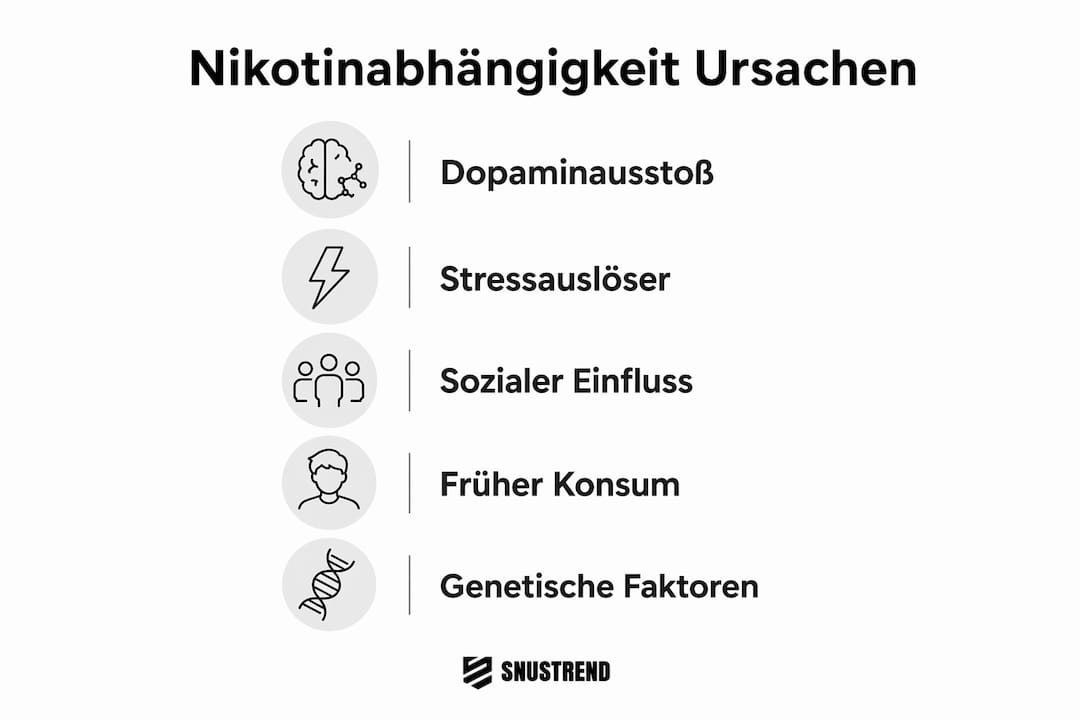
Nicotine acts directly on the brain's reward center. It triggers the release of dopamine, which makes smoking feel pleasant in the short term. With regular consumption, nicotine receptors in the brain multiply, and the body increasingly demands more to achieve the same effect. This is tolerance development in its purest form.

In addition, there is psychological conditioning. Smoking is linked to certain situations—coffee, stress, alcohol, breaks—and these associations strengthen with each repetition. Eventually, the mere sight of a cigarette pack is enough to trigger cravings.
Further risk factors:
- Genetic predisposition: Some people respond more sensitively to nicotine and develop a dependence faster.
- Social environment: Those with many friends or family members who smoke are statistically more likely to pick up a cigarette themselves.
- Stress and emotional strain: Nicotine has a short-term relaxing effect, which makes it particularly attractive during stressful life phases.
- Early start: The younger the start, the higher the risk of lasting dependence.
- The illusion of control: Many believe they can stop at any time. However, the rapid adaptation of nicotine receptors makes exactly that increasingly difficult.
Stress is not a minor topic here. It is one of the most common triggers for both relapses and starting to smoke. Anyone who is not aware of their personal way of dealing with stress significantly underestimates the risk of relapse.
How can nicotine dependence be clinically diagnosed?
Physical and psychological symptoms go hand in hand with nicotine dependence. Physically, typical withdrawal symptoms appear, such as nervousness, irritability, poor concentration, sleep disorders, headaches, and increased hunger. Psychologically, the dependence manifests in persistent craving, planning the day around smoking, and the feeling of being unable to function without nicotine.

According to the ICD-10, dependence is present if at least three of the following criteria are met over a month or repeatedly within a year:
| Criterion | Explanation |
|---|---|
| Strong craving | Compulsive urge to consume tobacco |
| Loss of control | Inability to regulate the start, amount, or cessation of consumption |
| Withdrawal symptoms | Physical symptoms during nicotine withdrawal that end with renewed consumption |
| Tolerance development | Increasing amount required to achieve the same effect |
| Neglect of other interests | Smoking displaces other activities and obligations |
| Consumption despite harm | Continued smoking despite known health consequences |
The Fagerström test has proven effective for assessing the severity of dependence. Among other things, it asks how soon after waking the first cigarette is smoked, how many cigarettes are consumed daily, and whether it is difficult to abstain in smoke-free places. The test provides an objective score that serves as a basis for therapy planning for both doctors and those affected.
Additionally, the doctor can examine the exhaled air for carbon monoxide. Increased levels confirm heavy tobacco consumption and help to estimate the extent of the physical burden. Subliminal psychological dependence—the craving without pronounced physical symptoms—is often overlooked in this process and should be addressed specifically.
How does nicotine dependence develop without treatment?
Nicotine dependence is a chronic disease. Without intervention, it intensifies over time because the body and psyche adapt more and more deeply to nicotine consumption. Physical withdrawal symptoms are strongest in the first days after the last cigarette and subside significantly after about two weeks. Psychological dependence, however, can persist for years.
This is the point that many underestimate. Those who are physically through withdrawal believe they have survived the worst. But a certain scent, a familiar situation, or a stressful day can reawaken the craving even years later.
Prognostic factors and recommendations:
- Early start of treatment significantly improves the chances of recovery.
- Multiple attempts to quit are normal. On average, people need five to eight attempts before they become permanently smoke-free.
- Professional support significantly reduces the risk of relapse compared to trying alone.
- Stress management is a central success factor, as stress is the most common trigger for relapse.
- Longer abstinence gradually reduces the risk of relapse, but never excludes it entirely.
Early detection therefore pays off twice over: the dependence is less deeply anchored, and the psychological conditioning has had less time to consolidate. Anyone who intervenes after a few months of smoking has a much easier time than someone who has waited twenty years.
Which tests and early interventions do experts recommend?
The Fagerström test and the Hooked on Nicotine Checklist (HONC) are the two clinically established screening tools. The Fagerström test assesses physical dependence using six questions and is particularly suitable for adults. The HONC, with ten questions, also uncovers early psychological patterns of dependence and is well-suited for younger consumers. Both tests are freely accessible and provide an initial assessment within a few minutes.
The German S3 guideline on tobacco dependence recommends screening high-risk patients early, as nicotine dependence is chronic but treatable. Early intervention pays off because the neuronal changes in the brain are less pronounced at the beginning.
“Professional help upon early detection should not be viewed as a weakness, but as a strategic health measure.” Experts from the S3 guideline emphasize that coordinated approaches combining behavioral therapy and, where necessary, pharmacological support deliver the best results.
Early interventions include three levels. In terms of behavioral therapy, the focus is on identifying stress triggers and developing substitute actions for smoking routines before the stop begins. Pharmacologically, nicotine replacement products like patches or lozenges can cushion physical withdrawal. And psychologically, it helps to record one's motivation in writing, be aware of specific risk situations, and involve a supportive environment.
Anyone wanting to understand more about the development of nicotine addiction will find further information on Snustrend. Especially for young consumers, it is also worth looking at the risks for adolescents, as an early start accelerates the development of dependence.
Pro-tip: Before quitting, write down the situations in which you typically reach for a cigarette and plan concrete alternatives for exactly those moments. The first 72 hours are the hardest; anyone who survives them with a plan has the most difficult part behind them.
Key findings
Recognizing nicotine dependence early is the most effective protection against deeply rooted addiction, because psychological conditioning and neuronal adaptation are still reversible at the beginning.
| Topic | Details |
|---|---|
| Early warning signs | Restlessness without nicotine, automatically reaching for a cigarette, and failed quit attempts are clear early signs. |
| Diagnostic tools | Fagerström test and HONC provide a clinically sound assessment of the severity of dependence in just a few minutes. |
| Course without treatment | Physical withdrawal symptoms subside after about two weeks, while psychological dependence can persist for years. |
| Attempts to quit | Most people need several attempts before they become permanently smoke-free. |
| Early intervention | The S3 guideline recommends early screening and the combination of behavioral therapy and nicotine replacement for the best results. |
Recommendation
- Nicotine addiction: how it develops and what is behind it – Snustrend - Snus, Vapes & Snuff
- Significance of nicotine content: effects and risks 2026 – Snustrend - Snus, Vapes & Snuff
- What nicotine does to teenagers: risks 2026 – Snustrend - Snus, Vapes & Snuff
- Nicotine pouches: benefits, effects, and application 2026 – Snustrend - Snus, Vapes & Snuff






Share:
Peer pressure and nicotine products: What really drives adolescents
Snustobak.se alternatives: The best options for 2026