


In short:
- Nicotine-free habits can be successfully established by identifying triggers, designing your environment, and setting clear goals.
- Concrete strategies such as keeping a consumption log and habit stacking make it easier to quit nicotine in the long term.
How to build nicotine-free habits
Nicotine-free habits are not built through willpower alone. They are built when you know which situations make you reach for a cigarette, and when you have a concrete plan for those exact moments.
- Identify triggers: Write down when and why you reach for a cigarette or vape.
- Set substitute rituals: Determine a concrete alternative for every trigger, for example, drinking water or taking a short walk.
- Adjust your environment: Remove smoking accessories and keep alternatives visibly ready.
- Set SMART goals: Formulate your goal concretely, measurably, and with a date.
- Use habit stacking: Link new behaviors with existing routines.
- Plan for relapses: A slip-up is not a failure. Analyze what happened and keep going.
Which triggers make you reach for a cigarette?
Anyone who smokes or vapes regularly usually does so in the same situations: after coffee, during stress, or in social settings. The
therefore recommends keeping a consumption log to reveal the connections between consumption and stress, social settings, or time of day.
This is how you proceed:
- Make a mark on a piece of paper before every cigarette or vape.
- Note down: time, mood, situation, and whether you were alone.
- Repeat this for at least five days.
- Look at the patterns: When do the marks cluster?
This self-observation tracking increases the success rate of habit change because it makes actual behavior visible rather than perceived behavior.
Pro tip: Add a column for "cravings on a scale of 1 to 10." This way, you will identify not just when you reach for a cigarette, but also when the craving is particularly strong. These are your most important high-risk situations.
How your environment makes the transition easier
Psychotherapist Miriam Junge puts it in a nutshell: Those who design their environment to make new behavior easier require less willpower than those who fight against stimuli every day. This is not a trick, but behavioral science.
Concrete measures:
- Dispose of ashtrays, lighters, and cigarette packs immediately.
- Lay out workout clothes the night before so that exercise as a substitute ritual has no hurdles.
- Place healthy snacks like nuts or fruit in plain sight, and remove sweets from view.
- Involve your social environment: let partners, friends, and colleagues know that you are quitting.
- Avoid risk situations in the initial phase, for example, smoke breaks with colleagues or certain pubs.
Social support and group therapy are effective supplements to psychological support because they simultaneously address biological dependence, psychological habits, and the social context.
SMART goals: Why vague resolutions fail
"I want to smoke less" is not a goal. It is a wish. The Stiftung Gesundheitswissen shows that the SMART rule significantly increases the chances of success in changing habits.
| SMART criterion | Meaning | Example for quitting nicotine |
|---|---|---|
| Specific | Formulated clearly and concretely | "I will not smoke a cigarette starting Monday." |
| Measurable | Progress is verifiable | "I will keep my consumption log daily." |
| Accepted (Achievable/Relevant) | Fits you and your values | "I choose movement instead of nicotine patches because I enjoy exercise." |
| Realistic | Achievable in everyday life | "In stressful weeks, I plan for two smoke-free days, not seven." |
| Time-bound | Clear start and end date | "Nicotine-free for four weeks starting March 1st." |
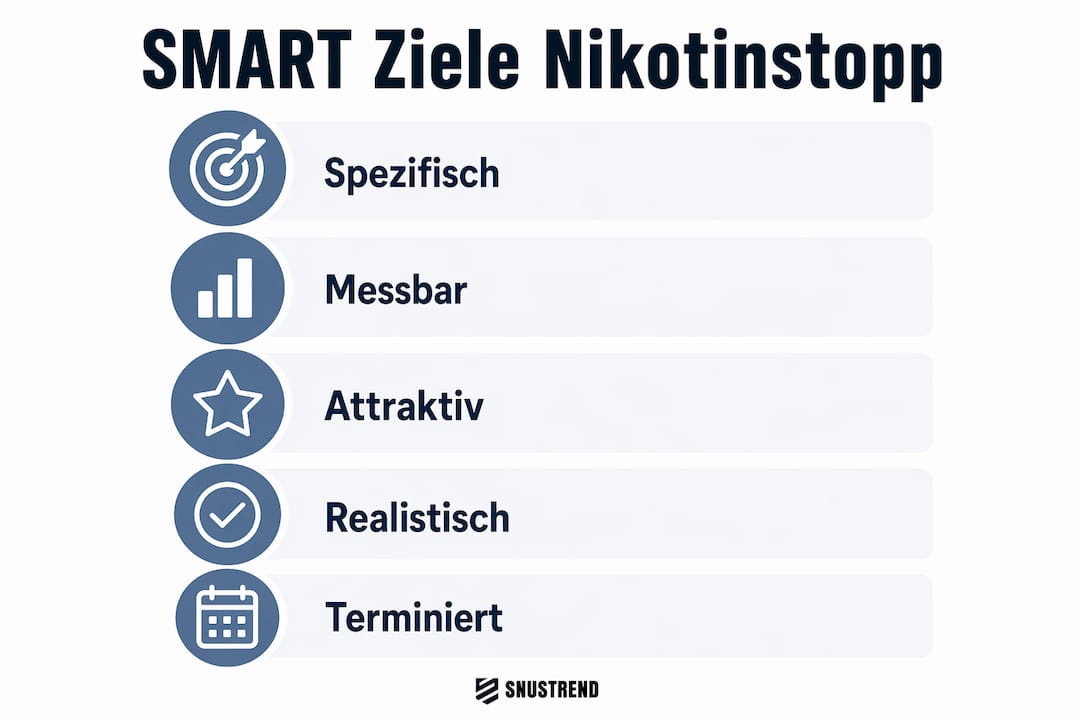
A goal that meets all five criteria gives you something you can track. And what you can track, you can adjust if it doesn't work out.
Habit stacking: Docking new routines onto old ones
Conscious decisions consume mental energy. Habit stacking avoids this by linking new behaviors to already automated routines. According to the mhplus health insurance fund, this is the fastest way to consolidate new habits.
Here is how it works, step by step:
- Choose an existing routine you perform daily: making coffee, brushing your teeth, lunch break.
- Define the new behavior you want to insert afterwards: breathing deeply for two minutes, drinking a glass of water, taking a short walk.
- Formulate it as an if-then sentence: "If I am done with my coffee, I will drink a glass of water first."
- Repeat this consistently for at least three weeks.
Proven substitute actions for everyday life:
- A glass of water immediately after waking up instead of the first cigarette.
- Three deep breaths after lunch.
- Short stretching during your break after work.
- Chewing gum or mint after coffee.
Overcoming cravings: What helps in the first few minutes
Acute nicotine cravings typically last 3 to 5 minutes. If you can bridge this time, you have won. Pulmonologist Dr. Wulf Pankow describes the 4-A method as a proven tool for exactly this moment.

Postpone: Do not react immediately. Simply pausing interrupts the automatic reaching for a cigarette.
Await: Take deep breaths and actively relax. Those who already know breathing exercises or progressive muscle relaxation have a clear advantage here.
Avoid: Avoid risk situations in the initial phase. The coffee break with smoking colleagues, the balcony after a meal.
Alternate: Consciously distract yourself. A glass of water, a piece of fruit, a lap around the block. Movement is particularly effective here because it actively lowers stress chemistry.
Withdrawal symptoms like restlessness, irritability, or sleep problems are unpleasant but temporary. Drinking at least 1.5 liters of water daily, avoiding alcohol in the first few weeks, and opting for healthy snacks additionally stabilizes the body.
Psychological techniques that really help
Behavioral therapy, or CBT for short, is demonstrably effective in smoking cessation. It helps to recognize and interrupt automatic thought patterns. A classic example: The thought "I need a cigarette now or I can't stand it" is replaced by the experience that the craving passes even without a cigarette.
Mindfulness complements this well. Those who learn to observe a craving instead of reacting to it immediately gain distance from the impulse. This is not a mystical concept, but a skill that can be trained: perceive the craving, name it, and wait.
Positive thoughts concretely support the process. A STOP signal that actively interrupts negative thoughts, or writing down three things you are grateful for daily, are simple techniques with measurable impact. Those who were heavily dependent or have relapsed multiple times will benefit from the combination of behavioral therapy and medical support, for example through nicotine replacement products like patches or lozenges.
How to stay smoke-free long-term
Relapses happen. This does not mean that everything is lost. What matters is what happens afterward. Anyone who analyzes which situation led to the slip-up learns from it and adjusts their plan.
Three traps that many know: "Just one" is often the beginning of the road back. "I've got it under control" underestimates how strongly triggers work. Stress, lack of sleep, and hunger combined significantly intensify the craving.
Long-term stability is built through identity change, not renunciation. Not "I am not allowed to smoke," but "I am smoke-free." Those who mark smoke-free days, visibly put away the money saved, and attach their three main reasons to their phone or mirror, build a self-image that holds up. Anyone who knows tobacco alternatives as transitional products also has more options for critical phases.
Snustrend: Alternatives for the transition
Those who want to accompany their quitting process with a substitute product will find a wide selection of smoke-free alternatives at Snustrend. From classic snuff to modern pouches: the products help maintain the ritual without combustion. The Pöschl Schmalzler Südfrucht snuff is a proven example for customers who want to keep the ritual of the action but forgo smoke.
Key insights
Nicotine-free habits are built by recognizing personal triggers, targeted environmental design, and consistently linking new behaviors with existing routines.
| Topic | Details |
|---|---|
| Recognize triggers | A consumption log reveals patterns between consumption, stress, and time of day. |
| Design environment | Removing smoking accessories and keeping alternatives visibly ready reduces relapse risks. |
| Set SMART goals | Specific, time-bound goals significantly increase the chances of success, according to Stiftung Gesundheitswissen. |
| Bridge cravings | Acute cravings typically last 3 to 5 minutes; the 4-A method helps in this time window. |
| Apply habit stacking | Linking new behaviors to existing routines automates the transition without constant effort of willpower. |
Recommendation
- Nicotine addiction: How it arises and what's behind it – Snustrend - Snus, Vapes & Snuff
- Consuming nicotine without smoke: Methods at a glance – Snustrend - Snus, Vapes & Snuff
- Choosing nicotine alternatives: 70% of beginners use moderate values – Snustrend - Snus, Vapes & Snuff
- Nicotine pouches: Benefits, effects, and application 2026 – Snustrend - Snus, Vapes & Snuff

Share:
Snus alternatives at a glance: nicotine pouches, nicotine-free pouches & co.
Smoke-free and nicotine products: What you really need to know