


In short:
- The nicotine content of snus can be specifically controlled through deliberate product selection, duration of use, and portion size. A gradual reduction in nicotine intake helps to minimize risks and adjust consumption in a controlled manner. Clear self-observation and avoiding excessively rapid product changes or overdosage are important.
Adjusting the nicotine content of snus means consciously managing dosage, product choice, and consumption technique in order to target the desired effect and well-being. Snus is a tobacco product available in loose and portioned varieties, containing between 1.8 mg and 47.5 mg of nicotine per pouch. This difference is enormous and demonstrates the importance of a conscious product choice. Anyone who knows their consumption habits and understands how nicotine strength, duration of use, and pouch size interact can precisely control their nicotine intake. This guide is aimed at adult snus users who want to take control of their own nicotine adjustment.
Which factors influence the nicotine content in snus?
The nicotine content in snus depends on several variables that you can directly influence. Understanding these factors is the foundation for any targeted nicotine adjustment.
Nicotine amount per pouch
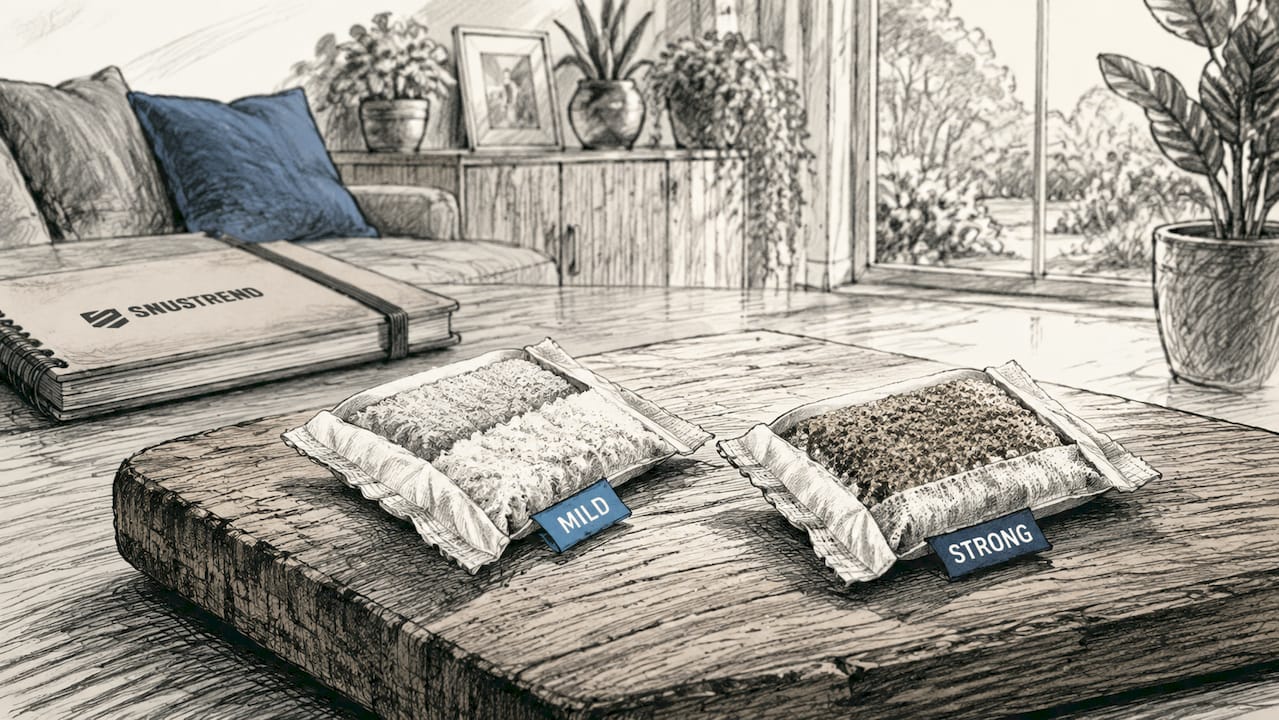
On average, nicotine pouches contain about 9.5 mg of nicotine per piece. This means that even small differences between products can have a noticeable effect on your body. At least half of this amount enters the bloodstream through the oral mucosa. The nicotine level is therefore comparable to that of a cigarette.
Product type: Loose versus portioned
Loose snus allows for individual adjustment of the nicotine amount through free dosing. Portion-packed snus, on the other hand, offers standardized amounts per pouch, which makes control easier but leaves less flexibility. Many experienced users prefer the loose variety because they can determine the amount per portion themselves.
Duration of use and temperature
The duration for which the pouch is worn significantly influences the amount of nicotine released. Wearing it longer increases nicotine absorption through the oral mucosa. Body temperature and saliva production also play a role, as they influence the release rate.
The most important influencing factors at a glance:
- Pouch size: Larger pouches contain more tobacco and thus more nicotine.
- Nicotine content of the product: Indicated in mg/g or as a percentage on the packaging.
- Duration of use: The longer the pouch remains in the mouth, the more nicotine is absorbed.
- Product type: Loose snus allows free dosing; portioned snus standardizes the amount.
- Moisture content: Moist snus releases nicotine faster than dry snus.
Pro tip: If you want to reduce your nicotine consumption, start by shortening the wearing time per pouch by five minutes. This is one of the easiest methods for nicotine reduction without changing products.
How to choose snus with the appropriate nicotine content?
Choosing the right product is the first step toward targeted nicotine adjustment. Labels such as "normal", "strong", and "extra strong" correspond to different nicotine amounts and help you find the right product. These details can be found on every package and give you initial guidance.
Nicotine strengths in comparison
| Strength | Nicotine content (approx.) | Suitable for |
|---|---|---|
| Mild / Normal | 4–8 mg/g | Beginners, nicotine-sensitive users |
| Strong | 10–16 mg/g | Experienced users with moderate consumption |
| Extra Strong | 20–30 mg/g | Heavy users with high nicotine tolerance |
| Ultra Strong | over 30 mg/g | Only for very experienced users |
This table shows that the difference between mild and ultra strong is enormous. Switching from extra strong to strong can reduce nicotine intake by up to 40 percent.
Correctly reading nicotine information on packaging
Nicotine is indicated in mg/g or as a percentage, although the actual effect also depends on the form of consumption. A product with 20 mg/g and a 1-gram pouch therefore contains 20 mg of nicotine per portion. Anyone who knows this calculation can compare products directly and choose specifically.
What you should look out for when choosing a product:
- Read the nicotine content in mg/g and multiply it by the pouch weight.
- Compare products of the same category, not different formats.
- Be aware of the difference between tobacco snus and tobacco-free nicotine pouches.
- When trying out a new strength for the first time, always choose the lower option.
Brands like Velo, Siberia, and General offer a wide spectrum of nicotine strengths. Siberia is known for very high nicotine levels, while Velo also offers low-nicotine variants for nicotine-sensitive users.
Practical methods for adjusting nicotine intake during consumption
Nicotine absorption during snus use can be directly controlled through concrete techniques. These methods work regardless of which product you use.
-
Reduce portion size with loose snus. Anyone using loose snus can gradually reduce the amount per portion. A reduction of 10–20 percent per week is well-tolerated and hardly noticeable.
-
Shorten the duration of use. Wear the pouch for a shorter time than usual. Instead of 30 minutes, try 20 minutes. This method lowers nicotine intake without switching products.
-
Alternate using low-nicotine pouches. Alternate between a strong and a mild product. This strategy lowers the daily average without sacrificing enjoyment.
-
Take breaks between portions. Instead of taking the next portion immediately after the last one ends, take a break of 30 to 60 minutes. This significantly reduces total daily intake.
-
Incorporate nicotine-free variants. Tobacco-free herbal pouches without nicotine can serve as a substitute for individual portions. They satisfy the oral habit without introducing nicotine.
-
Keep a consumption diary. Keep track of how many pouches you use daily and at what strength. Only once you know your starting point can you reduce it in a targeted way.
Pro tip: Combine method 2 and 3: Wear strong pouches for a shorter time and switch every second pouch to a mild variant. This combination lowers nicotine intake by up to a third without significantly changing the consumption experience.
The effect and choice of nicotine strength always depend on individual tolerance. What is mild for an experienced user may already be too strong for a beginner.
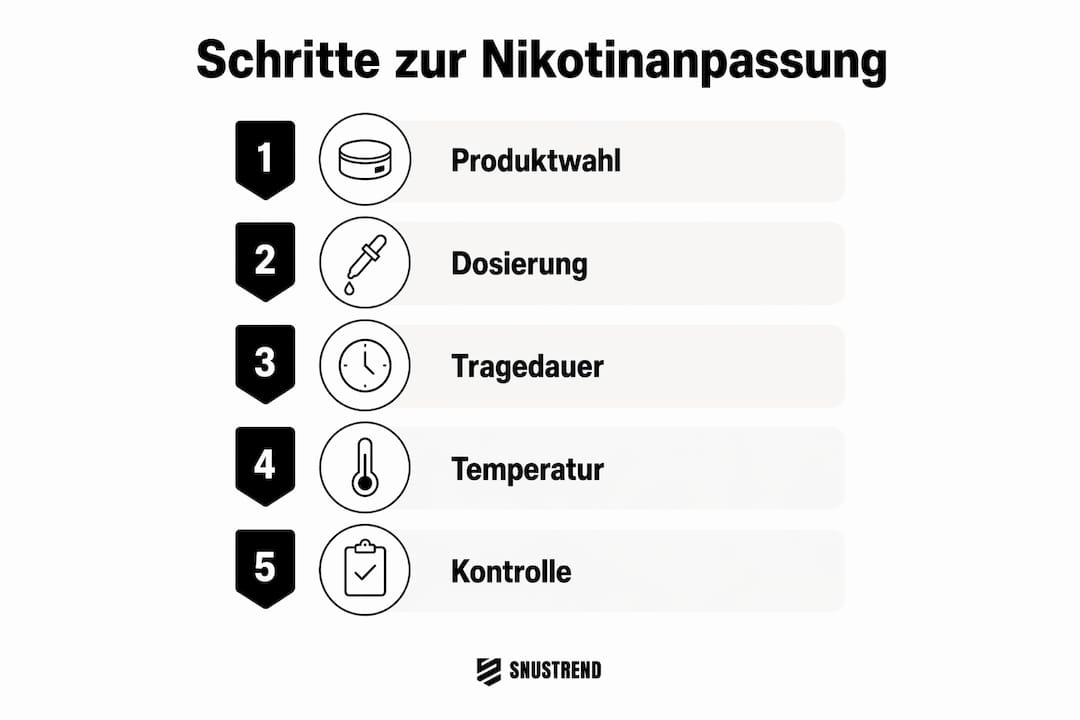
What errors and risks arise during nicotine adjustment?
Errors in nicotine adjustment can have unpleasant to dangerous consequences. Those who are aware of them can target and avoid them.
-
Increasing nicotine strength too quickly. Excessive nicotine leads to dizziness, nausea, and fainting. Anyone switching directly from mild to extra strong risks an overdose. Increases should always be made gradually.
-
Lack of self-observation. Many users do not notice that they are unconsciously using more pouches to achieve the same effect. This is a classic sign of increasing tolerance and should be taken seriously.
-
Using multiple pouches simultaneously. Two pouches at the same time double the nicotine intake. This practice is especially dangerous with strong products.
-
Underestimating nicotine content. Anyone who does not read the information on the packaging does not know how much nicotine they are actually absorbing. This leads to uncontrolled consumption.
Important note: Nicotine acts on the heart and circulatory system. People with cardiovascular diseases should only use snus products after consulting a doctor. Pregnant women should avoid consumption entirely, as nicotine can harm the child's development.
Nicotine is a neurotoxin and is addictive, regardless of whether it comes from snus, nicotine pouches, or other products. This fact applies equally to all forms of consumption. Those who consciously control their consumption reduce the risk of addiction.
How to control nicotine content in the long term?
Long-term control over nicotine content requires regularity and self-reflection. One-off adjustments help in the short term, but only a lasting awareness of one's own consumption leads to stable results.
Recommendations for beginners:
- Start with mild products in the 4–8 mg/g range and increase only if necessary.
- Set a weekly limit on pouches and record it in writing.
- Switch to the next strength level after four weeks, never earlier.
Recommendations for experienced users:
- Check every four weeks whether you are still achieving the same effect with less nicotine.
- Use the comparison with cigarettes to estimate your total intake.
- Intentionally incorporate nicotine-free days or hours into your daily routine.
For all users: The importance of nicotine content lies not only in the effect but also in the long-term risks. Anyone who documents their consumption recognizes patterns earlier and can take more targeted countermeasures. Nicotine alternatives like tobacco-free herbal pouches or nicotine-free snus products offer a sensible supplement for anyone who wants to gradually lower their nicotine consumption.
Important insights
Targeted adjustment of the nicotine content of snus is best achieved through a combination of conscious product selection, reduced duration of use, and gradual reduction of portion size.
| Point | Details |
|---|---|
| Knowing nicotine content | Read the mg/g information on the packaging and calculate the amount per pouch. |
| Managing duration of use | Wearing it for less time reduces nicotine absorption without switching products. |
| Reducing gradually | Never switch nicotine strengths abruptly, but in small steps over several weeks. |
| Observing risks | People with heart disease and pregnant women should avoid snus. |
| Documenting consumption | A consumption diary helps to recognize patterns and control them in a targeted manner. |
My experience with conscious nicotine adjustment in snus
Over the years, I have observed that most snus users do not really manage their consumption. They reach for the next pouch when the urge arises without asking themselves how much nicotine they are actually taking in. This is not a reproach; it is simply the nature of habit.
What really surprised me, however, is that even small changes in the duration of use have a measurable effect. Anyone who wears a pouch for only 15 minutes instead of 30 minutes absorbs significantly less nicotine without feeling like they are missing out on anything. This sounds trivial, but for many, it is a real turning point.
Another point that is often underestimated: Switching from portioned to loose snus gives you a level of control you never have with ready-made products. You decide how much goes into the pouch. That is a psychological difference that is noticeable in everyday life.
My honest advice: Do not start by testing the strongest products just because they are available. Siberia and similar high-nicotine products are intended for experienced users with high tolerance. Anyone starting there has almost no room for improvement and a lot of risk. It is better to start with a medium strength and get to know your body.
Conscious consumption does not mean less enjoyment. It means more control over what you give your body.
— Lukas
Finding snus with the right nicotine content at Snustrend
Snustrend offers a wide selection of snus products for every nicotine need, from mild to extra strong, with fast shipping to Switzerland.

Anyone looking for a classic snuff with a characteristic profile will find Pöschl Schmalzler Südfrucht as a proven option at Snustrend. This product is suitable for users who prefer a traditional tobacco experience with clear dosability. Snustrend provides all product information clearly and in detail so that you can make the right choice for your personal nicotine needs. Browse through the assortment and compare nicotine strengths directly on the product page.
FAQ
What is the average nicotine content in a snus pouch?
Nicotine pouches contain between 1.8 mg and 47.5 mg of nicotine per pouch, with an average of about 9.5 mg. At least half of this amount enters the bloodstream through the oral mucosa.
How can I lower the nicotine content of my snus?
The simplest methods are: shortening the duration of use, switching to a lower nicotine strength, and alternating with nicotine-free pouches. A gradual reduction over several weeks is more tolerable than an abrupt switch.
What do the strength indicators on snus packaging mean?
Indicators like "normal", "strong", or "extra strong" correspond to different nicotine amounts in mg/g. Anyone who multiplies the mg/g indication by the pouch weight gets the exact nicotine amount per portion.
Is loose snus better suited for nicotine dosing than portioned?
Loose snus allows for free dosing and thus more control over the nicotine amount per portion. Portioned snus offers standardized amounts, which facilitates comparability but leaves less flexibility.
Who should be particularly careful when consuming snus?
People with cardiovascular diseases should only use snus after consulting a doctor. Pregnant women should avoid consumption entirely, as nicotine can harm the development of the unborn child.
Recommendation
- Choosing nicotine alternatives: 70% of beginners use moderate values – Snustrend - Snus, Vapes & Snuff
- How many cigarettes is a snus equivalent to? The big comparison – Snustrend - Snus, Vapes & Snuff
- The significance of nicotine content: Effects and risks 2026 – Snustrend - Snus, Vapes & Snuff
- Dry snus vs. moist snus: The complete guide 2025 – Snustrend - Snus, Vapes & Snuff






Share:
Nicotine pouch shelf life explained: How to use safely
Vaping myths at a glance: 10 misconceptions cleared up