


TL;DR:
- Modern nicotine products such as e-cigarettes, snus, and nicotine pouches are enjoying increasing popularity, especially among young adults.
- All nicotine products carry health risks, with e-cigarette aerosols potentially containing harmful substances.
- Informed decisions require awareness of nicotine concentration, additives, and the actual risks involved.
Vapes, snus, nicotine pouches, and snuff are considered by many circles to be harmless alternatives to the classic cigarette. Those who do not inhale tobacco smoke often believe they are on the safe side. But this assessment is deceptive. Especially in Switzerland, more and more people are turning to modern nicotine products without truly knowing their risks. 15- to 24-year-olds consume e-cigarettes comparatively more frequently than older age groups. This article gives you a clear, fact-based overview of what you should really pay attention to with vapes, snus, and the like.
Table of Contents
- Use and prevalence of nicotine products in Switzerland
- Health hazards and long-term consequences of various nicotine products
- Dependency risk and consequences for adolescents and adults
- Underestimated risks: Passive exposure and additives in nicotine products
- Classification and practical tips: What really matters with nicotine products
- Safe alternatives and products: Your next step at Snustrend
- Frequently asked questions about the risks of nicotine products
Key findings
| Point | Details |
|---|---|
| Variety harbors risks | Modern nicotine products like vapes and snus are popular in Switzerland but are not low-risk. |
| Long-term effects unclear | Many side effects and long-term consequences of new nicotine products have been barely researched to date. |
| Dependency possible | Nicotine quickly leads to addiction regardless of the product, even with occasional use. |
| Be aware of passive risks | Not only users, but also their environment are potentially at risk from aerosols or vapors. |
| Critical additives | Additives and flavorings can harbor additional, hitherto underestimated dangers and should be checked. |
Use and prevalence of nicotine products in Switzerland
The idea that nicotine products are mainly a problem of the older generation is long outdated. Modern products such as e-cigarettes, nicotine pouches, and snus are recording high growth rates in Switzerland, especially among young adults. The image of the classic smoker has changed: today people vape, use pouches, or turn to snus, often in parallel with or instead of tobacco cigarettes.
According to the EGL 2023 analysis, 15- to 24-year-olds in Switzerland consume e-cigarettes more frequently than average. This means: especially in the age group where the brain is still developing, these products are particularly widespread. This development is not a coincidence, but the result of targeted product design with attractive flavors, slim design, and the perception of lower risks.
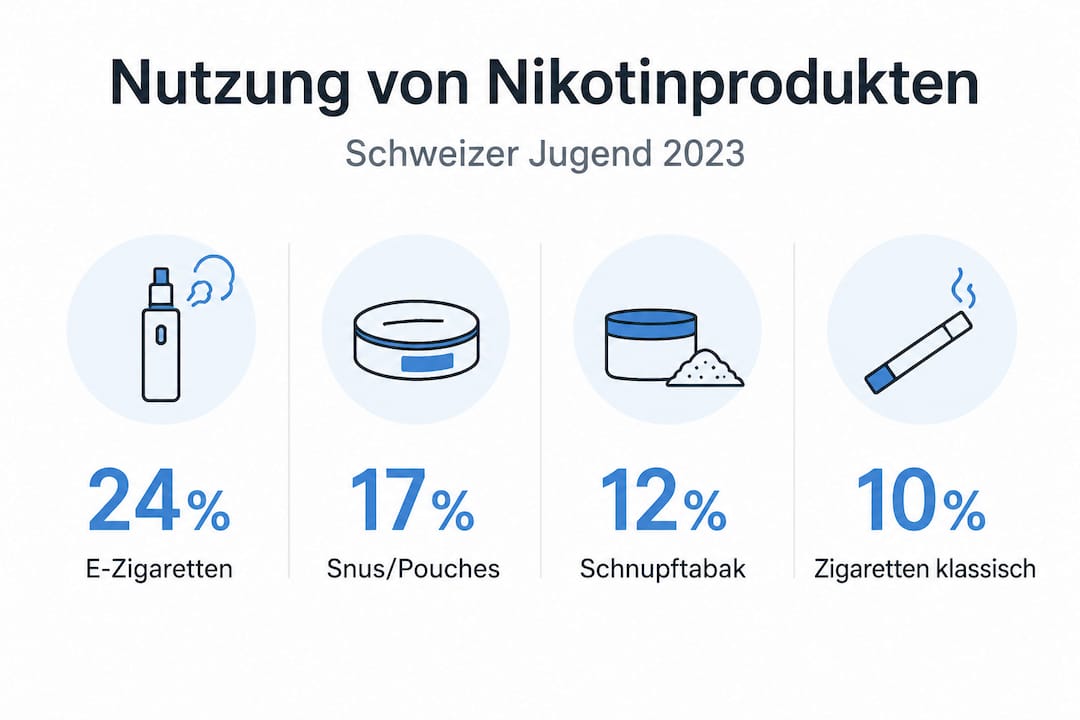
The most popular nicotine products in Switzerland currently include e-cigarettes (vapes), snus (tobacco under the lip), nicotine pouches (without tobacco), and snuff. Each of these products has its own risk profile, usage habits, and different nicotine amounts.
| Product | Typical form of use | Nicotine delivery | Main user group |
|---|---|---|---|
| E-cigarette (vape) | Inhalation of aerosol | Fast and intense | 18 to 35-year-olds |
| Snus | Place under the lip | Slow and sustained | Men 18+ |
| Nicotine pouch | Place under the lip | Slow | Broad age spectrum |
| Snuff | Inhale through the nose | Fast | Older users |
| Classic cigarette | Inhalation of smoke | Fast and intense | All age groups |
Particularly striking is the growth in the sector of disposable vapes. The Vape Trends Switzerland 2026 show that disposable devices like Elfbar or Vozol have gained significant popularity. Their uncomplicated entry without technical prior knowledge makes them particularly accessible, which simultaneously lowers the inhibition threshold for first-time users.
This development is significant for public health. When more and more people use nicotine-containing products, even if they have never smoked, the overall burden of nicotine addiction in the population increases. However, the societal debate often still focuses on classic tobacco smoke and neglects these new forms of consumption.
Health hazards and long-term consequences of various nicotine products
There is no nicotine-containing alternative that is completely harmless. But the risks differ significantly depending on which product is consumed. Those who want to make informed decisions must know these differences.
The WHO considers e-cigarettes to be harmful to health and emphasizes that the aerosol from e-cigarettes contains harmful and potentially harmful substances, including nicotine, heavy metals, and volatile organic compounds. It is not clean water vapor, but a mixture of various chemical compounds, the long-term effects of which on the lungs have not yet been fully researched.
“E-cigarettes are anything but harmless. This applies both to the user themselves and to individuals who are exposed to the aerosol.” German Federal Institute for Risk Assessment (BfR)
The BfR describes nicotine and aerosol risks in e-cigarettes in detail: in addition to nicotine addiction, respiratory irritation, cardiovascular strain, and potential carcinogenic effects from certain ingredients can occur. Particularly problematic is the fact that the data situation on long-term consequences is still thin; e-cigarettes are not old enough to allow for decades of studies.

For snus and nicotine pouches: the lack of a combustion process means no tar and fewer harmful substances overall. But nicotine is present in both products, often in very high concentrations. Snus is also associated with increased risks for changes in the oral mucosa and cardiovascular diseases.
Here is a direct comparison of the most important risks:
| Risk factor | Classic cigarette | E-cigarette | Snus | Nicotine pouch |
|---|---|---|---|---|
| Cancer risk | Very high | Low to unclear | Increased (oral) | Low to unclear |
| Lung burden | Very high | Moderate | None direct | None direct |
| Cardiac burden | High | Moderate | Moderate | Low to moderate |
| Addiction potential | Very high | High | High | High |
| Long-term data | Extensive | Hardly any | Partially available | Hardly any |
What applies to all these products:
- Nicotine increases blood pressure and heart rate and strains the cardiovascular system
- Addiction develops regardless of the form of delivery
- Flavorings and additives can pose additional risks
- Long-term data is almost entirely missing for new products
- Dual use (e.g., smoking and vaping simultaneously) multiplies the risks
The differences between vaping and smoking are often based on the assumption that e-cigarettes are significantly safer. This is correct regarding tar and combustion products, but it is too simplistic. The question of nicotine strengths and risk is central: products with very high nicotine content, such as some snus brands or high-dose pods, can foster addiction just as strongly as cigarettes.
Dependency risk and consequences for adolescents and adults
Nicotine is one of the most addictive substances we know. That is not an exaggeration. Nicotine activates the reward system in the brain by triggering the release of dopamine. The brain quickly learns to crave this stimulus and, after a short time, signals desire when nicotine is absent.
According to the WHO, nicotine is highly addictive, and ENDS (Electronic Nicotine Delivery Systems, i.e., e-cigarettes) can also lead to addiction. Particularly risky is so-called dual use: anyone who both smokes and vapes absorbs twice as much nicotine and has a significantly more difficult starting position when quitting.
What is the path to addiction?
- First contact: Nicotine triggers a pleasant feeling, relaxation, slight euphoria, or increased concentration.
- Repetition: The brain links the product to this feeling and develops a desire for repetition.
- Tolerance development: The same amount of nicotine is soon no longer enough; the dose is increased.
- Physical dependency: Withdrawal symptoms such as irritability, concentration problems, and sleep disturbances occur upon nicotine withdrawal.
- Psychological dependency: The ritual of consumption becomes part of everyday life and self-image.
Adolescents are particularly vulnerable because their brains are not yet fully developed. The prefrontal system, which is responsible for impulse control and decision-making, continues to develop into early adulthood. Nicotine can disrupt this development and increase susceptibility to other addictive substances.
Pro tip: If you notice that you become restless or irritable without a vape or snus, that is a clear sign of an incipient addiction. The first step is to recognize this and think about nicotine-free alternatives.
For adults, the addiction issue is no less relevant. Many adults switch to e-cigarettes in the hope of quitting smoking. In fact, some succeed, but many become long-term vapers without truly overcoming the addiction. The perception of using a “safe alternative” lowers the motivation to reduce overall nicotine consumption.
Current nicotine replacement trends in Switzerland 2026 show that the range of products with reduced nicotine amounts is growing. This is generally positive, but only makes sense if a real reduction in nicotine consumption is the goal and not just a brand switch.
Underestimated risks: Passive exposure and additives in nicotine products
Personal consumption is one thing. But what many disregard: nicotine products also affect others. Passive exposure is real, even with e-cigarettes. The aerosol from vapes contains nicotine and other substances that can be inhaled by people nearby, even if there is no visible glow.
According to the EGL 2023 analysis on passive exposure, passive exposure to tobacco smoke or e-cigarette aerosols remains common in Switzerland. This means that many people are regularly exposed to harmful substances without consuming them themselves.
“The aerosol from an e-cigarette is not just water vapor. It contains nicotine, fine dust, and chemical compounds that can be harmful to third parties.” German Federal Institute for Risk Assessment
In addition to passive exposure, additives play an underestimated role. Many vape products contain not only nicotine and propylene glycol, but also flavorings and special cooling agents. These substances provide the pleasant menthol sensation that many users value.
The BfR warns that cooling agents in e-cigarettes such as WS-23 or WS-3 are poorly researched and health damage cannot be ruled out. This is particularly relevant because exactly these substances are contained in many disposable vapes and popular pods, giving the product the “fresh vaping” feeling.
What should you specifically pay attention to?
- Read ingredient lists: Many manufacturers are not transparent, but in Switzerland, there are labeling requirements.
- Avoid products with unknown additives: If a product does not have a clear ingredient list, caution is advised.
- Do not vape indoors: Protect others, especially children, pregnant women, and people with respiratory diseases.
- Critically examine cheap products without proof of origin: Low-cost products without certification can contain higher amounts of problematic substances.
- Regular review: Scientific findings on additives evolve quickly; stay up to date.
- Nicotine replacement trends in Switzerland: What's important in 2026 – Snustrend - Snus, Vapes & Snuff
- Choosing nicotine alternatives: 70% of beginners use moderate levels – Snustrend - Snus, Vapes & Snuff
- The significance of nicotine content: Effects and risks 2026 – Snustrend - Snus, Vapes & Snuff
- Nicotine pouches: Benefits, effects, and application 2026 – Snustrend - Snus, Vapes & Snuff
Pro tip: When buying a vape product, check whether the manufacturer provides transparent information about cooling agents and flavorings. The safety of vapes and additives is a topic that is often neglected but has a direct impact on your health.
Another risk: nicotine salts in modern pods and disposable vapes. Nicotine salts allow for higher nicotine concentrations with less throat hit, which means you can absorb more nicotine without feeling it directly. This significantly increases the potential for addiction and is an important factor that many users do not know about.
Classification and practical tips: What really matters with nicotine products
The honest truth about the nicotine product market is this: the search for the “safe nicotine product” often leads astray. Not because all products are equally dangerous—they aren't. But because the question is asked incorrectly.
The relevant question is not: “Which product is the safest?” It is: “How much nicotine do I consume daily, for how long, and what is my goal?” Anyone who answers this honestly comes to a different assessment than someone who just looks for the product with the best reputation.
The BfR clarifies that while e-cigarettes may produce fewer harmful substances than tobacco cigarettes as an alternative, the risk of dependency and the variety of products remain problematic. This nuance is almost always overlooked in everyday life. Instead, you hear: "I've switched to vaping, so it's much healthier." This is partially true but glosses over the existing risks.
From our perspective, what responsible consumption means:
First: Critically examine your own nicotine intake. Many people don't even know how much nicotine is in their favorite product. Someone who vapes several high-dose pods a day may be consuming more nicotine than an occasional smoker.
Second: Switching products is not quitting. A nicotine pouch instead of a cigarette is a change, but it is not a solution if the goal is to be nicotine-free. Anyone who wants to use nicotine pouches safely should know how to reduce their use step-by-step, not just replace it.
Third: Use independent sources. Product manufacturers have an interest in presenting their products as positively as possible. Authorities such as the FOPH, the BfR, or the WHO offer independent, scientifically sound information, even if it is sometimes less convenient to read.
Fourth: Think about what consumption does to your daily life. If you can no longer travel, go to the cinema, or hold a conversation without first vaping or using a pouch, then that is a signal that should be taken seriously.
We see every day that users want to make informed decisions. Those who know the risks and consume anyway are making a conscious choice. Those who do not know them are making no choice at all. That is the difference that counts.
Safe alternatives and products: Your next step at Snustrend
Anyone who wants to consume in an informed way needs access to transparent product information and a selection that is truly comparable. This is exactly where Snustrend comes in.

At Snustrend, you will find vapes, snus, nicotine pouches, and snuff from verified sources, with clear information on nicotine content and flavors. Whether you are looking for products from Velo, Siberia, Elfbar, or Vozol, or are new to the world of nicotine alternatives: our range offers you the selection you need to make well-founded decisions. Make use of our range of verified products and keep reading our blog to stay up to date. Good consumption begins with good information.
Frequently asked questions about the risks of nicotine products
How harmful are e-cigarettes compared to conventional cigarettes?
E-cigarettes usually contain fewer harmful substances than regular cigarettes because no combustion process takes place. However, they are by no means harmless: the BfR emphasizes aerosol risks, and nicotine dependency as well as long-term consequences remain relevant health risks.
How high is the risk of nicotine dependency with occasional use?
Nicotine causes dependency even with occasional consumption, especially in adolescents and young adults. The WHO confirms the high addictive potential of nicotine regardless of the product form.
Are there any nicotine products that are completely harmless to health?
No. No known nicotine product is completely harmless to health, as there are always risks of dependency and health issues. The BfR confirms that even supposedly safe alternatives have problematic properties.
How can I protect myself and others from passive exposure?
Consume exclusively outdoors and consistently ensure the protection of children and sensitive individuals. According to the 2023 EGL evaluation, passive exposure remains widespread in Switzerland and is a serious health issue.
How do I find out which additives are contained in my vape product?
Check the ingredient lists on the packaging and research critical substances such as specific flavorings or cooling agents separately. The BfR explicitly warns against cooling agents such as WS-23, whose health risks have not yet been sufficiently researched.






Share:
Snuff explained: varieties, usage, and money-saving tips for Switzerland
Snus vs. cigarettes: taste, cost, and risks