


In short:
- Peer pressure has a strong influence on teenagers, particularly through social networks, imagery, and the desire for belonging. Teenagers often overestimate the smoking and vaping rates of their peers, which increases the pressure on them. Early prevention programs and social empowerment can effectively counteract the start of nicotine consumption.
Being with friends who smoke or use vapes significantly increases the risk of starting nicotine use yourself. This influence is particularly pronounced in children. These figures demonstrate, more clearly than any warning, how closely peer pressure and nicotine products are linked. Among teenagers, the social pressure to feel a sense of belonging and avoid exclusion often outweighs the awareness of health risks.
Peer pressure regarding smoking or the use of e-cigarettes operates on several levels simultaneously: directly through offers and prompts, and indirectly through merely observing what others do. Furthermore, there is a third channel that is often underestimated: social networks and platforms such as TikTok or Instagram, where vaping is portrayed as cool and normal. Teenagers absorb these images and adjust their behavior without ever being directly asked.
The following factors particularly reinforce the influence of peer pressure on nicotine consumption:
- Smoking friends in the closest circle increase one's own risk the most, even more so than siblings and parents.
- Overestimated prevalence: Teenagers believe more peers smoke than is actually the case, which artificially intensifies social pressure.
- Social identity: In some groups, those who smoke are considered rebels or outsiders with a coolness factor.
- Digital reinforcement: Influencers and trends on social platforms normalize consumption without requiring direct personal contact.
- Loneliness and fear of exclusion: Teenagers who feel socially insecure are more susceptible to peer pressure.
Types of peer influence that shape nicotine consumption
Not all peer pressure works the same way. The most direct case is the open offer: "Want one too?" But that is by no means the most frequent form. Much more effective is often the silent social pressure that arises when an entire group smokes and you are the only one not participating.
Prof. Gerd Lehmkuhl, child psychiatrist and member of the German Society for Child and Adolescent Psychiatry (DGKJP), has described how social identity shapes the smoking behavior of teenagers: smokers often position themselves in their peer group as rebels, non-smokers as conformists. This role distribution is no coincidence, but a mechanism by which teenagers define their place in the group.
The following types of peer influence can be distinguished:
- Direct pressure: Explicit requests, offers, or mockery towards non-smokers.
- Indirect pressure: Observing that everyone else in the group smokes, without anyone saying anything.
- Normative pressure: The conviction that smoking is simply part of the group as an unspoken rule.
- Digital pressure: Content on social platforms that portrays vaping or smoking as attractive.
Close friends have the strongest influence, followed by classmates and acquaintances. Educational level, family environment, and gender also play a role: research indicates that girls react more frequently to social pressure through a desire for belonging, while boys tend to respond to status symbols and dares. Teenagers from households with lower educational backgrounds are generally more at risk from peer influence because family protective factors are less common.
Pro Tip: When conducting prevention discussions, educators should address not only direct pressure but also the silent social pressure that arises from observation. Teenagers often do not recognize this mechanism themselves.
Why teenagers overestimate nicotine consumption in their group
One of the most effective reinforcers of peer pressure is a simple misperception: teenagers believe that significantly more of their peers smoke or use vapes than is actually the case. This overestimation of smoking prevalence distorts the perception of norms and creates social pressure that does not actually exist.

Those who assume the majority smokes feel like an outsider if they do not. Yet the reality is different: in many German classrooms, the majority of teenagers do not smoke or vape. But because smokers are more visible, because they stand together outside, and because the topic is present in conversations, the impression of a norm is created where there is none.
This also raises the question of whether teenagers smoke because their friends smoke, or whether they choose friends who already smoke. Research shows that selection and socialization both play a role, but in different phases: in early adolescence, selection—the tendency to seek out like-minded people—dominates. Only later, once the group is established, does socialization set in, and the friends' behavior begins to shape one's own.
This is crucial for prevention. Those who intervene early, before smoking peer groups become established, have better chances. Those who start later must work against an already entrenched group norm.
How peer pressure arises and how to resist it
Peer pressure works not through force, but through the desire for belonging. That is the core. Teenagers want to belong, they want to be accepted, and if smoking or vaping is considered normal in a group, refusing it costs social capital. This calculation often happens unconsciously.
Social self-efficacy, i.e., the confidence in one's own ability to say no and still be accepted, is the strongest protective factor. Teenagers with high social self-efficacy decline offers without explaining or justifying themselves. According to research, short, firm refusals such as "No thanks, I don't want to" are more effective than long explanations because they provide no target for further debate.
Digital media have created a new dimension of peer pressure. On TikTok or Instagram, teenagers see content every day in which vaping is staged as part of a certain lifestyle. This pressure functions without personal contact, yet is no less effective. Those who compare themselves with peers who consume nicotine products online can develop the feeling of missing out, even without anyone ever having asked them directly.
Loneliness significantly intensifies this effect. Teenagers who feel socially isolated are willing to take more risks to fit in. Nicotine consumption can then act as a ticket to a group. Those who understand this realize that prevention requires not just education about health risks, but also offers for social integration.
Practical strategies against peer pressure:
- Decline briefly and clearly, without justification: "No, I don't want to."
- Change the subject before a discussion arises.
- Seek supportive groups where not smoking is a matter of course.
- Decide beforehand how to react if an offer comes, so you are not caught off guard in the moment.
Which prevention programs really help
Peer education is the approach that works best in the prevention of nicotine consumption among teenagers. The principle: peers who do not smoke themselves are trained to talk about risks within their group and show alternatives. Because the message comes from peers, it is received differently than advice from adults.
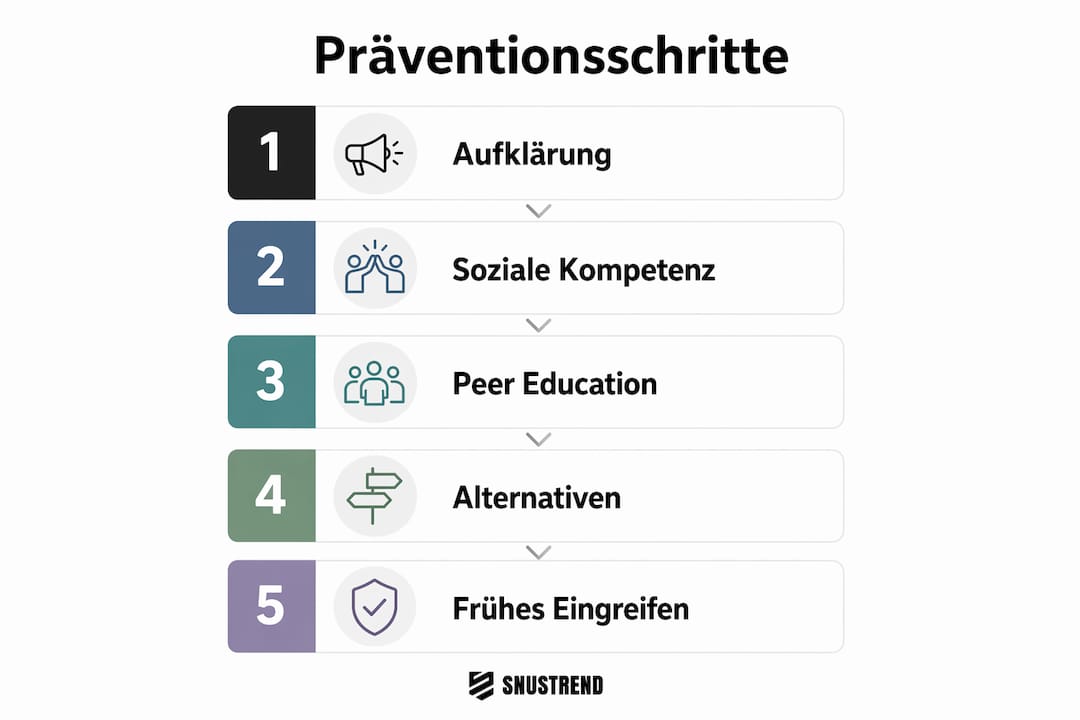
In Germany, programs like the Federal Centre for Health Education (BZgA) work with school-based approaches that strengthen social competence and the ability to refuse. The program "Be Smart, Don’t Start" is one of the best-known school-based prevention projects in Germany and is aimed at classes that want to remain smoke-free together. The group structure is no coincidence: those who refrain from smoking together with their class experience non-smoking as a group norm, not as an outsider position.
Peer education programs strengthen social self-efficacy and reduce nicotine consumption by teaching teenagers concrete skills: how to recognize pressure, how to refuse, how to steer conversations. It is crucial that not just individual teenagers are trained, but that as much of the entire group as possible is involved. Individual ambassadors in a smoking group have a difficult time.
Successful programs combine three elements: knowledge about risks, social competence, and real alternatives for leisure activities. Anyone who only tells teenagers what not to do without offering them something to replace social belonging will achieve little.
How family and home environment influence nicotine consumption
The influence of the family on teenagers' smoking behavior is stronger than often assumed, but it works differently than expected. Parents are not the most important role models regarding smoking. Siblings are. Those who have older siblings who smoke have a significantly increased risk of starting themselves, because siblings are closer to one's own social world than parents.
Parental behavior still plays an important role, but less through direct role modeling than through communication and relationship quality. Families in which risks are discussed openly and where teenagers feel they are heard produce fewer smokers. Parental education and social status act as protective factors because they are associated with more resources for education and leisure activities.
In Germany, the Youth Protection Act imposes a strict ban on the sale of tobacco products and e-cigarettes to persons under 18 years of age. This ban also applies to nicotine pouches and similar products. However, enforcement in practice is patchy, especially in online retail. Parents should be aware that teenagers can obtain nicotine products more easily via digital channels today than in the past.
Social stigmatization of teenagers who smoke has changed in recent years. Smoking is no longer considered cool in many schools, but rather unhealthy and expensive. Vaping, on the other hand, is still associated with a cool image in some groups, especially because of the variety of flavors and its discreet use. Parents and educators should be aware of these differences because they influence the prevention message.
Support options in the family environment:
- Have open conversations about peer pressure without moralizing.
- Show interest in the peer group without being controlling.
- Set clear rules regarding nicotine products in the home.
- Take the role model function seriously: Parents who smoke themselves have a harder time warning credibly.
- Seek professional help if teenagers are already consuming, for example via the BZgA advisory services.
What current research says about peer pressure and nicotine consumption
The data on peer pressure and nicotine consumption among teenagers is clear: those who have friends who smoke are more likely to smoke themselves. The VIVID study shows that teenagers with smoking friends have an up to 9-fold increased risk of starting nicotine consumption; children even up to 21-fold. A 10% increase in smoking prevalence in the circle of friends increases one's own probability of smoking by 5%. The Add Health study confirms this connection and shows that the influence of close friends on smoking behavior persists into young adulthood.
Particularly revealing is the difference between selection and socialization: early smokers actively look for like-minded people, which reinforces the effect. Only in later teenage years does the group begin to shape behavior. For prevention, this means: the earlier the intervention, the better.
Pro Tip: Parents and educators should not wait until a teenager already smokes. The most effective time for prevention is before smoking friendship circles form, i.e., in early adolescence between 11 and 14 years old.
Research on social networks also shows that teenagers with many smoking friends have a significantly increased risk of their own consumption, even if they have not yet started themselves. The influence works not only through direct requests, but through the perceived norm in the group. Those who believe that everyone smokes will conform, even without explicit pressure.
The effectiveness of peer education is also well-documented. Programs that strengthen social self-efficacy and provide teenagers with concrete refusal strategies measurably reduce nicotine consumption. It is crucial that the programs are not isolated, but are embedded in the school and family context.
Key findings
Peer pressure is the single strongest risk factor for the start of nicotine consumption among teenagers, and those who start early with education and social empowerment can effectively limit this influence.
| Topic | Details |
|---|---|
| Risk from smoking friends | Teenagers with smoking friends have a significantly increased risk of starting themselves. |
| Perceptual bias | Teenagers overestimate the prevalence of smoking in their group, which artificially increases pressure. |
| Selection before socialization | In early adolescence, smokers seek like-minded people; only later does the group shape the behavior. |
| Influence of siblings | Older siblings who smoke often have more influence than parents. |
| Peer education works | Programs that strengthen social self-efficacy measurably reduce nicotine consumption. |
Snustrend provides responsible information about nicotine products and is aimed exclusively at adults. Those who want to learn more about the risks of nicotine products and the mechanisms of nicotine addiction will find well-founded information on the Snustrend blog.

For adult consumers interested in snuff tobacco, Snustrend offers a selection of products such as the Pöschl Schmalzler Südfrucht, a classic fruit-flavored snuff tobacco.
Recommendation
- What nicotine does to teenagers: Risks 2026 – Snustrend - Snus, Vapes & Snuff
- Nicotine consumption among teenagers: Risks clearly explained – Snustrend - Snus, Vapes & Snuff
- Nicotine addiction: how it arises and what is behind it – Snustrend - Snus, Vapes & Snuff
- Nicotine replacement trends in Switzerland: What is important in 2026 – Snustrend - Snus, Vapes & Snuff






Share:
Vaping techniques compared: the practical guide
Early detection of nicotine dependence: Warning signs 2026