


TL;DR:
- Nicotine consumption among youth in Switzerland is rising rapidly, primarily due to vapes, snus, and nicotine pouches. These products are particularly addictive because they specifically target the reward system in the adolescent brain. Preventive measures focus on education, regulation, and support to prevent long-term damage.
Vapes in bright colors, fruit-flavored nicotine pouches, tiny devices that smell like mango or watermelon: what looks like harmless accessories has a serious catch. Nicotine consumption among youth in Switzerland is skyrocketing, and many hardly know what is happening in their brains as a result. This article explains, in a factual and direct way, how nicotine affects the young brain, the figures behind the trend, what makes modern products so attractive, and what really helps to avoid falling into the addiction trap.
Table of Contents
- Physiological Effect of Nicotine on the Adolescent Brain
- Current Figures on Nicotine Consumption Among Youth in Switzerland
- New Nicotine Products and Trends: Vapes, Snus, and Nicotine Pouches
- Risks and Consequences of Nicotine Consumption for Youth
- Prevention Strategies and Support Services for Youth
- Editorial Perspective: What the Experts Underestimate
- Further Resources and Products for Responsible Nicotine Consumption
- Frequently Asked Questions About Nicotine Consumption in Youth
Key Findings
| Point | Details |
|---|---|
| Brain is particularly vulnerable | Nicotine can severely and permanently impair brain development during youth. |
| Rapid development of addiction | Vapes and nicotine pouches lead to addiction particularly quickly in adolescence. |
| Spread of alternative products | Snus, vapes, and nicotine pouches are becoming increasingly popular – with hidden dangers. |
| Prevention must be individual | Risks can only be effectively reduced through education, counseling, and support. |
| Conscious product selection is important | Not every nicotine product is the same; informed decision-making protects against unwanted consequences. |
Physiological Effect of Nicotine on the Adolescent Brain
Nicotine is not a simple recreational substance. It intervenes deeply in the chemistry of the brain in a way that is particularly potent in adolescents. The teenage brain is not yet fully developed and therefore reacts much more sensitively to external substances than the adult brain.
The mechanism works like this: nicotine binds to nicotinic acetylcholine receptors (nAChRs) in the brain, activates the cholinergic system, and leads to the release of dopamine, serotonin, noradrenaline, and glutamate. That sounds complicated, but simply put: the brain is temporarily shifted into a state that promotes concentration, alertness, and a good mood. This is exactly what makes nicotine so tempting for many young people.
Important to know: The short-term performance improvement from nicotine is real, but it is an illusion. The brain learns quickly to function worse without nicotine than it did before, and then demands more and more.
The real problem lies in the reward system. Dopamine, the happiness hormone, is released by nicotine and creates a feeling of satisfaction. The adolescent brain is particularly susceptible to this signal because the reward system is not yet stable during the teenage years. Studies show: addiction develops faster in adolescents due to the immature reward system, and although regeneration is possible, long-lasting damage can remain.
An overview of the most important short-term and long-term effects:
- Short-term positive (apparently): Better concentration, faster reaction time, mild euphoria, stress reduction
- Short-term negative: Racing heart, nausea at higher doses, dizziness
- Long-term negative: Development of tolerance (you need more and more for the same effect), psychological dependence, physical withdrawal symptoms
- Specific to adolescents: Impaired brain development, increased susceptibility to addiction to other substances, altered emotional responses
Anyone who wants to know more about the concrete risks of nicotine products will find a detailed overview there. Similarly, it is worth looking at the effects and risks of nicotine to better understand the connections.
Current Figures on Nicotine Consumption Among Youth in Switzerland
Facts can sometimes be sobering. In this case, they show that nicotine consumption among youth in Switzerland is not a marginal phenomenon.
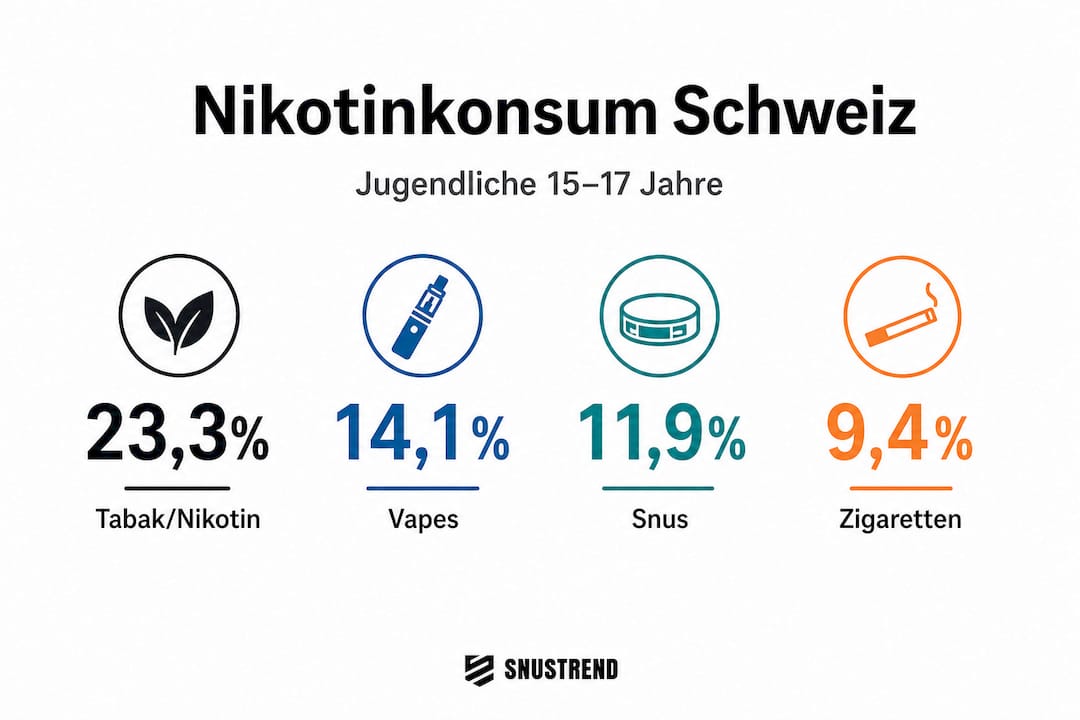
According to the TPF EGL2023 report by the Federal Office of Public Health, 15% of 15- to 17-year-olds in Switzerland consume tobacco or nicotine products monthly, and 7% do so daily. According to the 2023 Omnibus survey, the overall prevalence is a staggering 23.3%. And in the 2022 HBSC study, 13% of 15-year-old boys reported consuming snus.
Focus on statistics: Almost one in four young people in Switzerland has experience with nicotine. These are no longer isolated cases; this is everyday life.
| Product | Group | Prevalence | Source |
|---|---|---|---|
| Tobacco/nicotine in general | 15 to 17-year-olds | 23.3% overall prevalence | Omnibus 2023 |
| Daily consumption | 15 to 17-year-olds | 7% | EGL 2023 |
| Monthly consumption | 15 to 17-year-olds | 15% | EGL 2023 |
| Snus | 15-year-old boys | 13% | HBSC 2022 |
The difference between the genders is particularly striking. Boys more frequently use snus and smoke-free products, while girls tend to lean towards vapes. This is also due to marketing: vapes are marketed in colors and designs that specifically appeal to different target groups.
The trend for traditional cigarettes is declining, but this seemingly positive trend is deceptive. The total number of nicotine consumers is not decreasing; it is simply shifting towards new products. Those who want to know which current nicotine products dominate the Swiss market will get a good overview there.
New Nicotine Products and Trends: Vapes, Snus, and Nicotine Pouches
Why do so many young people turn to vapes and nicotine pouches, even though the risks are known? The answer lies in the design, the marketing, and the way these products are presented.
Vapes and nicotine pouches are booming among youth in Switzerland. They are often seen as an entry point into nicotine consumption because they appear more harmless than cigarettes. There is no smoke, no smell, no yellow fingers. In addition, there are high nicotine doses that promote rapid addiction, and a frequently observed co-consumption with alcohol or cannabis. Although sales to minors have been prohibited since October 2024, bypass strategies via older friends or online channels are widespread.
| Product | Benefit according to marketing | Real risk |
|---|---|---|
| Vapes (E-cigarettes) | No smoke, less odor | High nicotine doses, lung damage possible |
| Nicotine pouches | Discrete, no tobacco | Very rapid addiction, oral mucosal irritation |
| Snus | Tradition, no smoking required | Nicotine addiction, risk of oral cancer with long-term use |
| Traditional cigarettes | Social ritual | Cancer, cardiovascular disease, lung damage |
The colorful packaging, fruit flavors like Watermelon Ice or Mango, and a minimalist design: this is no coincidence. Manufacturers invest millions in market research to find out what appeals to young people. The result is products that look more like a lifestyle choice than an addictive substance.
The following factors make new nicotine products particularly risky for young people:
- High nicotine concentrations: Many disposable vapes contain as much nicotine per unit as several packs of cigarettes.
- No visible warning signs: No coughing, no smell, no smoke means that social inhibitions decrease.
- Easy availability: Despite the age ban, many products are easily obtainable for young people.
- Social acceptance: In some peer groups, vaping is considered normal or even cool.
- Rapid habituation: Through frequent short puffs during the day, addiction often arises unnoticed.
Pro tip: If you notice that you reach for your vape or nicotine pouch first thing in the morning or feel uncomfortable when you don't have nicotine with you, that is a clear sign of beginning addiction.
Snustrend offers a good comparison of snus vs vapes for anyone who wants to better understand the differences between these products. Those who wonder what the differences between vaping and smoking really mean will find an honest analysis there. And for those who want to know where the journey is heading, you can learn about nicotine replacement trends in Switzerland.
Risks and Consequences of Nicotine Consumption for Youth
The risks are not abstract. They concretely affect the lives of young people, often permanently.
In young people, the developing brain is particularly susceptible to nicotine. It disrupts the maturation of brain regions until approximately the age of 25, increases the potential for addiction, and can impair memory, emotions, and personality development. This is not an exaggeration; it is the state of scientific knowledge.
What exactly happens when young people consume nicotine regularly? Here is a concrete overview:
- Disruption of brain maturation: The prefrontal cortex, which is responsible for decisions and impulse control, matures until the age of 25. Nicotine permanently alters its development.
- Increased addiction potential: Anyone who starts with nicotine early has a statistically higher risk of abusing other substances later.
- Memory problems: Long-term nicotine consumption changes the way nerve cells store and retrieve information. Affected individuals often only notice this at school or when studying.
- Emotional instability: Nicotine-dependent adolescents report more frequent feelings of anxiety, mood swings, and irritability, especially when nicotine is not available.
- Social consequences: Addiction costs money, time, and energy. It influences who you spend time with, what activities you prefer, and how you react to stress.
Note: Withdrawal symptoms in young people are often more intense than in adults. Nervousness, concentration problems, sleep disturbances, and irritability are typical symptoms that can significantly burden everyday life.
The insidious start is particularly treacherous. No young person thinks about becoming addicted in a few months after their first puff on a vape. The brain adapts quietly and secretly. At first, it needs nicotine to feel good, then to function. Those who want to learn about sensible tobacco alternatives will find helpful information there for more conscious consumption.
Prevention Strategies and Support Services for Youth

Prevention only works if it is honest. Anyone who confronts young people with fearmongering or outdated messages quickly loses credibility. What really works is a combination of education, structural measures, and real points of contact.
Nicotine consumption among youth in Switzerland is increasing due to attractive products like vapes, which are considered harmless thanks to their flavor and design, but actually represent a gateway drug. Prevention therefore requires youth protection, targeted education, and concrete withdrawal offerings, such as the Lung League project that helps young people quit. At the same time, experts from the FOPH and Addiction Switzerland are calling for stricter regulations to more effectively restrict access for minors.
The following strategies are proven to help:
- Open conversations: Parents and teachers who talk honestly about risks achieve more than prohibitive messages.
- School-based prevention: Programs that specifically provide information about new products like vapes and nicotine pouches are more effective than general addiction prevention.
- Professional support: The Swiss Lung League, Addiction Switzerland, and local addiction counseling centers offer free counseling and exit programs.
- Peer support: When peers talk about risks and model alternatives, it is more credible than any campaign.
- Legal measures: The ban on sales to minors that has been in effect since October 2024 is an important step, but it is not enough on its own.
Pro tip: If you or someone in your environment wants to quit, it is helpful to identify concrete triggers. Stress, boredom, or certain social situations are frequent triggers. Anyone who knows where it starts can counter it more effectively.
Find information on trustworthy platforms, use counseling services, and speak openly about uncertainties. If you are wondering whether snus can be a sensible option as a drug substitute, you will find an honest discussion of the topic there.
Editorial Perspective: What the Experts Underestimate
There is one aspect of the nicotine debate that is too often overlooked: the industry is not a neutral player. It invests specifically in designs, flavors, and campaigns that target the reward systems of young people. This is not a suspicion; it is a strategy.
At the same time, classic prevention often fails because it does not take the reality of young people's lives seriously. Posters and school lessons about the risks of smoking have little effect if the cool kid in class is currently pulling out a mango vape. Peer groups often have more influence than any prevention campaign.
What many experts underestimate is the role of the sense of self-efficacy. Young people who feel that they can make their own decisions and write their own story are less likely to turn to nicotine as compensation. Prevention that relies solely on bans takes away this sense of control instead of strengthening it.
Honestly: bans alone do not work. The sales ban in effect since October 2024 is an important step, but anyone who really wants to prevent young people from consuming nicotine must invest in education, relationship-building, and real alternatives.
Being well-informed also helps. Those who understand what a product contains and what it does to the body make better decisions. A sober comparison of nicotine content, for example, shows just how differently potent various products really are. This knowledge provides better protection than any ban because it creates conscious, independent decisions.
Individual motivation, open exchange without assigning blame, and realistic goal setting are the three factors that actually make a difference in practice. Experts in addiction counseling confirm this time and again.
Further resources and products for responsible nicotine consumption
Those who are well-informed make smarter decisions. Snustrend believes that education and a conscious approach to nicotine products go hand in hand. That is why on snustrend.com you will find not only products, but also information to help you make informed choices.

For adults who would like to explore traditional snuff products as an alternative, Snustrend offers a carefully selected product range: from classic Schmalzler Südfrucht snuff (100g) to the practical Schmalzler Südfrucht snuff small size (25g), and the handy plastic snuff bottle to the refreshing Gletscherprise (25g). All products are clearly described so that you know what you are buying. Fast shipping, transparent information, and a wide assortment for conscious consumer decisions. That is the standard of Snustrend.
Frequently asked questions about nicotine consumption among young people
How does nicotine affect the adolescent brain?
Nicotine activates specific brain receptors and releases neurotransmitters such as dopamine, which improves concentration and mood in the short term, but can permanently disrupt the ongoing brain development of adolescents.
Which nicotine products are most frequently used by young people in Switzerland?
According to EGL 2023 and HBSC 2022, snus, vapes, and nicotine pouches are the most widespread, while classic cigarettes are losing importance among young people.
How quickly does dependence develop through nicotine consumption in adolescence?
The immature reward system makes adolescents particularly vulnerable, so that dependence can develop after only a few weeks of regular use, especially with high-dose products like nicotine pouches and vapes.
What are the potential health consequences of nicotine consumption in adolescence?
Nicotine disrupts brain maturation until age 25 and can long-term impair memory, emotional stability, and personality development, in addition to physical dependence.
How can I protect myself from nicotine consumption and dependence?
The best protection strategy is knowledge: those who know the risks of attractive nicotine products make more conscious decisions. Counseling services such as the Lungenliga or SuchtSchweiz also offer free, professional support for anyone who would like to quit.
Recommendation
- Risks of Nicotine Products: Facts and Safe Alternatives – Snustrend - Snus, Vapes & Snuff
- Nicotine Pouches: All Facts, Usage, and Risks Explained – Snustrend - Snus, Vapes & Snuff
- Significance of Nicotine Content: Effects and Risks 2026 – Snustrend - Snus, Vapes & Snuff
- Nicotine Replacement Trends in Switzerland: What Matters in 2026 – Snustrend - Snus, Vapes & Snuff






Share:
Cleaning vapes properly: The guide for a better experience
Understanding Hybrid Vapes: The Better Alternative for Vapers