


TL;DR:
- Since October 2024, the sale of e-cigarettes to minors has been prohibited in Switzerland by the Tobacco Products Act, but many products do not meet legal requirements. Inspection data shows that 91% of tested disposable vapes in Basel are non-compliant, leading to sales bans. The Swiss market is more regulated than Germany's, particularly regarding liquid capacity, taxes, and advertising bans, and is moving toward sustainable reusable systems.
The supervision and regulation of vapes in Switzerland has fundamentally changed since October 2024. The new Tobacco Products Act introduces clear rules, but many consumers are unsure about what this means for their daily lives. Which products are legal, what limits apply, and why are so many vapes still subject to sales bans in stores? This article provides precise answers: from the legal foundations to the surprisingly poor market compliance data, and from the differences compared to Germany to the trends currently shaping the Swiss vaping market.
Table of Contents
- Key Findings
- The TabPG: The Basis for E-Cigarette Regulation
- Market Surveillance of Vapes: Current Inspection Data
- Vape Regulations in Germany: Regulatory Differences
- Market Trends and Impact on Consumers
- My Assessment of the Current Regulatory Situation
- Discover Compliant Vapes at the Snustrend Shop
- FAQ
Key Findings
| Point | Details |
|---|---|
| New Federal Act since 2024 | The TabPG has been in effect since October 2024, prohibiting the sale of e-cigarettes to individuals under 18. |
| Shocking market compliance | 91% of the disposable vapes tested in Basel did not meet legal requirements. |
| Federal enforcement | Cantons are responsible for operational inspections, leading to regional implementation differences. |
| Trend toward reusable systems | Tax incentives and environmental awareness are driving demand for refillable vapes. |
| Switzerland vs. Germany | Both countries share an 18+ age limit but differ regarding liquid capacities and taxation. |
The TabPG: The Basis for E-Cigarette Regulation
On October 1, 2024, the TabPG entered into force in Switzerland. For the first time, the law establishes a nationwide uniform rule that e-cigarettes may not be sold to minors. The legal age limit is 18, and the requirement for health warnings on packaging applies to all providers without exception.
Key regulations of the Tobacco Products Act at a glance:
- Sales ban for individuals under 18, both online and in brick-and-mortar stores
- Warning labels on packaging are mandatory for all nicotine-containing e-cigarettes
- Nicotine content restrictions: Maximum 20 mg/ml in liquids for consumers
- Advertising ban near schools, on public transport, and in media with high youth audiences
- Reporting requirements for manufacturers and importers to the authorities
Operational implementation of these rules lies with the cantons. Switzerland follows a two-tier regulatory process: the federal government sets the legal framework, while the cantons perform independent inspections. As a result, Ticino, Zurich, or Bern may inspect and sanction with varying intensity. Consumers in a canton with laxer enforcement are effectively buying in a different regulatory environment than those in a strictly regulated one.
Pro Tip: When buying vapes online, always check if the merchant actually performs age verification. A reputable provider will require proof of age before the purchase, not just upon delivery.
Advertising restrictions are specifically aimed at preventing young people from starting. Specifically prohibited are ads in print media with a youth audience over 30%, outdoor advertising near schools and youth centers, as well as sponsoring events that target minors. This significantly reduces the visibility of vape products in public spaces.
Market Surveillance of Vapes: Current Inspection Data
The figures are clear. The Cantonal Laboratory of Basel-Stadt examined disposable vapes in the Swiss market and found that 91% of the tested products did not meet legal requirements. As a result, 21 sales bans were issued.
| Violation category | Frequency | Consequence |
|---|---|---|
| Excessive nicotine content | Very common | Immediate sales ban |
| Exceeded liquid volume | Common | Sales ban and recall |
| Toxic substances (e.g., lead) | Occasional | Report to authorities and ban |
| Missing warnings | Common | Administrative sanction |
| Missing recycling fee | Approx. one-third of samples | Sales ban |
Particularly alarming: many importers do not pay the advance recycling fee for batteries, which is mandatory in Switzerland. About one-third of the samples tested exhibited this deficiency. While it sounds like a formality, it is a grounds for a sales ban.
“The non-compliance of vapes in the Swiss market often affects multiple legal and health requirements simultaneously, which significantly increases the complexity of monitoring.” Cantonal Laboratory Basel-Stadt, 2025
The consequences for trade are direct: sales bans, product recalls, and fines. For consumers, this means that cheap imports from questionable sources can pose a real health risk. The health risks of vapes with excessive nicotine levels or toxic ingredients are not theoretical. They are evident in the laboratory data.
Reputable importers and dealers are obligated to test their products before placing them on the market. Self-regulation is primarily the responsibility of the trade, while authorities act downstream. This is a structural problem that would need to be addressed with more resources for market surveillance.

Vape Regulations in Germany: Regulatory Differences
A direct comparison with Germany shows where Switzerland has stricter regulations and where it is more liberal. E-cigarette legislation in both countries shares some basic elements but differs in details relevant for cross-border purchases.
Liquid Capacities and Nicotine Concentrations
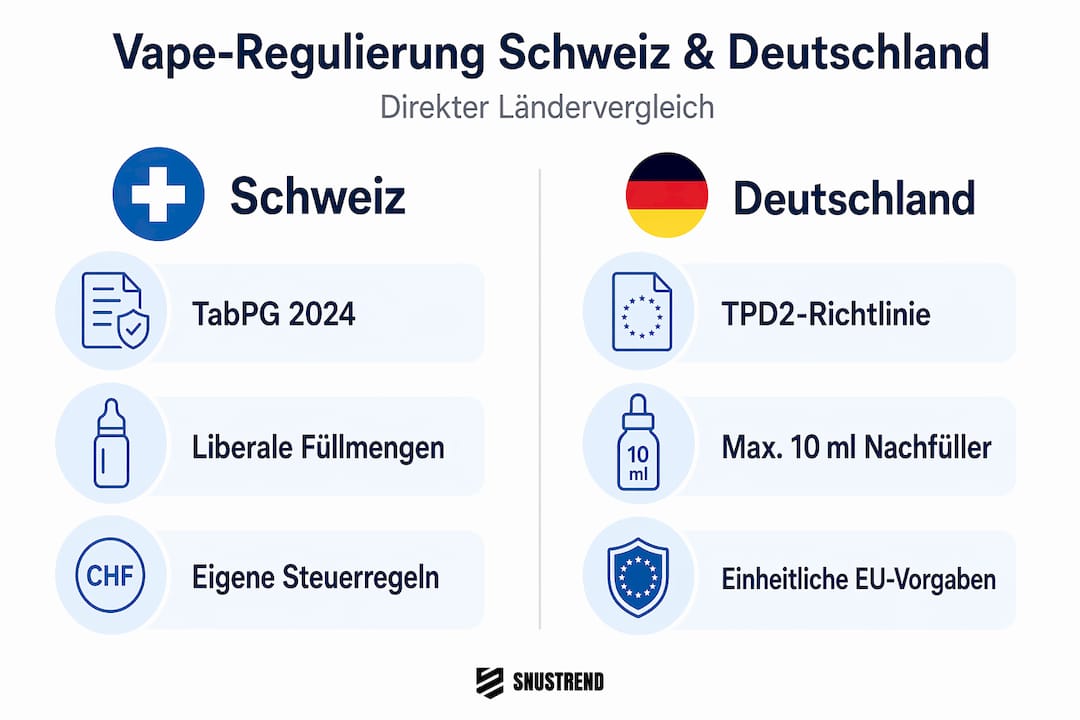
Germany limits refill containers for liquids to 10 ml, adhering strictly to the EU Tobacco Products Directive (TPD). Switzerland, which is not an EU member and follows its own path, has somewhat more liberal guidelines regarding liquid capacities and taxation. Nicotine concentration is limited to 20 mg/ml in both countries.
Taxation Differences
Since 2022, Germany has taxed liquids based on a volume principle per milliliter. Switzerland is still in the process of developing a comparable tax model. This has a direct impact on pricing: a 10-ml liquid is noticeably more expensive in Germany due to the tax than the same product in Switzerland.
Key Differences in Direct Comparison
- Age limits: Both countries require 18 years; Germany partially enforces this through more structured digital age verification
- Advertising: Germany follows the EU Tobacco Products Directive with clear bans; Switzerland has a special national path with comparable bans
- Online orders: Cross-border deliveries from Germany to Switzerland are subject to customs and can be stopped at the border if they do not comply with Swiss law
- Product notifications: In Germany, products must be registered with the BfArM; in Switzerland, with the FOPH (BAG)
Pro Tip: If you order vape products from Germany, check before purchasing whether the product meets Swiss vape safety standards. Not all products sold legally in Germany are automatically compliant in Switzerland.
The influence of the EU Tobacco Products Directive on German regulations makes the neighboring country more strictly regulated than Switzerland in some areas. Particularly regarding the guidelines for vapers in Germany, the EU mandate leaves less national leeway than in Bern.
Market Trends and Impact on Consumers
The Swiss vaping market is in flux. And this change is driven not primarily by consumer preferences, but by regulatory pressure. Here are the five most important developments you as an adult consumer should know about:
-
Decline in disposable vapes: Experts have been calling for a rapid implementation of a ban on disposable e-cigarettes for some time, as these are seen as particularly problematic entry-level products for youth. The market is already responding with reduced availability of certain models.
-
Growth in reusable systems: The trend toward refillable vapes is being strengthened by tax differentiation and environmental awareness. Those who use a reusable system benefit in the long term from lower costs per puff and a better ecological footprint. Learn more on the sustainability page of Snustrend.
-
Information obligations are being taken seriously: Dealers are increasingly required to actively inform customers about ingredients, warning labels, and proper disposal. Those who fail to do so risk sanctions.
-
Price increases due to regulation: Compliant products with tested ingredients, proper labeling, and paid recycling fees cost more to produce. This is reflected in the retail price.
-
Stronger digital age verification: Online retailers are investing in more robust age verification systems after government pressure has increased. The disposable vape ban and other legal requirements make seamless compliance unavoidable for dealers.
The aspect of "Harm Reduction" plays a special role here. Long-term health risks of e-cigarettes are not yet fully understood. This has direct consequences for the intensity of regulation: authorities act cautiously because science has not yet provided a definitive picture.
For consumers, this means: buy only from dealers who are transparent about ingredients, take age verification seriously, and offer compliant products. The costs of a cheap import that gets stuck at customs or harbors health risks quickly exceed the saved Swiss francs.
My Assessment of the Current Regulatory Situation
The TabPG was long overdue. I see the introduction of clear age limits and mandatory warning labels as real progress, but the sobering compliance figures from Basel show that laws alone are not enough. 91% non-compliance is not a marginal problem. That is market failure.
What concerns me most: disposable vapes are not just ecologically questionable, but from everything we know, they are also the most common entry point for young people into vaping. In my view, the demand for a ban on disposable vapes is not ideological, but empirically justified.
At the same time, I am convinced that adults have the right to make informed decisions. Harm reduction only works if consumers receive honest information about risks and are not pushed into the uncontrolled gray market by stigmatization. There, products are of lower quality and risks are higher.
Supervision of vaping products must become more consistent. Not with more bans, but with more inspection and real sanctions for non-compliant dealers. Federal enforcement is a strength of the Swiss system but can also lead to gaps if cantons prioritize differently.
— Lukas
Discover Compliant Vapes at the Snustrend Shop
As a Swiss consumer, you want to know that the product in your hands is legal, tested, and safe. Snustrend places exactly this value on its products. The range includes vapes from established brands like Elfbar and Vozol that meet Swiss vape safety standards. Age verification, correct labeling, and product information are standard. Those who want to learn more about the safety of vapes can find well-founded information in the Snustrend blog on risks. Those looking for a compliant alternative to vapes can also check out the selection of snuff products. The Snustrend shop makes it easy to find legally compliant products without having to spend hours reading the fine print.
FAQ
What does the Tobacco Products Act regulate for vapes?
The Tobacco Products Act, in effect since October 2024, prohibits the sale of e-cigarettes to persons under 18 years of age and mandates warning labels on packaging. Additionally, it limits nicotine content to a maximum of 20 mg/ml and prohibits certain forms of advertising.
Why were so many vapes banned in Basel?
The Cantonal Laboratory of Basel-Stadt found violations in 91% of tested disposable vapes, including excessive nicotine content, exceeded liquid volumes, and toxic substances such as lead. 21 sales bans were the direct result.
Can I order vapes from Germany to Switzerland?
Cross-border orders are subject to customs. Products must comply with Swiss requirements, which include, among other things, carrying correct warning labels in German and adhering to permitted nicotine limits. Non-compliant products can be stopped at the border.
Are disposable vapes banned in Switzerland?
Disposable vapes are not generally prohibited, but are increasingly under regulatory pressure. Experts and health organizations are calling for a swift ban, and many disposable products are being withdrawn from the market due to compliance violations.
How do I find out if a vape product is legal in Switzerland?
Look for warning labels in German, a clearly stated nicotine concentration of less than 20 mg/ml, and information regarding the recycling fee. A reputable retailer will also conduct age verification before purchase and can provide product documentation upon request.
Recommendation
- Ban on disposable vapes in Switzerland: innovations, background, and international comparisons – Snustrend - Snus, Vapes & Snuff
- The most important vape trends: What counts in Switzerland in 2026 – Snustrend - Snus, Vapes & Snuff
- Vape models at a glance: The Swiss buying guide – Snustrend - Snus, Vapes & Snuff
- Vape beginner's guide Switzerland 2026: starting safely – Snustrend - Snus, Vapes & Snuff
Share:
Vaping gadgets overview: the Swiss comparison 2026
How to choose the right snus: Tips for 2026