


TL;DR:
- In Switzerland, "Schnupf" is a term for smoke-free nicotine products such as snuff, not the common cold symptom. Since 2024, legal regulations have been in place regarding youth protection and product safety, though nicotine remains harmful regardless of the form of consumption. Adolescents and adults should be aware of nicotine content to minimize risks such as addiction and cardiovascular damage.
Anyone searching for "why choose snuff" rarely means the common cold. In Switzerland, "Schnupf" is an established term for snuff tobacco and related nicotine products consumed without combustion. The everyday word "Schnupfen" describes a cold symptom. The nicotine product, by contrast, is correctly called "Schnupftabak" or "Schnupf" for short. This article clarifies the difference, explains the motives behind the growing interest, and shows what adults and young people in Switzerland should know about snuff products, their risks, and their alternatives.
Table of Contents
- Key Takeaways
- Snuff products in Switzerland: Market and regulation
- Health aspects compared to cigarettes
- Why choose snuff? Motives and consumption patterns
- Comparison: Snuff, snus, and vapes
- Mindful use of snuff products
- My assessment of snuff as an alternative
- Discovering snuff tobacco at Snustrend
- FAQ
Key Takeaways
| Point | Details |
|---|---|
| Clarifying the term | In Switzerland, "Schnupf" refers to a smoke-free nicotine product, not a cold symptom. |
| Regulation since 2024 | The Tobacco Products Act regulates snuff products nationwide with age limits and product safety. |
| Smoke-free does not mean risk-free | Nicotine damages the heart and blood vessels regardless of whether you smoke or use snuff. |
| Discreet use as a main motive | No smoke, no smell: That is exactly what makes snuff popular among young people and adults. |
| Mindful use is crucial | Those who use snuff products should know age limits and realistically assess addiction risks. |
Snuff products in Switzerland: Market and regulation
The Swiss market for smoke-free nicotine products has changed significantly in recent years. What was once a niche product for older consumers now appeals to a growing group of adults and teenagers. Snuff tobacco, snus, nicotine pouches, and vapes now sit side by side on shelves, both in physical stores and online.
Legally, a new Tobacco Products Act (TabPG) has been in effect since October 1, 2024, regulating e-cigarettes and other nicotine products uniformly across Switzerland. The focus is on youth protection and product safety. Those who buy or sell snuff products operate within a clearly defined legal framework. According to the Snustrend overview, snuff and snus products are legally available in Switzerland, albeit with specific age restrictions.
The most important points about the current market at a glance:
- Traditional snuff tobacco, such as Pöschl Schmalzler, is one of the oldest forms. It is inhaled through the nose and contains tobacco as well as nicotine.
- Snus is an oral product placed between the gums and lip. It is legally available in certain forms in Switzerland.
- Nicotine pouches contain no tobacco, but do contain nicotine. They are considered a more modern alternative by some.
- Vapes and e-cigarettes are also considered smoke-free products and have fallen under the TabPG since 2024.
- The need for advice in specialist shops has increased because many consumers are unaware of the differences between products and the new legal regulations.
The product range is broad. The decision of which product to choose should be based on knowledge, not hype.
Health aspects compared to cigarettes
This is where a misunderstanding arises very often: "Smoke-free" is frequently equated with "harmless." That is wrong.

Nicotine remains a significant cardiovascular risk factor, regardless of whether it is smoked, vaped, or snuffed. It damages blood vessels and raises blood pressure. According to research, nicotine is toxic to the heart and blood vessels, no matter the form in which it is ingested.
What distinguishes snuff tobacco from cigarettes is the absence of combustion processes. This means no combustion products such as tar and carbon monoxide. That is a real difference. For the lungs, refraining from smoke can be beneficial. Nevertheless, nicotine remains active in the body and affects heart rate, blood pressure, and the nervous system.
“Smoke-free does not mean risk-free. Nicotine causes cardiovascular damage regardless of the form of intake.” University Medical Center Mainz
Another important point directly concerns young people: Adolescence is particularly vulnerable to nicotine addiction. The brain is still developing during this phase. Nicotine increases dopamine release and anchors addiction patterns more deeply than in adults.
- Snuff tobacco contains nicotine in varying concentrations.
- Addiction can develop quickly, even with occasional use.
- Starting young statistically carries a higher risk of long-term addiction.
- Withdrawal symptoms in adolescents are stronger and last longer.
Pro Tip: If you want to assess health risks, look not only at the smoke but at the product's nicotine content. That is what determines how strong the potential for addiction is.
Why choose snuff? Motives and consumption patterns
The question of why people prefer snuff products over cigarettes or other products has clear answers. No smoke, no smell, no burned cigarette butts. Especially in social situations, in public spaces, or in the office, this is a real advantage over conventional tobacco.
Which factors play a specific role?
- Discreet use: Snuff produces no visible smoke. Those who use it are barely noticed. This makes it particularly attractive in schools, at work, or in restaurants.
- No smoking ban applicable: In places where smoking is prohibited, snuff products can still be consumed. This is practical, but it is also a reason why consumption is harder to control.
- Variety of flavors: Snuff tobacco is available in many varieties: menthol, fruit notes, classic tobacco. This variety appeals to different tastes.
- Ease of use: No fire, no device needed. A pinch is enough. This is more low-threshold than smoking or vaping.
- Social sharing: Teenagers often use snuff in groups. Easy sharing encourages starting, as initial consumption often happens through peers.
- Price: Snuff tobacco is often cheaper than a comparable amount of cigarettes or a vape device with refill cartridges.
- Supposedly harmless reputation: Many believe snuff is less harmful than smoking. This is partially true, but [44% of teenagers](https://www.srf.ch/radio-srf-1/nikotin-bei-minderjaehrigen-vapes-und-snus-kinder-brauchen-hilfe-beim Entzug) in German-speaking Switzerland already consume nicotine products, which shows that this supposedly harmless entry point has consequences.
Pro Tip: If you are evaluating snuff products as an alternative to cigarettes, you should directly compare the nicotine content, not just the form of consumption. Some snuff tobaccos have a significantly higher nicotine content than a normal cigarette.
Comparison: Snuff, snus, and vapes
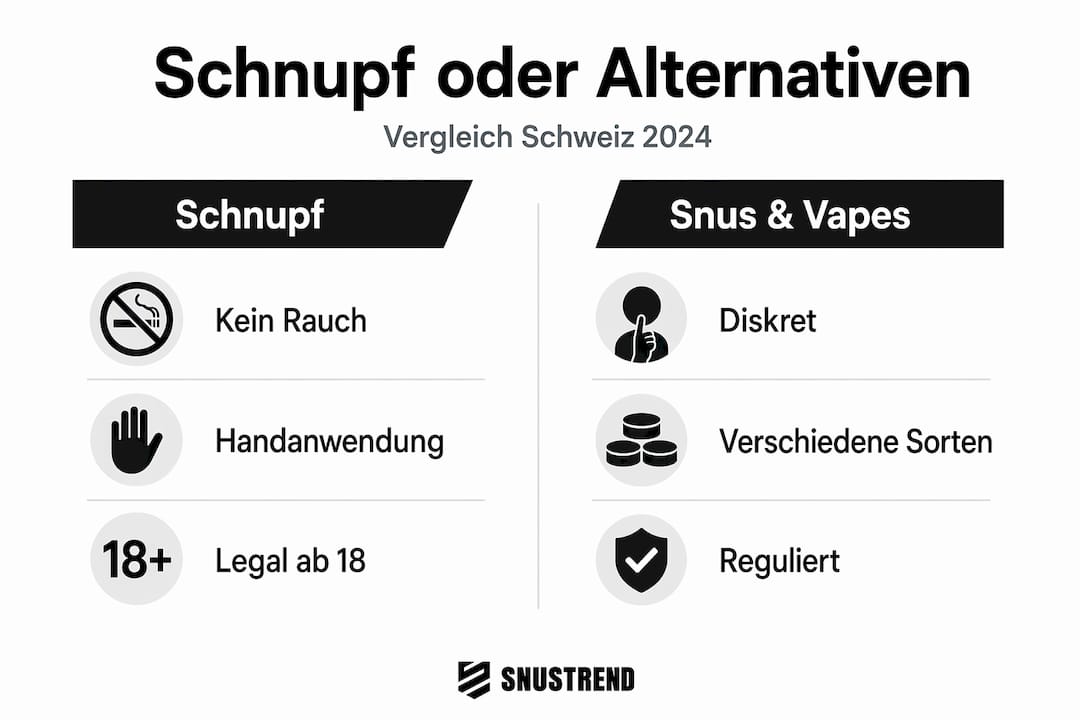
Anyone choosing between different smoke-free products needs clear facts. This comparison of snus and vapes shows the most important differences.
| Product | Application | Legal status in Switzerland | Nicotine content | Special feature |
|---|---|---|---|---|
| Snuff tobacco | Inhaled through the nose | Legal with age limit | Variable, often high | No device needed, classic form |
| Snus | In the mouth, under the lip | Legal in certain forms | Medium to high | No smoke, no smell |
| Nicotine pouches | In the mouth, under the lip | Legal | Variable | Tobacco-free, nicotine only |
| Vape / E-cigarette | Inhaled via device | Legal with age limit since 2024 | Variable | Device and refills needed |
| Cigarette | Smoked | Legal with age limit | Medium | Combustion products present |
The commonality of all products: They deliver nicotine into the body. The difference lies in the method of intake, accessibility, and the social image. Snuff tobacco has a long tradition and is easier to handle than a vape device. Snus and nicotine pouches, in turn, are more odor-neutral. Vapes offer the greatest variety of flavors but require a device and electricity.
Important points for your own decision:
- All products are subject to age limits in Switzerland. Anyone under 18 may not purchase them.
- No smoke-free product is free from nicotine risks.
- Individual preference for discretion, handling, or taste influences the choice.
Mindful use of snuff products
If you have informed yourself and decide to try out or continue using snuff products, you should know a few basic points.
- Respect the age limit: In Switzerland, an age limit of 18 applies to tobacco and nicotine products. The Snustrend snuff tobacco guide explains what to look out for when buying.
- Observe hygiene: Snuff tobacco is ingested through the nose. Clean hands and clean accessories reduce the risk of infection.
- Know the dosage: Taking too much at once risks nausea and dizziness due to nicotine overdose. Beginners should start with small amounts.
- Recognize signs of addiction: If the craving for snuff becomes stronger, that is an early warning signal of addiction. It is better to counteract early than later.
- Seek help: Swiss addiction counseling centers offer free and anonymous support for anyone who wants to reduce their consumption or quit. This service is available to all age groups.
- Choose safe sources: Products from unknown sources can be counterfeit or incorrectly labeled. Buy only from trustworthy providers with transparent product information.
Pro Tip: Keep a simple consumption diary: how often, when, and why you use snuff. Often, after two weeks, this will clearly show whether your consumption is increasing or remains situational. This is more valuable than any app.
My assessment of snuff as an alternative
I have been observing the Swiss market for smoke-free nicotine products for several years. My honest assessment: Snuff tobacco is not a harmless option, but it is not evil either.
What bothers me in the public discussion is the black-and-white logic. Either everything is downplayed or everything is dramatized. Neither helps anyone. What I really consider important: Anyone who already smokes and wants to switch to a smoke-free product can see snuff or snus as a practical transitional solution. But "transitional solution" does not mean that you should start with it if you didn't consume anything before.
What worries me about teenagers is not snuff itself. It is the combination of easy availability, discretion, and the feeling of staying under the radar. Parents notice nothing, and neither do teachers. This is precisely what makes preventive work so difficult.
My conclusion: Education and regulation must work together. Anyone who chooses snuff products as an adult consciously and with information is making their own decision. But anyone who believes smoke-free automatically means risk-free is mistaken. That is the one thing I want to make clear time and again.
— Lukas
Discovering snuff tobacco at Snustrend

Those who are interested in snuff tobacco and are looking for a high-quality product from a reputable source are in good hands with Snustrend. Snustrend offers a carefully curated selection of snuff products, snus, and vapes for the Swiss market, with transparent product information and fast shipping.
A proven classic in the assortment is the Pöschl Schmalzler Südfrucht 25g, ideal for those who would like to try snuff tobacco for the first time. Those who already know they like it should opt for the larger Schmalzler Südfrucht 100g pack for better value for money. All products at Snustrend comply with Swiss quality standards and are sold only to people over 18. Anyone wishing to learn more about tobacco alternatives will also find further information on various product categories on the platform.
FAQ
What is the difference between "Schnupfen" and "Schnupf"?
"Schnupfen" refers to the cold symptom with a runny nose. "Schnupf" is the term in Switzerland for snuff tobacco, a nicotine product ingested through the nose.
Is snuff tobacco less harmful than cigarettes?
Snuff tobacco contains no combustion products, which can make a difference for the lungs. However, nicotine itself remains a cardiovascular risk factor, regardless of how it is consumed.
At what age can you buy snuff in Switzerland?
In Switzerland, there is an age limit of 18 for tobacco and nicotine products. The Tobacco Products Act, which has been in effect since October 2024, regulates this uniformly across Switzerland.
Why do young people often choose snuff instead of cigarettes?
Snuff produces no smoke and no odor, which makes consumption less noticeable. Young people use this to stay under the radar. The ease of use and the low price are additional factors.
Is snuff addictive?
Yes. Snuff contains nicotine, which can trigger a strong addiction. The risk is particularly high for young people because the brain in its developmental phase reacts more sensitively to nicotine stimuli.
Recommendation
- Top 6 Schnupfhus.com Alternatives 2026 – Snustrend - Snus, Vapes & Snuff
- Buying Snus in Switzerland: Safe, affordable & legal – Snustrend - Snus, Vapes & Snuff
- Buying Snus Switzerland: Buy affordable & safe 2026 – Snustrend - Snus, Vapes & Snuff
- Snuff Guide: Application, selection and safety – Snustrend - Snus, Vapes & Snuff






Share:
List of common vaping styles: Your 2026 guide
Using snuff products: Benefits and risks 2026